Welcome
Welcome to the February 2023 edition of the East Riding Archives e-newsletter! We hope that you enjoy reading about what we have been busy cataloguing, preserving and promoting across the past few weeks.
In this issue:
-
News & Updates- East Riding Archives visit the Carnegie Heritage Centre; National recognition for the East Riding Blockdown project; Access Digital Archives via the Online Catalogue.
-
What's On?- Enter the 'What Was Here' app free prize draw; 'Archives Up Close: Humour' display; 'Fashion on a Plate' exhibition.
-
Collections spotlight- Sugar and the East Riding; A Village Pump; The findings of a Sanitary Surveyor in 1934; Clothes thro' the Ages.
-
From Conservation- School Plans, and some Archival Serendipity.
Best wishes from the East Riding Archives and Local Studies Team.
archives.service@eastriding.gov.uk / 01482 392792
News & Updates
East Riding Archives visit the Carnegie Heritage Centre
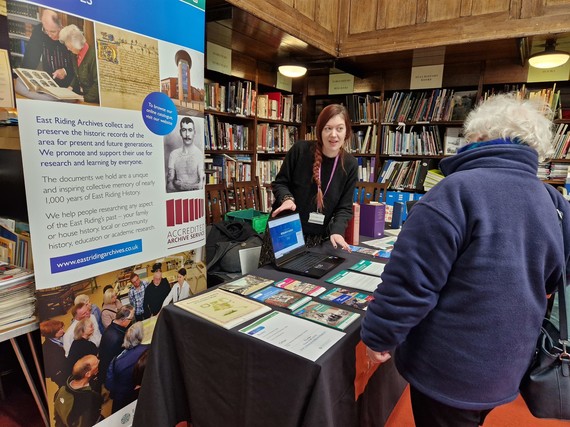 Above: Archivist Hannah Stamp at the East Yorkshire Family History Society 'Family & Local History Book Fair' event
Thank you to the East Yorkshire Family History Society for inviting us to have an archives stand at their popular 'Family and Local History Book Fair' event at the Carnegie Heritage Centre, Hull, on the 15th January 2023. It was also wonderful to be joined by Librarian Sarah from Bridlington Central Library on the day to speak to everyone about the extensive resources we hold.
Have a look at the East Yorkshire Family History Society's website to find out more about the society:
__________
National recognition for the East Riding Blockdown project
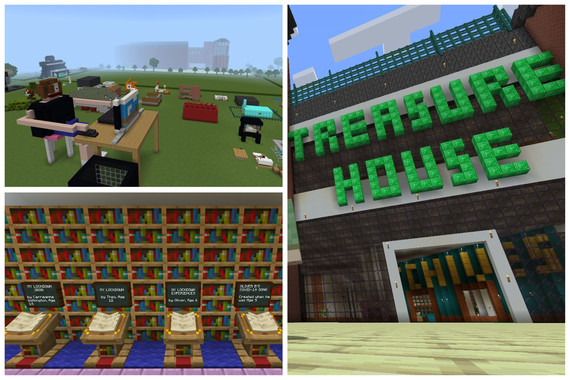 Above collage: screenshots from the project's Archiverse Minecraft world
Our East Riding Blockdown project has been featured in The National Archives' online publication, 'A Year in Archives 2022'. We are delighted to be selected as the case study for their ‘Digital’ category. The project aimed to collect young people's experiences of the COVID-19 lockdown via an 'Archiverse' created in the Minecraft videogame.
You can read The National Archives' feature online:
The East Riding Blockdown project has now worked with over 120 young people via in-person events, and school workshops. You can read more about the project’s progress across the past 12 months in our blog:
The East Riding Blockdown is supported by The Audience Agency’s Digitally Democratising Archives project thanks to funding from DCMS and the National Lottery, as part of The National Lottery Heritage Fund’s Digital Skills for Heritage initiative.
 __________
Access Digital Archives directly via the Online Catalogue
by Sam Bartle, Archivist
Last year, we launched our new ‘Universal Access Portal’ (UA) for online access to our digital archive content. As part of the development of that tool, it is now possible to go straight from a search result in the online catalogue (https://www.eastriding.gov.uk/CalmView/) to the relevant digital archive item in our access portal.
Whilst the vast majority of our holdings are original hard copy archives, any available digital content will now appear in catalogue search results with a clickable link through to the UA, under the field ‘Preservica Universal URL’ (See image below). This means that if we have an available archive video, oral history recording, or set of digital photographs; you will be able to go straight to that item and access it from anywhere in the world, simply by clicking the ‘Preservica Universal URL’ link.
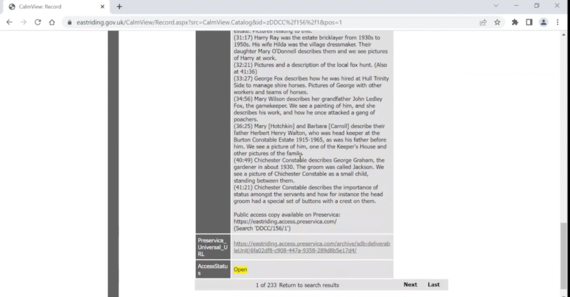 Above: Example from a record in the online catalogue showing a link to the Universal Access Portal
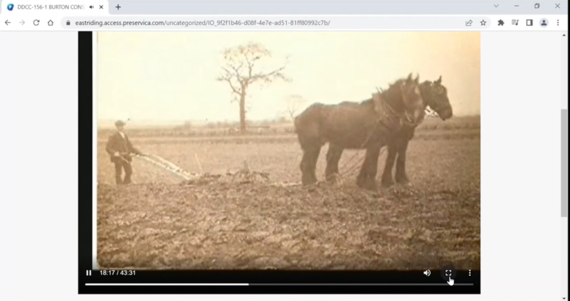 Above: The record shown in the Universal Access Portal
Although it may seem a simple, small development, it is actually a huge step forward in our service delivery as it means that, in principle at least, any archival collection that is within our capacity to digitise and make publicly available could now be made globally accessible via online catalogue searches.
The reality however, is that the financial and technological limitations around digitisation and data storage mean it will probably never reach a point (under current conditions) where our entire archive is available digitally. It would likely take someone a good 175 years to photograph each and every piece from the strongrooms, by which time, technology will have probably have moved on to different forms of access!
Search the online catalogue at:
The Universal Access Portal (UA) is available at:
What's On?
‘What Was Here?’ App Survey and Free Prize Draw
 We’ve got an Amazon Echo Dot to give away in our free prize draw! To enter, download our ‘What Was Here?’ app then take our survey:
__________
Archives Up Close: Humour
30 January 2023- April 2023, Treasure House Museum
Visit the Treasure House Museum to see our current 'Archives Up Close' case which features documents on the theme of humour and includes postcards from the Alice in Holidayland series illustrated by Frank Henry Mason.
This postcard image shows Tweedledum and Tweedledee having fun at Bridlington!
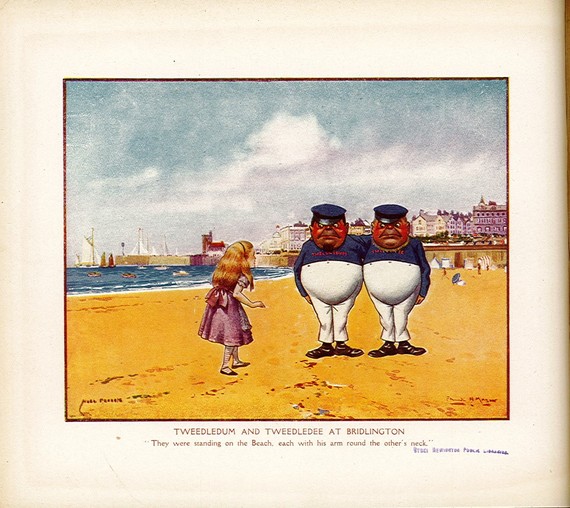 Archives reference: YE/827, 'Alice in Holidayland, a parody in prose, verse, and picture, perpetrated with profound apologies to Lewis Carroll and Sir John Tenniel' by F W Martindale, nd. [c.1910]
__________
Exhibition: Fashion on a Plate
11 February 2023- 6 May 2023, Treasure House
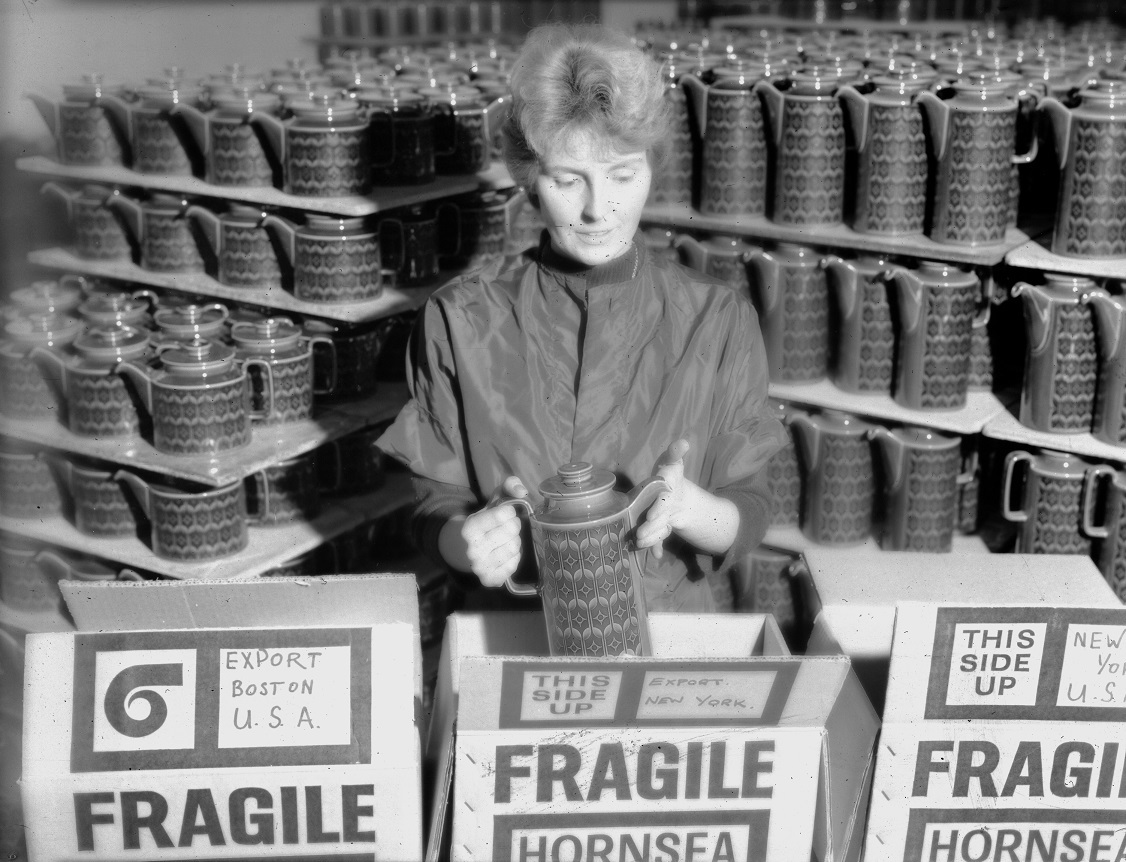 Above: Photograph showing staff packing Hornsea Heirloom coffee pots for dispatch (Archives reference: DDPH/9/1/65, Standard negatives 8000-8099, July 1970)
Carrying on with the seaside connection, our Treasure House exhibition Fashion on a Plate explores 1950s domestic tableware - of which Hornsea Pottery was a huge name. A selection of archive photographs from the extensive collection of over 800 records relating to Hornsea Pottery are on display in the cafe area.
If you would like to find out more about Hornsea Pottery content in the East Riding Archives take a look at our webpage:
Collections Spotlight
Interesting stories found in the archives from the Public Services and Collections teams.
Sugar and the East Riding
Your monthly sugar fix in an single article? Done. Here are some notes on our locality’s historic connections to the sweet stuff.
Sugar has long been a popular commodity for obvious reasons. And by the seventeenth century it was big business. In the will of Ann, wife of John Hawkesworth of St Michael’s, Barbados, dated to 1678-80, she bequeathed to her son-in-law Robert Legard of Anlaby 20,000 pounds of muscovado sugar, the equivalent of a fortune. But these riches came at a huge human cost. According to the census made up in 1679-80 in Barbados, the parish of St Michael’s counted a total of 225 owners, 300 servants and 3,746 black slaves. At 63 acres, Ann and John’s plantation was substantial. And working it were their 20 black slaves.
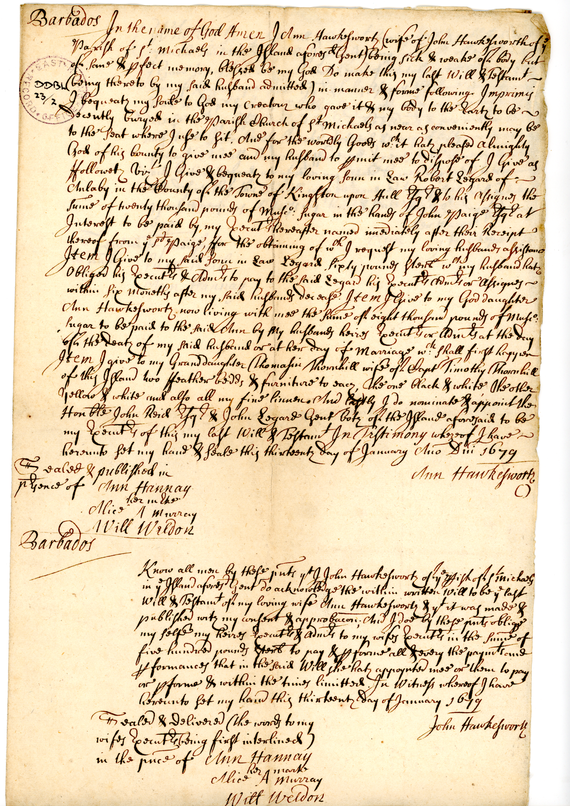 Above: Copy will of Ann wife of John Hawkesworth of parish St Michaels, Barbados, 13 Jan 1679-80 (archive reference: DDBL/23/2)
We will explore the topic of sugar further in our next e-newsletter!
_______________
A Village Pump
It is perhaps not surprising that in the 1930s many villages were relying on the village pump or well for their water supplies. However, after the Bridlington Corporation Act of 1933 the drive to provide the district with fresh, clean water took on a new impetus.
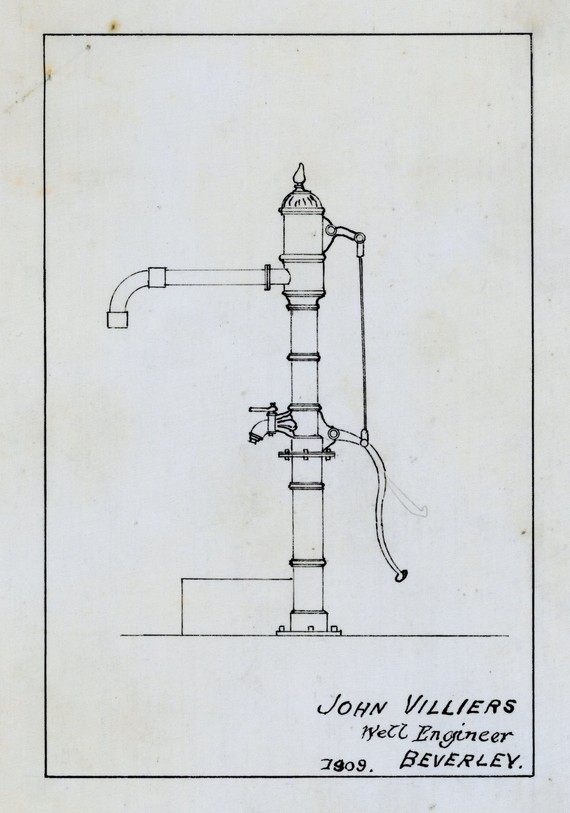 Above: Drawing of a pump, 1909 (archives reference: RDBR/6/8/5)
A file relating to water pumps and sewers includes a small drawing of a village pump attached to a schedule of public pumps. The drawing is by John Villiers, a well engineer of Beverley and is dated 1909.
It could be suggested that this drawing represents the style of pump that was installed at the various villages in the schedule. The schedule is dated 1934 and records how many pumps each village had, the depth in feet with some general remarks.
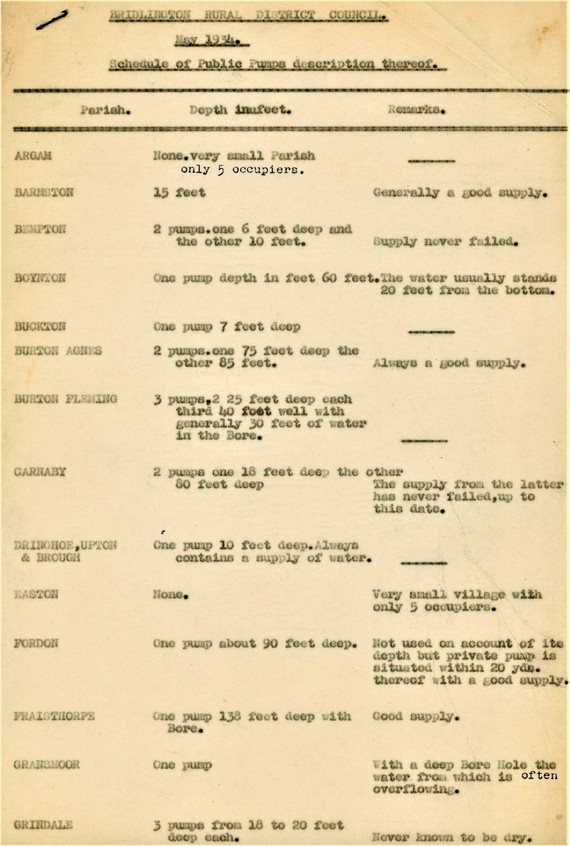 Above: Schedule of pumps, 1934 (archives reference: RDBR/6/8/5)
It is interesting to note the differences in depth for each of the pumps which highlights how deep they needed to dig into the ground to access clean water. Some areas such as Burton Fleming and Grindale had three pumps whereas Easton had no pump at all because of its occupancy of just five residents.
The remarks given in the schedule tend to be a comment upon the reliability of the supply rather than its purity. However, another file (RDPO/2/20/4/3) for a different council sheds light on the scientific analysis of water quality. Read the next article for more.
_______________
The findings of a Sanitary Surveyor in 1934
J M Murdie was the sanitary surveyor for Pocklington Rural District Council. His reports of 1934, archives reference RDPO/2/20/4/3, were based upon a systematic chemical analysis of the water purity present for the villages in his district.
The evidence showed that in many areas the water was not fit for human consumption. It revealed which villages were in most urgent need of a proper water supply. The presence of nitric nitrogen and albuminoid nitrogen (possibly due to animal contamination) were often given as the reason to label the pumps as unsanitary.
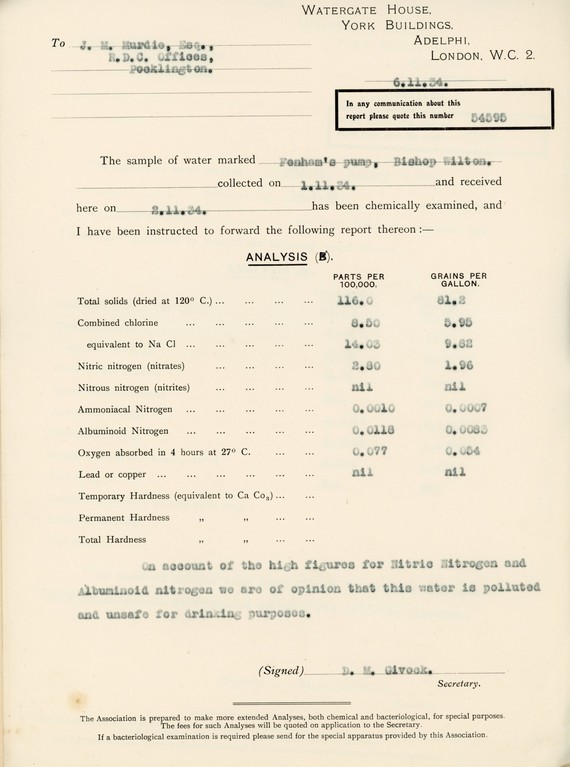 Above: Chemical analysis report for ‘Fenham’s Pump’ at Bishop Wilton by The Clinical Research Association Ltd (1934), from a file for the Rural District Council of Pocklington (archives reference RDPO/2/20/4/3)
The file includes further documentation on the villages’ water supply and that only nine parishes had piped supplies, two relied on springs (Millington with Little Givendale and Sancton with Houghton) and two parishes on rainwater (Fridaythorpe and Huggate). The remaining villages relied upon shallow wells.
In addition to other papers in this collection, the information in this file helped the council to devise an efficient water supply of purity, volume and permanency but which would also need to take into consideration the geography and legal matters such as water rights and easements.
_______________
'Clothes thro' the Ages'
A delightful, hand-made book entitled 'Clothes through the Ages' by Wilfred "Bill" Bolton of Skidby (archives reference DDX1932/4) was, by happenstance, recently unearthed in the archives.
A member of the public inquired about dating photographs based on the style of dress worn by the subjects. While investigating resources to aid in this venture, 'Clothes through the Ages' was found in the archive catalogue and pulled. What emerged from the repositories was Wilfred Bolton’s unique thirty-eight-page book dating from 1943, produced for children in Primary and Secondary schools to illustrate and describe the evolution of male clothing from the Stone Age to the present (1943).
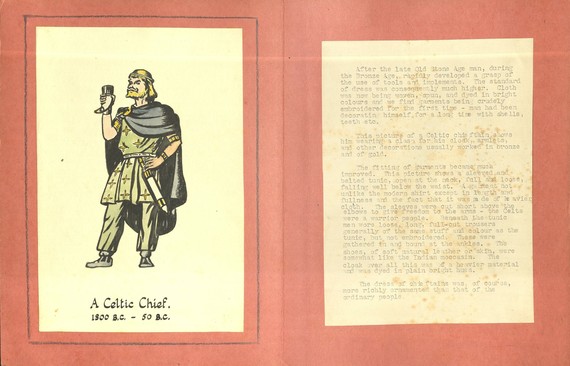 Above: A Celtic Chief (archives reference: DDX1932/4)
The book includes seventeen periods, each consisting of a charming, hand-drawn illustrations and a typed description. Bolton opens his book by writing:
“The story of the evolution of male attire is a romantic one. It illustrates the march of our civilization, and is witness to our growing refinement, and to amazing changes in a nation’s outlook and emotion.”
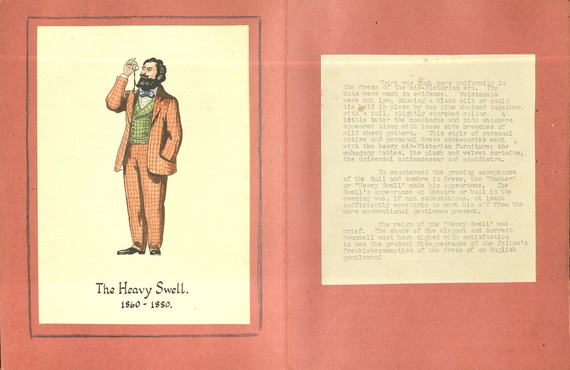 Above: The Heavy Swell (archives reference: DDX1932/4)
Bolton’s concise yet informative descriptions explain the transformation of articles of clothing we recognise today, the formation of guilds and evolution of materials, and how clothing reflected contemporary religious and political ideals. Although this may not be the most current or thorough resource concerning the history of male attire, it is no less treasured for the object’s intent and craft.
From Conservation
by Kat Saunt, Conservator
School Plans
Between March and September 2022 I was assisted on Monday afternoons in the conservation workshop by James Barnes, our Kickstarter placement. Together we worked on the SGP collection of school building plans. These date from 1844-1873 and some of them are really charming examples of architectural draftmanship. Many thanks to James for helping us stabilise 95 plans in total!
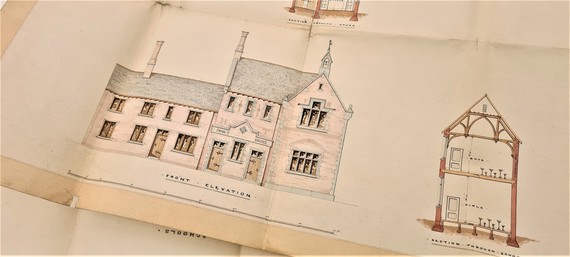 Above: Plan from the 'East Riding and Hull School Building Grant Plans' collection (archives reference: SGP)
The collection consists of 87 packets, most containing multiple plans on a mixture of paper, drafting-cloth and tracing-paper. The problem was not the condition so much as the amount of items to be treated. The majority of paper and tracing paper items needed work and everything needed cleaning as at some point in their history they had picked up some sooty surface dirt. As it’s best to just start somewhere and dive in to a project like this, I decided we should start with the paper plans. We worked our way through cleaning, flattening and applying feathery strips of Japanese tissue to repair all the tears and breaks that risked further damage from handling.
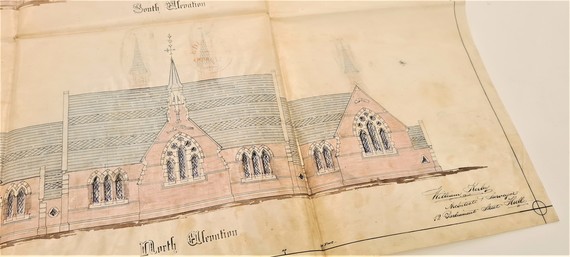 Above: Plan from the 'East Riding and Hull School Building Grant Plans' collection (archives reference: SGP)
I have recently finally completed all the 95 paper plans. Now they’re clean and stabilised. I’ve also given them all individual folders for more protection and easier access. The next step will be working on the tracing paper items in the collection, which are even more damaged and fragile.
_______________
Archival Serendipity
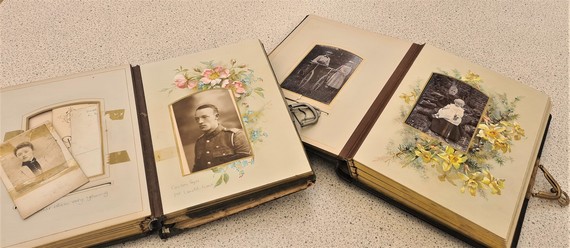
In an interesting example of archival serendipity, we have recently received deposits of two near identical late 19th/early 20th Century photo albums. The two items are completely unrelated and were deposited independently of each other within a fortnight. One is suffering from extensive damage and will be repaired so that it can be accessed. As albums they’re lovely objects in themselves with padded covers, decorative clasps and gilt-edged pages.
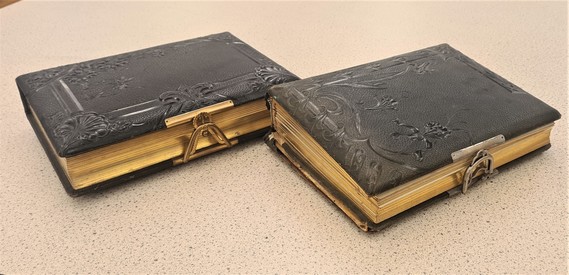 Albums and scrap-books present complex conservation problems as they are usually composed of so many varied materials with differing preservation needs. They also often suffer from being over-filled and as with one of these items – a liberal application of the conservator’s nightmare -Sellotape.
If you enjoyed this e-newsletter, why not pass it on?
Click the link "View this e-newsletter as a web page" at the top of this e-newsletter. Simply
copy and paste the web address into wherever you would like to share, such as on social
media.

|