Welcome
Welcome to the February 2022 edition of the East Riding Archives e-newsletter! We wish you a Happy New Year and hope that you enjoy reading about what we have been up to across the past few weeks. In this issue we wish a happy retirement to Geraldine, launch the East Riding Blockdown project, take a look at Bridlington history, see what exhibitions are on at the Treasure House, and more!
Best wishes from the East Riding Archives and Local Studies Team
A Fond Farewell!
At the end of January we said a farewell to Geraldine Gray, known to most as Gerry, who retired from the Archives after many years of service.
Gerry was one of the mainstays on the 'Archives Desk' and became our First World War expert with the all hard work and enthusiasm she put into cataloguing the work of our volunteers on the First World War Lives project, and all the assistance she provided them. Gerry will be missed by both staff and customers alike. We wish her all the best for the future. Keep twitching!
 Local Minecrafters Needed to Make Their Mark on History!
Do you know any Minecraft obsessed young people age 11-16 who can add their experiences of the pandemic to the archives?
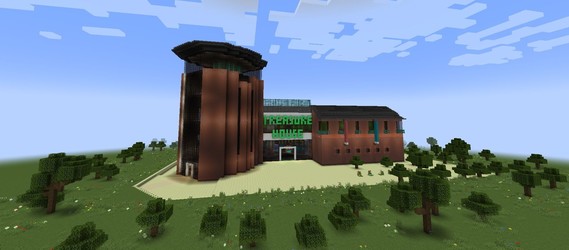
We are excited to announce that the East Riding Blockdown is now LIVE and ready for history builders to explore our Minecraft world- the Archiverse!
For information on how to register, and the several ways of participating, visit our project website:
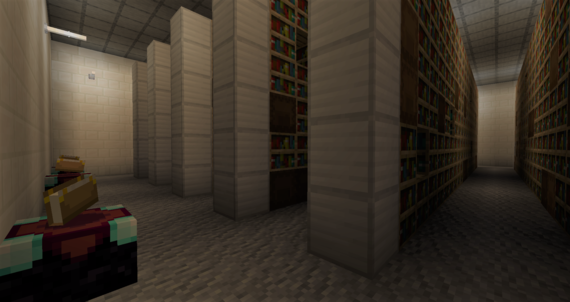 One of the Treasure House archive repositories recreated in the Archiverse (East Riding Blockdown project)
The East Riding Blockdown is supported by The Audience Agency’s Digitally Democratising Archives project thanks to funding from DCMS and the National Lottery, as part of The National Lottery Heritage Fund’s Digital Skills for Heritage initiative.
Bridlington's Children's Corner
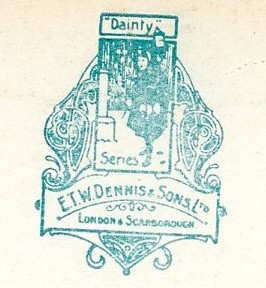
This charming postcard of Bridlington’s Children’s Corner clearly has some age to it. It was produced by E. T. W. Dennis and Sons Ltd., a company credited with being the first in the country to print commercial postcards, from as early as 1894. Although based in Scarborough, the company published postcards for numerous places located throughout the UK and Ireland.
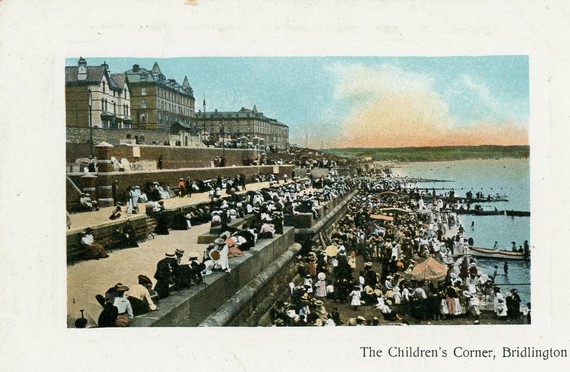 Undated postcard, archive reference DDX2406/1
This particular picture is part of their ‘Dainty Scenes’ series, produced between 1902 and 1910. Bridlington’s sea defences had recently been extended south and the sea wall we see in the photograph can only have been a few years old.
During the Second World War, the company’s factory, then located on Melrose Street, was hit by a bomb and completely destroyed. The business nevertheless recovered and continued to publish works until went out of business in 2000. The red brick printworks on Vernon Road in Scarborough have now been demolished.
ETW Dennis & Sons Ltd stamp, archive reference DDX2406/1
Document Detectives: A look at Postcards
A gift of postcards and photographs to the archives is not an uncommon event and over the years we have received many collections that include visual images. If we are lucky the images are already correctly identified and labelled. However sometimes we are left wondering who the person, location, building or event might be.
A date can be estimated from an individual’s clothing or hairstyle, the photographer’s name (if given) can help provide an idea as to when the photographer was in business. The style and colourisation of the photograph can sometimes also help when deciding on a date.
We recently acquired a gift of postcards and photographs in our collection DDX2399 which offered up this very challenge. Some of them have, very helpfully, the building and location printed on the front, while others have been identified by the depositor, such as the one showing the foundation stone being laid for Driffield Cricket Club.
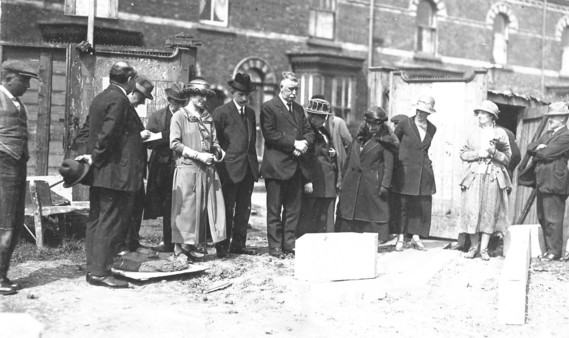 Foundation stone being laid for Driffield Cricket Club. Archive reference DDX2399/3/1
Others easily identifiable include a photograph of the vicarage at Wetwang and ‘Brandesburton Barff Ram Sale’. The humorous cartoon, ‘The last car to Brandesburton’, speaks for itself.
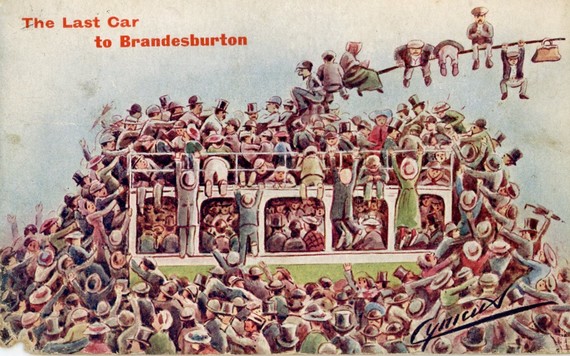 The Last Car to Brandesburton. Archive reference DDX2399/2/12
Can you help with these mystery images?
Some postcard and photograph images remain a mystery. These include a construction of a bridge at an unknown location and some soldiers from the First World War in front of an unknown country house (presumably requisitioned by the army). Further research might provide answers to these questions.
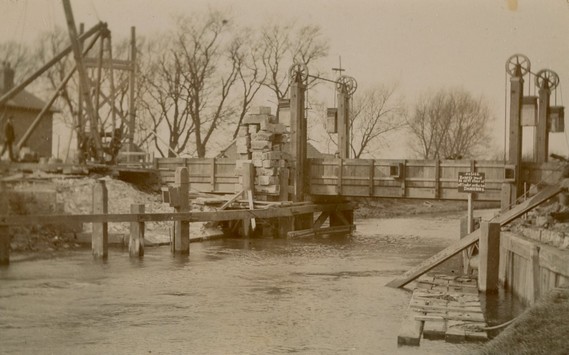 Construction of an unknown bridge. Archive reference DDX2399/3/8
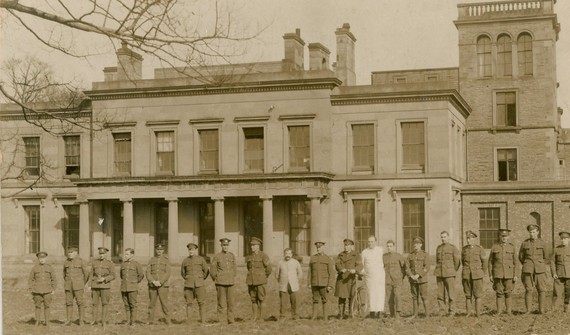 Soldiers infront of a country house. Archive reference DDX2399/1/2
The Pub That Moved
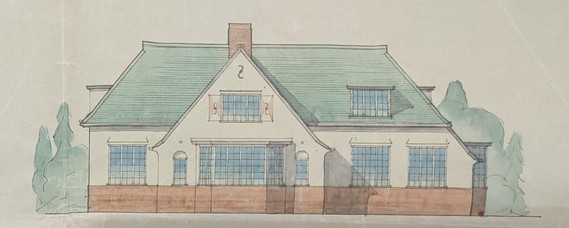 George & Dragon pub elevation 1936. Archive reference PSGO/5/1/2
Like many village pubs, the George & Dragon pub in Whitley (between Castleford and Goole) has been part of village life for a very long time. One of the things that sets this pub apart, however, is the fact that it moved location. The original George & Dragon was positioned rather too closely to the Selby Road. This far from perfect situation eventually led to a radical solution, and between 1937 and 1941 the pub was moved to its current position, further away from the thoroughfare that is the A19.
These plans of the new pub, with the existing and proposed location, include very pretty architectural drawings of the front elevation.
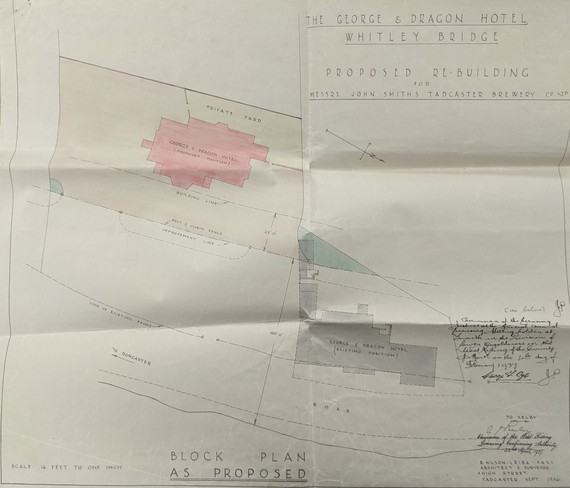 Plans for a proposed re-building, 1936. Archive reference PSGO/5/1/2
On the Ordnance Survey Map published in 1853, the George & Dragon is clearly drawn into a gentle bend of the Selby Road, its front façade lined up against the road itself. By the 1930s, the increased volume of motorised traffic presumably led to worries over customers’ safety.
The old pub was demolished and an adjacent plot with sufficient space for a more sizable building and some parking spaces was bought. And so the entire pub was moved. The new location allowed for a c-shaped drive in front of the pub, which in turn ensured that patrons staggering out of the front doors would not be walking straight into moving traffic.
Photographing the Belvedere Sea Wall, Bridlington
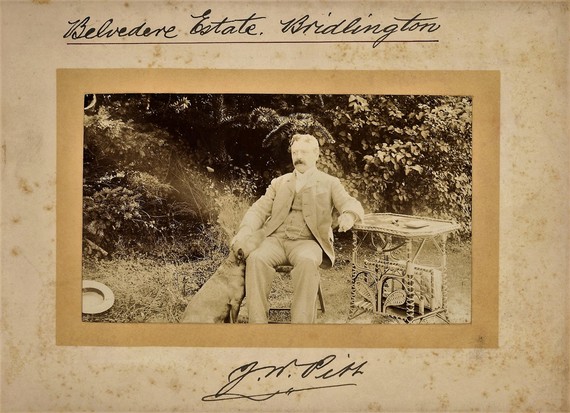
A book of photographs, reference BOBR/2/15/12/4, documenting work along Bridlington’s coast provides a visual record of an important part of the area’s history – the structure of a sea wall. This book dating from the early 1900s was compiled by Mr J Pitt who owned a substantial amount of land in Bridlington on the sea front. He was a landowner and businessman with vision.
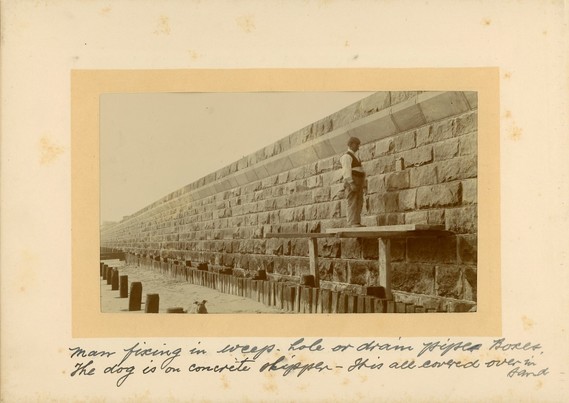 Archive reference BOBR/2/15/12/4
Originally purchased by him in 1898 he realised that the land, which was purely agricultural at this time, had much more potential. His vision was that this area would be suitable for building development and the fine sea frontage offered a chance to redefine this part of Bridlington.
Bridlington was an expanding town. The resident population numbers were gradually increasing and the annual influx of summer visitors temporarily swelled the numbers. He also noticed that over a number of years the development in Bridlington had been more rapid on the south side of the town rather than the north.
 Archive reference BOBR/2/15/12/4
 Archive reference BOBR/2/15/12/4
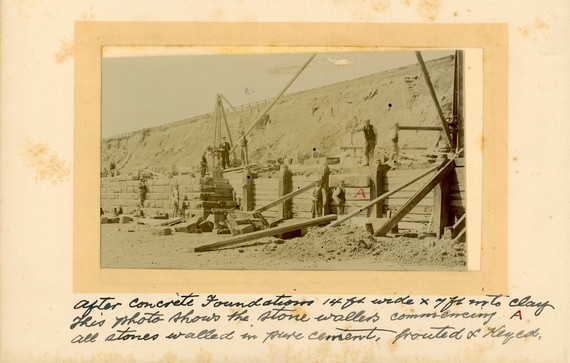
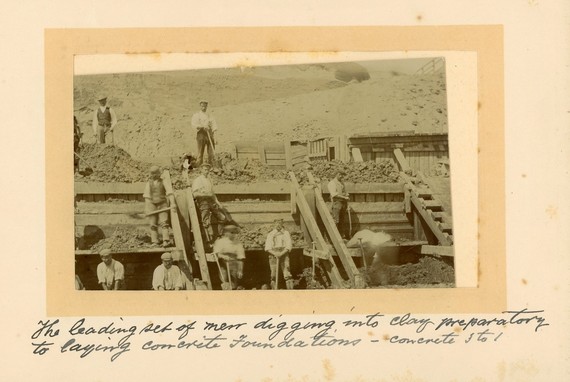
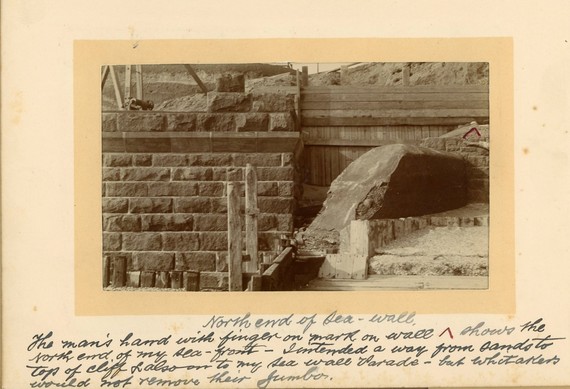
The erection of the massive sea wall contributed to the safeguarding of his estate. It was a wise decision to make as further south coastal erosion would later take its toll. Its construction was therefore vital but it was also seen at the time as one of the finest-looking sea walls along the east coast.
Mr Pitt’s book of photographs include images, including one of the man himself, with annotations by him which add vital information about the construction process. On the opening page he provides the context of his vision and it also reveals something about the man himself. It reads:
‘Before commencing the work I asked for tenders which varied from £150,000 to £200,000. To make sure of the best work & materials I decided to do the work myself & have no contract of piece work. Just at this time a large sea-wall was about finished at Blackpool – so I engaged the leading men and they came over and my sea wall was commenced at once. Every day I told my men to do the best work they could. One man was overhead to say that if he had a shilling for every bag of cement he had handled on the wall he would never have to work again…. The first man I met a year later on and giving him a shilling said that is one bag – he said it is twenty bags – and so it was a sov [sovereign]. After that I was meeting my men at every street corner’
[A sovereign was worth 20 shillings]
 Archive reference BOBR/2/15/12/4
 Archive reference BOBR/2/15/12/4
From the Conservation Workshop
By Kat Saunt, Conservator
Recently I have been conserving the WW2 prisoner of war diary of Sidney Rippingale (DDX1680/7). This small notebook was in unusable condition; the poor-quality wartime paper had aged to become so fragile and brittle it couldn’t really be opened at all without risking damage to the text. I chose to remove the rusted staple holding the book together to treat the pages individually. After removing some Sellotape and deacidifying the paper to prevent further decay I then lined the pages with very lightweight Japanese tissue (only 3.5g per square meter) to hold them together. Usually I would wash such acidic paper but because it really was so fragile I decided to use a solvent-based deacidifying solution and adhesives to avoid having water swell and distort the paper fibres and risk more losses.
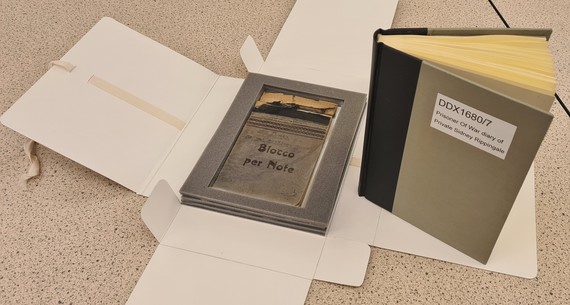 DDX1680/7
I’m always grateful to work on a document where only one side of the page has been written on as it makes lining much more straightforward - thanks, Sidney! Once they were stabilised I rehoused them in a protective fascicule book that allows them to be read without handling the original pages.
However, only 46 pages of the notebook had been filled. I chose to leave these in the notebook and created a recessed compartment in the custom made box for it to be stored in with the fascicule book. I think this is a fair compromise to preserve some of the original structure of the document while ensuring the diary can actually be accessed without harm.
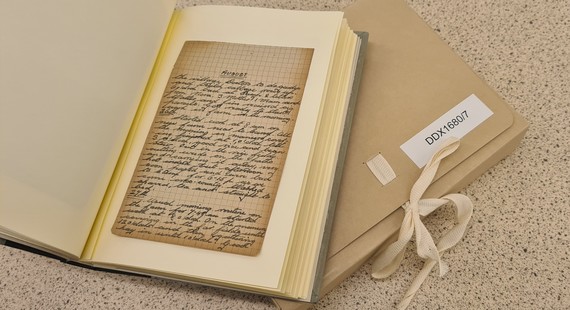 DDX1680/7 in a custom made box
Archives Up Close
Our quarterly-changing selection of historic documents in the Treasure House Museum is a great opportunity to shine a light on a few of the thousands of documents held in East Riding Archives.
Now that the days are getting brighter and longer, we’ve picked the theme of “flowers” for our next display. Centre stage is a beautiful book with a very long title: Alpine plants, figures and descriptions of some of the most striking and beautiful of the alpine flowers which was printed by master printer Benjamin Fawcett in Driffield in 1874.
East Riding Archives YE/FAW/582
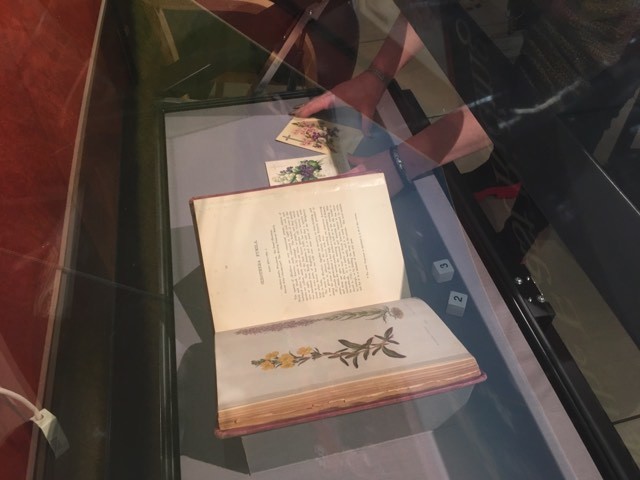 'Alpine Plants' 1874, Local Studies reference YE/FAW/582
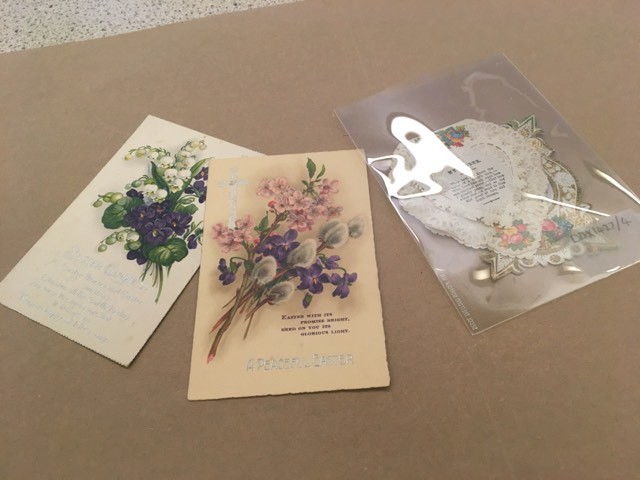 Printed Floral Greetings c.1916, Archive reference DDX1427/4
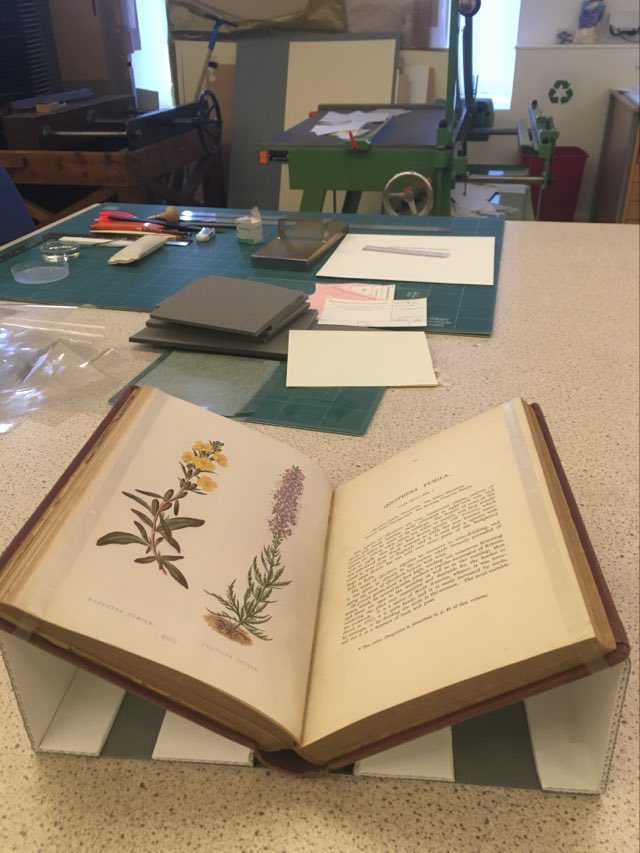 'Alpine Plants' 1874, Local Studies reference YE/FAW/582
Hidden: Cold War Women now online
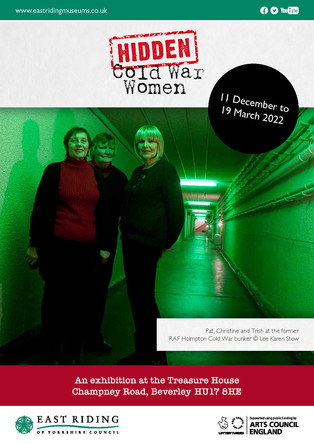
Our previous newsletter gave an introduction to some of the Cold War material in East Riding Archives which Treasure House curator Sally Hayes has been exploring as part of the Hidden: Cold War Women project with photographer Lee Karen Stow. We're delighted to say that the webpage is now live. Have a browse:
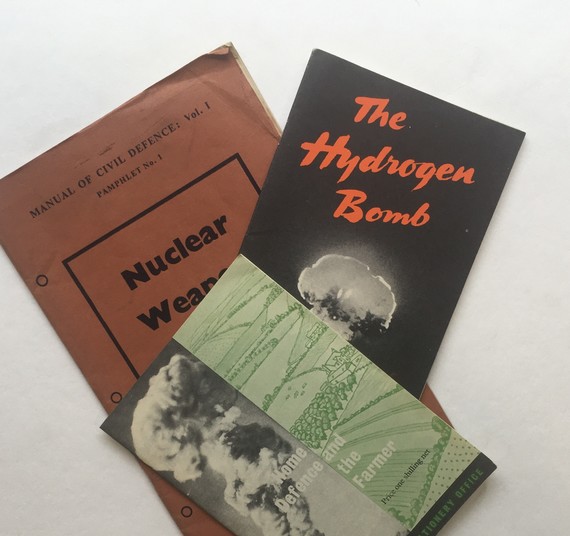 The Hydrogen Bomb (1957), East Riding Archives CCHU/6/3/7/20, Manual of Civil Defence Nuclear Weapons (1956), CCHU/6/3/7/1 and Home Defence and the Farmer, (1958) CCHU/6/3/7/21
The exhibition at the Treasure House runs from Saturday 11 December until Saturday 19 March and will include Lee's photographic portraits, testimonies from some of the women involved in the project, original documents from Archives and loans from York Cold War Bunker (English Heritage).
Hidden: Cold War Women Drop In
Saturday 5th March, 10am- 12 noon.
Pop into the Treasure House exhibition space and chat to Lee Karen Stow, the photographer behind Hidden: Cold War Women.
Treasure House Curator Sally Hayes will be on hand to talk about content in the East Riding Archives and loans from York Cold War Bunker.
No need to book, just turn up.
The 1921 Census has arrived!
One of the most anticipated genealogy dates in the 2022 calendar has now arrived! Findmypast were awarded the contract by The National Archives UK to transcribe and digitise the records of 38 million people held within 28,000 bound volumes of the 1921 Census. The fruits of this mammoth task are now available on Findmypast for us to delve into 1920s life.
Please note that transcripts and digitised images of the 1921 Census are not freely available via the East Riding Archives and Library's Findmypast Library subscription, but are available by charge at prices set independently by Findmypast. The 1921 Census index can be browsed without charge on Findmypast (please book an appointment to use a public computer).
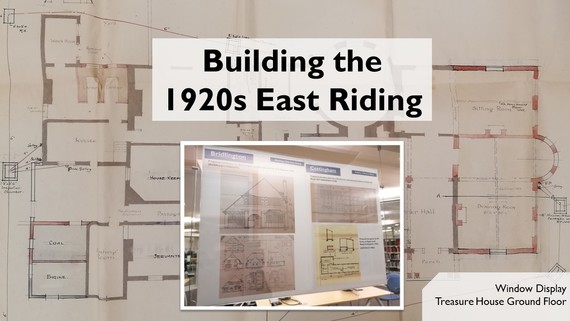
Building the 1920s East Riding
To celebrate the 1920s era, we have decorated our archives windows with a selection of images of East Riding building plans that show some architectural developments from the period. This display only touches the surface of the quantity we hold in the archives, just from the 1920s alone, and are a rich information resource detailing property owners, addresses, building contractors, and architects as well as being visually appealing. These wonderful documents can be found in the collections of urban district, rural district, and borough councils. Come and have a look at the display in the ground floor Treasure House foyer!
If you've enjoyed this newsletter, why not pass it on?
Click the link "View this e-newsletter as a web page" at the top of this e-newsletter. Simply copy and paste the web address into wherever you would like to share, such as on social media.
|