This Autumn at the Country Park
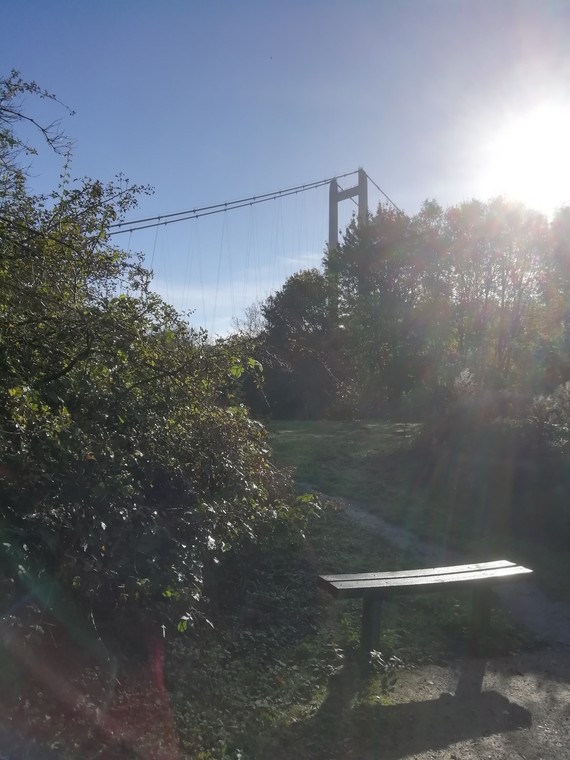 While September saw the Humber Bridge Country Park move from Summer to Autumn, we enjoyed some glorious weather and some great events down at the Country Park last month. Read on to find out what we got up to during the Walking the East Riding Festival and our beginners stone carving Workshops. You can also enjoy some fantastic artwork from the Country Park alongside our regular feature 'From the Newspapers'. We also give you a hint about what we having coming up this Autumn half term!
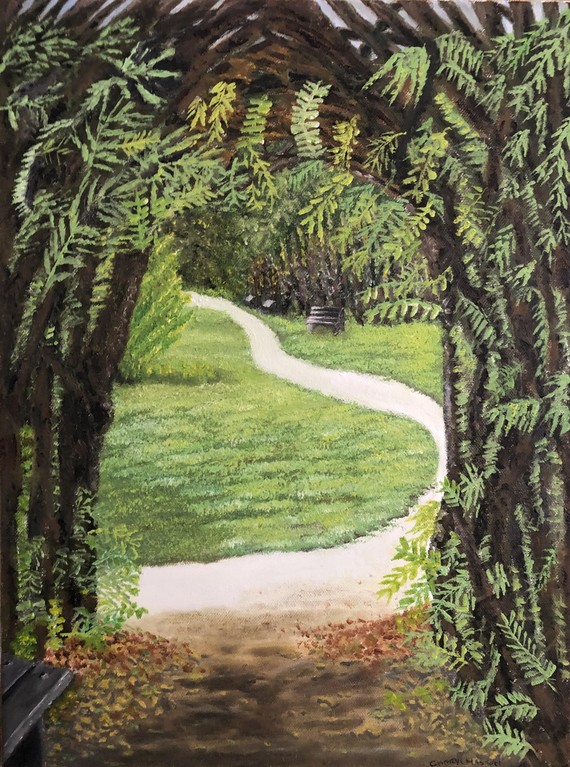 Oil on Canvas by Cheryl Maston
This wonderful oil painting (above) of the Country Park's willow tunnel, near the bird feeding station, was sent in to us by Cheryl Maston. We think Cheryl has captured the lush summer greenery of the Country Park beautifully. She oil paints every day and it takes her over a month to finish an oil painting from photographs she takes in the Country Park.
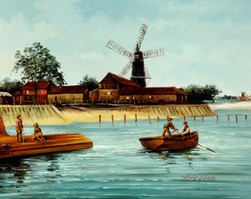
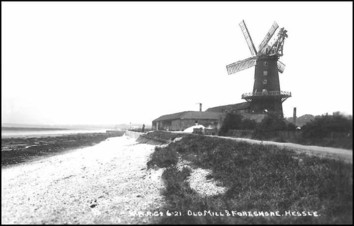
There is a long tradition of amateur artists painting the wonderful scenery of the Country Park and Foreshore dating back at least 120 years! For example, this scene (left) of the Mill, Whiting Works and the Foreshore was captured during the 20th century by an artist named Hoffman. It shows characteristics of the Dutch painting tradition of flat landscapes with windmills. The palette is bright, almost exotic, which unites the industrial aspect of the mill with the pure beauty of nature. The painting is from the collection of Beverley Art Gallery. A large reproduction the piece is on display in the mill on the third floor.
Below is the work of another amateur artist, Tom Kirk dating from around 1900. It is a watercolour of the Country Park during it previous life as a chalk quarry. It shows the white chalk cliff face with wagon trucks on the rocky ground below and grass top and trees around edges and above the cliff top. The grass and curving tree trunk frames the right of the foreground. This work belongs to the collection of the Hull Ferens.
|
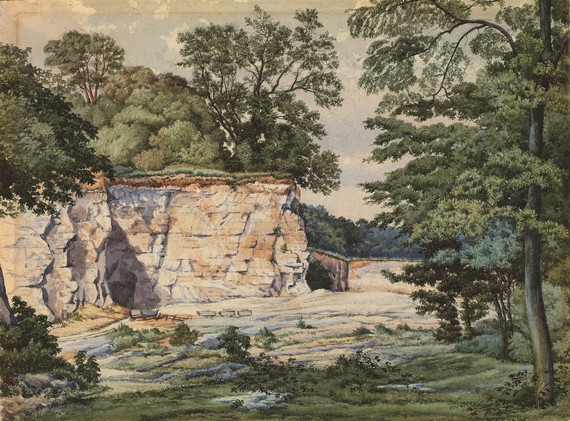 Hessle Quarry c.1900 by Tom Kirk. Hull Museums and Galleries
If you are a budding amateur artist and have created a piece depicting the Country Park, Mill or Foreshore, we'd love to see your work! Please email alex.ombler@eastriding.gov.uk and, like Cheryl's beautiful scene, we'll feature it in next month's e-newsletter.
Stone Carving Workshops at the Mill
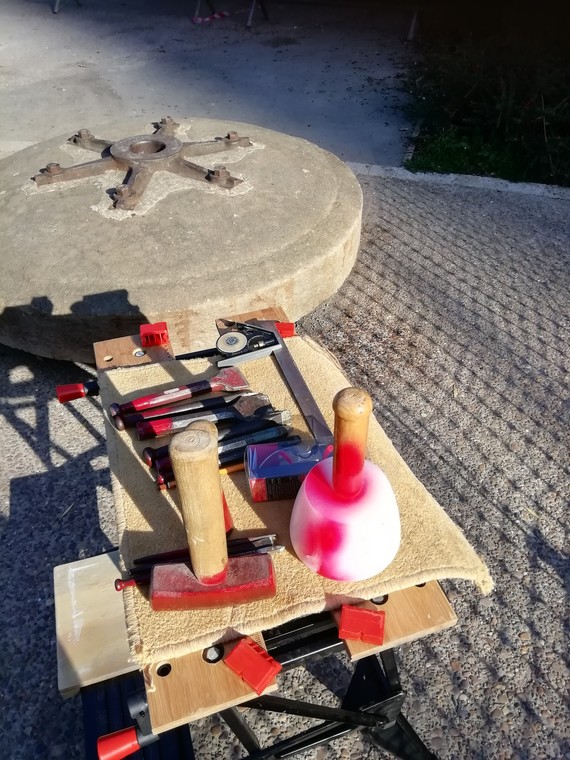 Stone carving tools, each set were marked with a particular colour, so participants, who were socially distanced, only handled their own tools.
 |
|
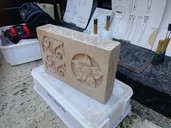
In September we ran our free beginners stone carving workshops at the whiting mill. Each of our participants had the opportunity to learn stone carving skills and take home their very own masterpiece at the end of the day. As well as introducing beginners to stone carving, the workshops aimed to get participants and visitors to think about stone, limestone (of which chalk is a type) in particular, as a material for art. |
The sessions were run by the highly talented artist Saffron Waghorn, a qualified stone mason, sculptor and letter cutter. Many of you may not know, but you will already be familiar with some of Saffron's work: the wood carvings of the Country Park's Nature Trails. These oak way markers were part of a project designed and installed by Saffron with the help of local people. Each was individually transformed from plain timber into hand carved nature trail posts which, guide you around each individual trail on the reserve. |
|
 |
From the Newspapers: "Hessle Chalk Pits", Hull Daily Mail 27th May 1909
Transcribed by Sally George, Quarry to Country Park Volunteer
"The other Hessle? You turn towards the river to find it. It is the Hesle of small houses and spacious views, the Hessle where the Humber rolls brown when the sun is not brilliant enough to transform its dinginess to silver; the Hessle of windmills with five sails, of red-tiled roofs, of chalk pits, and rural paths through pleasant hill sides. This is my Hessle when the weather is fair, when skies are bright, and warm winds are blowing.
Such a day came after the rain of Tuesday morning....it was the perfect day for exploring the Hessle of the chalk pits, and breathing the air that came careering from over the Wolds and down the broad estuary that glittered in the sunlight, and was as busy with craft as a Clarkson Stanfield picture.
|
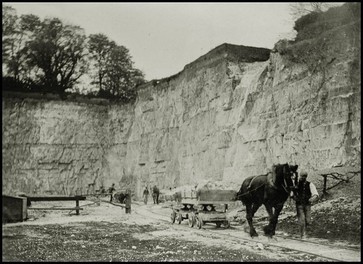
The chalk cliff gleamed white in the glare of the sun, a dazzling blinding white that made you close your eyes and wonder how the men at work amid the crags of chalk could bear the strain upon their sight. The workmen who daily toil with pick and crowbar may not believe me when I say that there is singular beauty and charm about this white wall of chalk at the end of a wide green field, but charm and beauty there is - to an unaccustomed townman, at any rate.....It is nothing that there are birds flying about the heads of these ten men at work with crowbar and pick, dividing their time between their nests in the holes in the cliff, and the sunshine. These chalk cliffs have a story to tell too. If we had brought Mr. Sheppard along he might have told us this story - but he is at the Museum superintending the reconstruction of the wonderful boat "dug out" from a mighty tree in the Bronze Age, and found some years ago at Brigg. Mr. Sheppard would have told us that these chalk cliffs began their history ages before the Bronze Age people were born. He would have told us how these cliffs were once the bed of an ocean. He would have told us that age after age the floor of the sea grew deeper and deeper with deposit, and that the ocean was swept away in some mighty elemental upheaval, leaving the deposit bed to solidify in the flight of years. But our geologist not being available we must sit and watch the men at work till they are familiar with our presence and we have mustered up sufficient courage to call to the man we imagine to be the foreman to indulge in converse. He may not be a geologist, but he is familiar with the practical aspects of chalk. He knows what chalk is and what flint is and he can point out the difference between white flint and red flint. He is a most sociable sort of fellow this foreman, and you can readily believe him when he tells you how trying the summer heat is to the workers on the Cliff, and how the dust rises and settles in their throats, and sends them flying to their cans of tea.
|
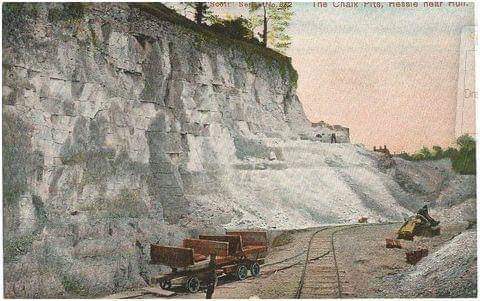
This is a state of things that really needs no explaining, for the visitor to these chalk pits has not to be there long on a dry afternoon before he finds himself consumed by a violent thirst. The air seems charged with fine powder, with powers of penetration that are simply extraordinary. When first I began to watch these men at their excavation, I thought what a pleasant occupation theirs must be, out there in the open, the blue sky above, green grass below, and the broad bosom of the Humber stretching out before them. I envied them their task. How different, I thought, from a Whitefriargate office! How much more pleasant to wield the pick-axe than the pen! It seemed to me there was a fascination about the work because of its destructiveness. We are all "smashers" at heart. We all like to smash things.....There was one man right at the top, hidden somewhere behind piles of rock; but there was not lacking evidence that he was busy, for a constant shower of lumps of chalk and flint came toppling down the face of the cliff, enlarging his heap of accumulations at the bottom. Closer at hand a couple of workmen were performing scientific wonders with a ton of rock that they had loosened. They were giving an object lesson in the use of the lever. I wished ardently I could have been plying their crowbar lever. It would have given me immense joy to have given the lever the final jerk that sent the huge piece of chalk-stone hurtling to the bottom. But after a time when the invisible powder had begun to ingratiate itself, I began to realise that it was an unpleasant way of earning a living after all, and that it was one of the most remarkable inspirers of thirst I had ever encountered. Indeed, I came to the conclusion that no chalk cliff where men were working could be considered complete without a brewery or an aerated water works on the spot.
|
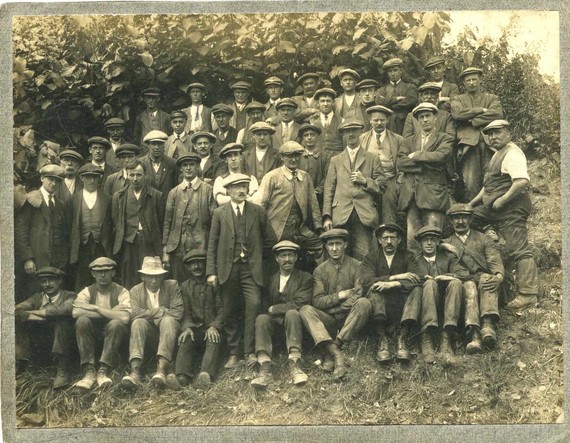 Hessle Quarrymen. This photograph was taken around the time the article was written. Perhaps the author met some of these men?
My foreman friend told me that there is chalk - and chalk. There was Gravesend chalk and Hessle chalk - not to mention others. The qualities differed. For instance, the chalk with which the schoolboy is familiar does not have its origin at Hessle. But the "whiting" or "whitening", with which the schoolboy's mother may be familiar, does.
Not far from where we sat and talked were mountains of chalk fresh from the cliffs ready to be shipped abroad. At the moment a cargo was being got ready for America. It would be taken there, ground down between huge rollers working in water, and made into "whiting". This same operation was being performed in the mill close to the cliffs. The great stone millwheels, faced with steel tyres, were crunching up the lumps of chalk stone with which they were constantly fed by a man who kept as watchful an eye as he could that he did not give them more than they could digest - for flints have a habit of damaging the "tyres" of the wheels if they happen to get into the trough by mistake. When the grinding has been done the "mortar-like" product is carried to pits, where it separates itself - the sand and heavier matter sink, and the chalk proper rises, to be shaped into lumps of "whiting" and put to dry.
Day by day the same work goes on with pickaxe and crowbar; day by day the horses drag waggon loads to the waterside; day by day the bang of detonators strike the air and startle the sand marins when blasting is afoot. My foreman friend illustrated the power of a dynamite cartridge - not for my benefit, but in the course of his resumed work. Into a hole that he had made he dropped his package of dynamite, to which was attached a few feet of fuse. The warning was given, and the workmen retreated to places of safety - and after a thud down came a great mass of rock many tons in weight. When the sand martins came back to their nests in the crannies they were no longer there."
|
A Walk in the Park.... and Mill: Walking East Yorkshire Festival
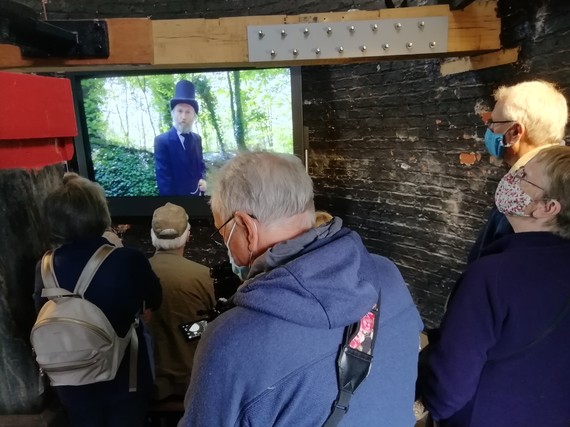 The particpants at this year's Country Park and Mill walking event pause to rest and watch the film inside the mill's tower.

The Walking East Yorkshire festival took place in September and our team at the Country Park and Mill led a guided walk through the reserve and inside the mill. The participants enjoyed the fresh air and greenery of the Country Park while learning about the site's rich history as a chalk quarry and the story of it's modern life as a carefully conserved nature reserve and important habitat for wildlife. The walk finished on the foreshore with a tour on five levels inside the historic whiting mill.
|
Hessle Mill: Over 3,600 Visitors since May!
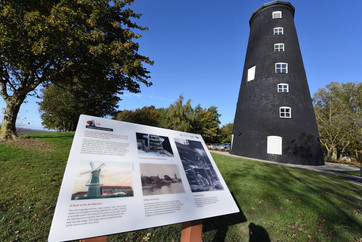
Since opening to the public in May this year, Hessle Whiting Mill has welcomed over 3600 visitors through it's doors. Just over 600 hundred of this figure visited on our two Heritage Open Days last month.
The Mill underwent refurbishment between November 2019 and October 2020 as part of the Quarry to Country Park Heritage. Following this, it was opened to visitors as part of the brand new 'Chalk Walk' heritage trail. Throughout the spring, summer and Autumn, our Heritage Officer and Volunteer team have welcomed literally thousands through the mills doors. Our Heritage Officer Alex, said:
"This year has been a hugely enjoyable experience for myself and the volunteer team. We've worked really hard staffing the mill, welcoming people and sharing our knowledge about the history of the mill. The Country Park and Hessle Foreshore have been hugely popular places for decades, and in the last few years they have been more important than ever- a real life line for people, places where they can safely exercise and socialise. The mill and the Chalk Walk have been a bonus as they have added a new layer of heritage to the greenery and wildlife of the reserve."
The Mill has now closed it doors to visitors for the winter, however, it will open on Wednesday 27 October during half term week for our Autumn event for families. Further details will be announced via our Facebook Page here or you can email alex.ombler@eastriding.gov.uk.
|
|