|
There is still time to have your say on how local council services are delivered in the future – as part of the biggest change to local government in 50 years.
Under proposals drawn up by Derbyshire’s eight district and borough councils, together with Derby City Council, there would be just two unitary authorities in the county. One would be in the south of the county and the other would be in the north. A six-week public consultation runs until Sunday 10 August.
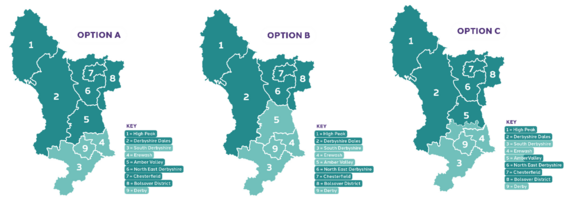 The options:
Option A: A north / south split of the county, with Amber Valley being part of the northern council
-
Northern council: Amber Valley, Derbyshire Dales, High Peak, Chesterfield, Bolsover, North East Derbyshire (Population: 584,000)
-
Southern council: Derby City, South Derbyshire, Erewash (Population: 494,000)
Option B: A north / south split of the county, with Amber Valley being part of the southern council
-
Northern Council: High Peak, Derbyshire Dales, North East Derbyshire, Chesterfield, Bolsover (Population: 456,000)
-
Southern Council: South Derbyshire, Erewash, Amber Valley, Derby City (Population: 622,000)
Option C: A north / south split of the county, with different parishes from Amber Valley joining each of the two councils, depending on where they best fit.
-
Northern Council: High Peak, Derbyshire Dales, North East Derbyshire, Chesterfield, Bolsover (Population: 567,000)
(Joined by the following parishes of Amber Valley - Shipley, Heanor and Loscoe, Denby, Kilburn, Belper, Hazelwood, Shottle and Postern, Idridgehay and Alton, Ashleyhay, Alderwasley, Ripley, Codnor, Aldercar and Langley Mill, Ironville, Riddings, Somercotes, Alfreton, Swanwick, Pentrich, South Wingfield, Crich, Dethick, Lea, and Holloway.)
-
Southern Council: Derby City, Erewash, South Derbyshire (Population: 511,000)
(Joined by the following parishes of Amber Valley - Kirk Langley, Mackworth, Kedleston, Ravensdale Park, Weston Underwood, Quarndon, Turnditch and Windley, Duffield, Holbrook, Horsley, Horsley Woodhouse, Smalley, Mapperley.)
The views of people and organisations will feed into the development of final proposals, which must be considered by existing councils and submitted to Government by 28 November 2025.
Government will then review the proposals for Derbyshire, and for 20 other county areas across England, before making final decisions in the Summer of 2026.
If the Government accepts the proposals for Derbyshire, elections for the new shadow authorities would take place in 2027 and new councils would start to operate by April 2028.
There is also a video on the council's YouTube Channel where Leader of the Council, Councillor James Dawson explains the situation.
|
|