Healthcare Technologies Newsletter -
May 2024 Issue 14
|

|
|
|
 Credit: Pexels - fauxels
EPSRC Health Technologies welcomes new Strategic Advisory Team members
Our strategic advisory team (SAT) advise us on research and training strategy in different areas of our remit, paying particular attention to multidisciplinary opportunities.
We are pleased to welcome new SAT members to our SAT.
The SAT membership for all EPSRC themes can be found on the UKRI website.
|
|
 Credit: Unsplash - campaign-creators
Health Data for Research Workshop - 24 September 2024
EPSRC are hosting a workshop on use of health data for research. It will take place virtually on 24 September 2024, between 10am and 1.30pm.
Join us to hear about guidance and resources available to access health data and share your thoughts around challenges and opportunities in the health data space.
There are a limited number of places, so please register to attend the workshop using the Zoom registration link.
We are looking forward to hearing your views.
|
|
 Credit: Pexels-Pixaby
Send us your ideas for high risk research
The EPSRC Healthcare Technologies theme are seeking disruptive and transformative ideas in engineering and physical sciences research with the potential to deliver a step change for health.
Your input will inform early stage scoping of future high-risk funding opportunities.
We are looking for ground-breaking and innovative ideas that could be truly disruptive and solve an important healthcare challenge.
Please share your ideas for topic areas by emailing healthcare@epsrc.ukri.org by 2 August 2024.
|
|
|
|
|
|
|
EPSRC-NIHR technologies to enable independence for people living with dementia
The National Institute for Health & Care Research (NIHR), Engineering & Physical Sciences Research Council (EPSRC) and Alzheimer’s Society have recently announced the funding opportunity ‘Technologies to enable independence for people living with dementia’.
The opportunity invites applicants to develop a NetworkPlus focused on the use and development of novel tools and technologies to enable people to live independently with dementia.
Networks should be multidisciplinary and embed people with lived experiences of dementia. Funders are looking to build capacity and bring together new communities across engineering and physical sciences, and health and care, to tackle challenges in dementia research. The full economic cost of projects can be up to £2 million.
The funders will be hosting a webinar for potential applicants on 26 June 2024 which will provide more information about this funding opportunity and a chance to ask questions. Please be aware that the date of this webinar has, very recently, been changed from 26 June to the new date of 5 July 2024. We are in the process of amending the date of the webinar that appears against the funding opportunity on the UKRI website.
Please use the zoom registration link to register for the webinar.
The opportunity will close on 10 September 2024 at 4:00pm UK time.
|
|
Health Technologies Connectivity Awards
Apply for funding to spend time in a different research or user environment to build new connections within health technologies.
Novel engineering and physical sciences (EPS) research contributing to the delivery of the EPSRC health technologies strategy must comprise a proportion of the placement.
We will hold a webinar on 25 June 2024 at 10:00am UK time. This will provide more information about the funding opportunity and a chance to ask questions.
Please use the zoom registration link to register for the webinar
The opportunity opened on 1 May 2024 and will close on 3 September 2024 at 4:00pm UK time.
|
|
Pre-announcement – EPSRC engineering healthier environments funding opportunity
Applicants will be able to apply for funding to develop an interdisciplinary Micro Network or Micro Network Plus focussed on developing new and existing collaborations within the topic of engineering healthier environments.
The networks are expected to involve a breadth of expertise and experience as well as facilitate collaboration and engagement across sectors and disciplines.
We refer to these grants as ‘micro’ as they are shorter in duration compared to standard EPSRC Network grants. The ‘plus’ element includes funding for grant holders to deliver a sandpit(s).
A pre-announcement with further details will be published soon on the UKRI funding finder.
The opportunity is planned to open in July.
|
|
|
Pre-announcement - EPSRC Health Technologies Translation Partnership Scheme
Applicants will be able to apply for funding to accelerate progress of fundamental research towards application and impact in areas bringing significant health benefit, through partnering with clinical/healthcare professionals and industrial partners.
A pre-announcement with further details will be published soon.
|
|
|
|
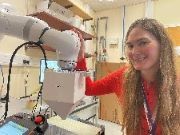 Credit: University of Warwick
EPSRC funded Terabotics programme grant: Using terahertz waves to help with skin cancer treatment
Scientists at the University of Warwick are creating a new way to detect skin cancer. Using so called "terahertz waves" to do it.
Previously thought to be too low energy for any useful applications, their research is now at the stage where they are starting to study patients with skin cancer, with the aim of helping surgeons remove as little healthy skin as possible during surgery.
Further information is available on the YouTube video: using terahertz waves to help with skin cancer treatment.
|
|
 Materials for Bioelectronics in Healthcare Strategy and Action Plan: Stakeholder Survey
The Henry Royce Institute is the UK’s centre for advanced materials and is exploring the opportunities for materials innovation in bioelectronics as part of its biomedical materials challenge areas.
The valuable insights gained through this survey and follow-up interviews will be used to inform a future innovation strategy and action plan for materials developed for and used in bioelectronic healthcare.
Royce would like to hear from anyone involved in the following: developing materials for bioelectronics in healthcare products, developing or selling these products, applying them in clinical settings, or otherwise supporting the sector.
Response from all backgrounds are welcome, regardless of specific experience in materials for bioelectronics in healthcare.
Please note that the survey should take 10 minutes to complete and must be completed in one sitting.
|
|
 Institute of Physics and Engineering in Medicine Artificial Intelligence Group: Survey
This is a questionnaire compiled by the Institute of Physics and Engineering in Medicine (IPEM) Artificial Intelligence (AI) Group.
The aim of the questionnaire is to assist and appropriately direct the activities of the group, provide evidence for IPEM’s lobbying activities and to develop a snapshot of opinions and attitudes towards AI in healthcare across the medical physics and clinical engineering community.
The questionnaire is targeted at all colleagues working in Medical Physics and Clinical Engineering, in clinical, academic and industry roles, regardless of their level of experience or knowledge of AI.
The survey is open until 30 June 2024.
Further information about the AI Group can be found on the IPEM website
|
|
|
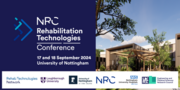
National Rehabilitation Centre's Conference on Rehabilitation Technologies: 17-18 September 2024
Join the EPSRC Rehabilitation Technologies Network on 17 – 18 September 2024 at the first National Rehabilitation Centre's Conference on Rehabilitation Technologies. This 2-day event at the University of Nottingham is your chance to explore the latest advancements in rehabilitation technologies and connect with experts in the field.
Poster abstract submissions are accepted by 31 July 2024, 5:00pm. Guidelines for poster abstracts can be found here.
For all queries, including financial assistance, please email rehabtech@nottingham.ac.uk.
This event is organised by the Rehabilitation Technologies Network and funded by the EPSRC.
|
|