|
|

|
|
|
|
|
|
|
|
First experiment results point to fusion energy solution
Initial results announced by the UK Atomic Energy Authority demonstrate the success of a world-first concept that could remove a barrier to fusion energy.
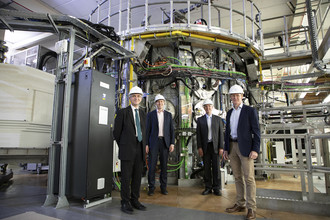
Using the new MAST Upgrade experiment based at Culham near Oxford, the UK Atomic Energy Authority (UKAEA) has successfully tested an exhaust system capable of withstanding the extreme heat generated by fusion power stations.
The World First Concept Super-X divertor system tested would allow components within tokamaks, the machines which will heat gases to generate energy in fusion plants, to last for much longer and greatly increase their availability while reducing the cost of fusion electricity.
MAST Upgrade is funded by the Department for Business, Energy and Industrial Strategy, UK Research and Innovation’s (UKRI) Engineering and Physical Sciences Research Council (EPSRC) and the EUROfusion consortium.
The results were announced at the formal opening of the MAST Upgrade, which was attended by astronaut Tim Peake, who created his own artificial ‘star’ by running a plasma test on the machine.
|
|
|
|
Eleven projects launched to decarbonise heating and cooling
Exploring using water from abandoned mines to heat the UK’s homes is among 11 new projects aimed at decarbonising the heating and cooling of buildings.
Heating is one of the largest contributors to the UK’s carbon emissions, with nearly 13% of greenhouse gases a result of home heating using fossil fuels. This is a similar level to emissions from cars.
With the UK set to experience hotter summers in the future, the carbon cost of cooling buildings will continue to grow unless renewable methods of generating this energy are found.
The projects announced are supported by a £14.6 million investment from:
- Engineering and Physical Sciences Research Council (EPSRC)
- Natural Environment Research Council (NERC).
EPSRC and NERC are both part of UK Research and Innovation (UKRI).

|
|
|
|
Bowel sensors among 20 innovative healthcare technology projects
Researchers aim to develop tiny robotic sensors to detect bowel cancers, the second most common cause of cancer death in the UK.
Armed with cutting edge terahertz imaging, the sensors could be used in colonoscopies or even to detect skin tumours, allowing for diagnosis in situ without having to wait for biopsy results.
The project, led by the University of Warwick, is among 20 innovative projects announced to:
- revolutionise healthcare
- improve treatments for millions of people with a wide range of conditions save the NHS money.
These include a project led by Heriot-Watt University to create bowel sensors that could warn people when they need to go to the toilet.
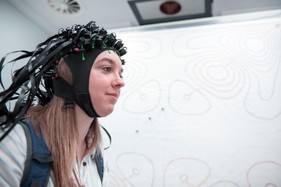
And researchers at the University of Nottingham aim to develop a helmet-like device to help pinpoint the source of epileptic seizures in children’s brains non-invasively.
The projects are supported by £30.8 million of funding by the Engineering and Physical Sciences Research Council (EPSRC), part of UK Research and Innovation (UKRI).
Four projects were co-funded by UKRI’s Medical Research Council (MRC).
|
Haptic tech turns phones into multi-sensory nature learning tools

Researchers will develop new technology to allow children to experience nature through their smartphones by ‘feeling’ textures such as feathers, fur and tree bark.
Professor Advaith Siddharthan and his team from the Open University have received a share of £8 million from the Engineering and Physical Sciences Research Council (EPSRC), part of UK Research and Innovation (UKRI), to carry out this interdisciplinary research project. In collaboration with:
- University of Edinburgh
- Imperial College London
- Learning through Landscapes.
This is one of 10 projects receiving funding to find sustainable digital solutions to pressing sustainability issues through the EPSRC Sustainable Digital Society call.
By simulating the experience of touching the natural world through haptic technology, the researchers are aiming to encourage and enhance pupils’ sensory explorations of nature. This will support better engagement with, and stewardship of nature, supporting the UK’s United Nations Climate Change Conference (COP26) commitments.
|
Introducing the EDI Resource Bank
 Earlier this year, a new initiative launched as part of STEMM-CHANGE (https://www.stemm-change.co.uk/) at the University of Nottingham, one of the EPSRC’s Inclusion Matters projects. The EDI Resource Bank is an open-access database which brings together materials to support EDI work in a range of HE settings, building on good practice already taking place across the sector. Though originating from a STEMM-focused project, the EDI Resource Bank now includes more than 100 resources (such as reports and initiatives) relevant to work and study across all subjects and disciplines.
The EDI Resource Bank is designed so that anybody working in EDI can contribute to it: this might include guidance they’ve written for staff in their university on how to support students with protected characteristics, for example, or a report on inclusive hiring practices published by a research council that they’ve found useful. Through an intuitive, straightforward portal, users can quickly locate information which will help them in planning and developing their own work towards breaking down barriers and creating more inclusive practice. As EDI practitioners contribute to the Bank, so the Bank will come to reflect the changing questions, concerns, and priorities of the EDI community itself.
We invite you to take a look at the EDI Resource Bank today, via the link below. Please also help us build the database even further by submitting resources that you’ve developed or would recommend to others working in EDI!
Have your say!
 |
|
EPSRC are keen to better understand the recipients of this newsletter and would appreciate if you could spare 5 minutes to complete a quick survey for us. There is also an opportunity to let us know which parts of this update you appreciate the most and anything you’d like to see in the future. |
|
|
|
|
|
Heathcare Technologies Grand Challenges Update
The Healthcare Technologies grand challenges have been updated, following consultations with members of the community. The four main changes include;
- Changes to titles to better encompass what the grand challenge is about.
- Updates to the grand challenge description to address any gaps and make them more relevant and inclusive.
- Updates on research descriptions to include new areas of direction.
- Inclusion of case studies, to demonstrate the research funded under each grand challenge.
Updated versions are now live on our website.
We welcome feedback on the updated descriptions, please contact:
Katherine Freeman (Katherine.freeman@epsrc.ukri.org)
Jeanine Woolley (Jeanine.woolley@epsrc.ukri.org)
Refresh of the EPSRC Early Career Forum in Manufacturing Research
EPSRC is seeking applications from Early Career academics to join the Early Career Forum in Manufacturing Research for a three-year term. We are looking to recruit 10 new members in this exercise.
Members will have access to a range of tailored events and opportunities, which have previously included:
• Networking and idea-sharing with all other Early Career Forum members.
• Discussions, networking and mentoring opportunities with senior academics and industrialists from the Manufacturing the Future theme and beyond.
• Insight and mentoring into EPSRC processes and procedures, including various EPSRC grant awards and the associated peer review processes.
• Developing working relationships with EPSRC.
• Joint sessions with the EPSRC Manufacturing the Future Strategic Advisory Team.
Application is by Expression of Interest, submitted via the smart survey linked on the opportunity webpage by 4pm on 22 July 2021. Eligibility follows standard EPSRC rules for research grants and is limited to UK Higher Education Institutions. A brief institutional statement of support is required.
|
|
|
|
Strategic Advisory Team Recruitment
 We are recruiting for our Strategic Advisory Teams (SATs), welcoming applications 3rd June – 29th July 2021. This year, EPSRC has vacancies in the following advisory groups: Capital Infrastructure, Digital Economy Programme Advisory Board (PAB), e-Infrastructure, Energy Strategic Advisory Committee (SAC), Engineering, Information Communication Technologies, Manufacturing the Future and Mathematical Sciences. We welcome applications with a diverse range of expertise and experience from across academia, industry, users of research, and individuals working in the third sector and government organisations. SAT members are chosen for their range of perspectives across key stakeholder groups.
Diverse representation within our advisory bodies is important to ensure we include a range of opinions and viewpoints in our decision making. Appointments to the advisory teams are made primarily on merit and we are keen to obtain greater diversity across the membership. We particularly encourage applications from women, from people who identify as an ethnic minority, people with a disability, and other groups who are currently under-represented. We welcome applications from people based in all regions and nations of the UK.
The SAT members recruited this year will serve an initial 3 year term, beginning in January 2022. Specific vacancies will be detailed on the SAT vacancies page of EPSRC’s website when the advert opens on 3rd June. For further information about the role of a SAT member, please see the SAT terms of reference page of our website.
Materials for Quantum Survey

EPSRC invite you to help us understand the opportunity spaces in materials science, in areas which hold the potential to underpin the delivery of next generation Quantum Technologies. We are looking to gather evidence in these areas, and an indication of the key challenges to development of these scientific frontiers, to support the development of future opportunities.
The responses to this survey, developed collaboratively across the EPSRC Advanced Materials, Physical Sciences and Quantum Technologies teams, will help shape our future strategic thinking in this space.
Individual responses to the survey will be treated in confidence and will not be shared outside of EPSRC. The survey closes on 30 June 2021. and comprises 22 questions, taking approximately 15 minutes to complete. If you have any questions or concerns in relation to completing this survey, please contact materials@epsrc.ukri.org.
|

|
|
|
|
|
|
Civil nuclear research with Japan: phase 8
Apply for funding to research challenges in civil nuclear energy relevant to Fukushima and Sellafield.
You must be a UK-based researcher employed by an eligible research organisation.
You must collaborate with Japanese researchers.
Closing Date: 1 July 2021
Digital technologies for health and care
Develop research ideas for novel digital technologies to monitor, diagnose and treat the population remotely.
You can be from any research area and must be eligible for EPSRC research grant funding.
The first stage of the process is a ‘sandpit’ event. In this three-day online event you will work with other researchers to develop ideas for proposals.
Closing Date: 21 July 2021

|
|
|
|
Protecting citizens online complementary projects: outline stage
Apply for funding to research the needs of citizens online, help them control how their data is used and protect them from online harms.
Proposals must be submitted by a team of investigators from a mix of disciplines.
You can apply if you are based in the UK.
Closing Date: 6 July 2021
Embedded research on UK climate resilience
Apply for funding to do an ‘embedded researcher’ project. This is a research placement at a non-academic organisation. You’ll support the sharing of knowledge between academics, decision-makers and practitioners.
You must be a UK-based researcher employed by an eligible research organisation.
Your project must focus on climate resilience in the UK.
Closing Date: 22 July 2021
|
|
|
|
Adventurous energy research for a sustainable net zero: outlines
Apply for funding for high-risk research into technologies to enable a sustainable net zero.
You must be a UK-based researcher employed by an eligible research organisation.
Holders of postdoctoral fellowships are not eligible to apply.
This is an outline stage. If you’re successful, we will invite you to interview.
Closing date: 8 July 2021
Develop digital economy research communities with NetworkPlus
Apply for funding to build digital economy and manufacturing research communities with NetworkPlus. These must address one of the EPSRC digital economy theme priority areas.
The following can apply:
UK higher education institutions
research council institutes
UKRI-approved independent research organisations
public sector research establishments
NHS bodies with research capacity.
Closing Date: 29 July 2021
|
|
|
|
|
|
EPSRC Quantum Technologies Community Webinar

Registration is now open for 'EPSRC Quantum Technologies Community Webinar’ on 1st July 2021 at 13:00-15:00.
The Quantum Technologies Joint Heads of Programme, Anke Davis and Katharine Dunn, will give a 45-minute talk alongside Deputy Director for Cross Council Programmes Liam Blackwell. This will be followed by up to an hour of Q&A with members of the Quantum Technologies team. The talk will cover EPSRC’s strategy and vision in the field, as well as upcoming funding opportunities. All are welcome to attend; however, we would like to particularly encourage those who have had limited interaction with the team previously.
Registration will close 22nd June. If you have any further questions, please contact: QuantumTechnologies@epsrc.ukri.org
|
Northern Power Inclusion Matters Workshop

Durham University are holding an online Diversity and Inclusion workshop taking place on Wednesday 26 May 2021 ‘Making Inclusion Matter – An Evidence Base from the Northern Power Inclusion Matters Project’.
Durham University led a 2 year research project focussed on increasing diversity in Engineering and Physical Sciences (EPS) with 8 Northern University partners and 8 industry partners including Siemens, Stanley Black and Decker and Arup. We designed, implemented and evaluated a range of activities to support the development of people traditionally under-represented in EPS.
This free, online workshop promises to be an inspiring and informative day, designed to support Higher Education and Industry professionals in retaining and developing diverse communities of people within their organisations, and assist Early Career Researchers in their personal development.
Come and join us as we share what we did, what we found and listen to inspiring speakers and panels. With sessions relevant to EDI, HR and Organisation Development professionals, and Early Career Researchers this promises to be a day with something for everyone. We will also share with you some practical resources including a free, practitioner toolkit designed to support you in implementing similar activities within your own organisation.
|
|
|
|