Improving Flood Resilience Across Devon
January 2026
 Happy New Year and welcome to the first edition of the DRIP newsletter for 2026!
As we begin a new year, we want to take a moment to celebrate DRIP's achievements over the past year. From installing a range of innovative Natural Flood Management (NFM) solutions and advancing diverse monitoring techniques to earning awards and engaging communities across Devon through education and outreach, DRIP and partners have made incredible progress.
In honour of World Wetlands Day, we're also spotlighting the vital role wetlands play in our planets health - supporting biodiversity, providing livelihoods, managing floodwater, and acting as powerful natural carbon sinks.
We're excited to continue inspiring, empowering, and building the resilience of even more communities across Devon and beyond in 2026. Here's to a year of confidence, collaboration, celebration, and climate resilience.
We hope you enjoy the read!
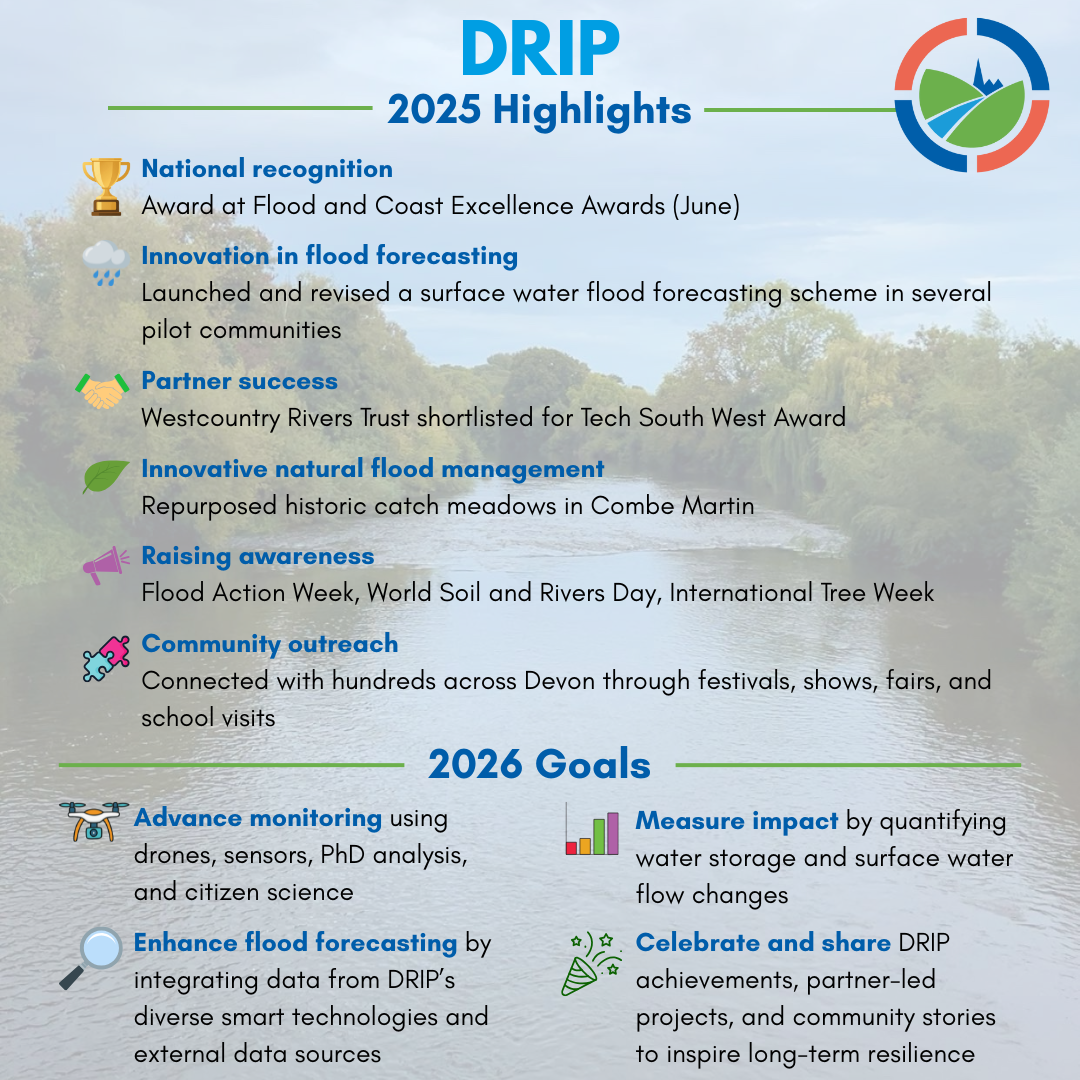
2025 Reflections and Looking Towards 2026
A Year of Progress and Our 2026 Vision
2025 was a fantastic year for DRIP, thanks to the support of our partners, communities, and landowners across Devon. Together, we've taken positive steps towards building flood resilience. Take a look at our key milestones from this year and our goals as we look towards 2026.
Project Partner Stories
Culm Project Inspires Climate Resilience Conversations
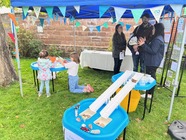
Our partners Blackdown Hills National Landscape proudly showcased the Connecting the Culm project at the Autumn Festival in Cullompton. It was a fantastic day, with around 150 community members engaging at their stand, sharing knowledge, and driving valuable conversations about climate change, the importance of nature-based solutions in addressing its impacts, and the future of the River Culm. These discussions highlighted how the river and its catchment can be safeguarded through innovative, natural approaches. The day was a huge success!
Visit the Connecting the Culm project website to learn more.
|
Award Nomination: Cutting-Edge Community Engagement Tool
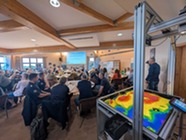
A huge congratulations to our partners Westcountry Rivers Trust for their award nomination at the Tech South West Awards! Their innovative and interactive Augmented Reality Sandtable has been a powerful tool for engaging and educating communities across the South West. This engagement tool offers a practical way to explore and discover catchment-wide opportunities for flood resilience. Its success in captivating audiences has been recognised through this nomination, and we are proud to support such a fantastic project and tool.
|
Miyawaki Forest Takes Root in Torbay

As well as engagement successes, there have been exciting advancements in nature-based solutions within a more urban setting. Torbay Council teamed up with pupils at Watcombe Primary School and SWISCo to plant 700 native trees across 20 different species on the school grounds. The trees were planted using the Miyawaki method - a technique that creates a dense, fast-growing mini forest delivering multiple benefits including:
-
Improved flood resilience through enhanced water uptake by tree roots and soil
-
Greater biodiversity and new wildlife habitats
- Cleaner air quality
- Carbon capture
-
More greenery on school grounds, supporting health and well-being.
Their video (linked below) showcases how this initiative has connected students with nature while providing a natural approach to climate adaptation, enhanced flood resilience, and environmental education and awareness. We are excited to watch this forest grow and see the positive impacts it brings to local communities, the school, and the natural environment.
Torbay Council also plans to create a second Miyawaki forest, and we look forward to seeing these inspiring projects come to life across Torbay and further afield in the future.
To learn more, head over to the full story on the DRIP website.
|
NFM in Action at October Board Meeting
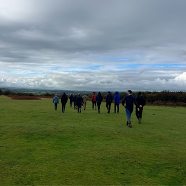
Back in October, the DRIP team and project partners visited Dartmoor for our quarterly Board meeting to explore Natural Flood Management (NFM) features within the catchment. Working closely with local landowners, DRIP partners Westcountry Rivers Trust have created a network of scrapes and leaky dams, alongside improved soil management practices, to reconnect the river with its floodplain and enhance upstream water storage. It was inspiring to see how this collaborative, nature-based approach can strengthen local flood resilience.
The day brought heavy rain (perfect for showcasing the NFM in action!), and Dartmoor did not disappoint with its stunning views once the skies cleared.
|
Nature's Wonderlands
World Wetlands Day 2026
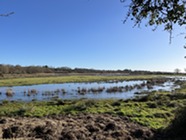
Every year on the 2nd of February the world celebrates wetlands and highlights the importance of conserving and restoring these vital ecosystems.
These incredible ecosystems store carbon, regulate water, support livelihoods, and are rich in wildlife. This year’s World Wetlands Day theme celebrates cultural heritage and traditional knowledge in sustaining wetlands. DRIP values local community knowledge and experience, integrating it into our work - aligning well with this year's theme.
We are also working with partners to re-wet landscapes and reconnect floodplains, creating natural wetland habitats that strengthen flood resilience through water storage, increase biodiversity, and improve water quality. We are proud to champion both the importance of wetlands and community, not just on World Wetlands Day, but every day.
Join us in February to celebrate - updates and details will be posted on our social media, so follow and stay tuned!
To get involved you could:
-
Visit a local wetland to experience its biodiversity and learn why it matters
-
Volunteer with organisations dedicated to wetland restoration and conservation
-
Raise awareness by sharing your support for wetlands in conversations or on social media
-
Join activities such as guided wetland walks, clean-ups, and bird/wildlife trips.
|
Drone Perspectives: NFM Insights from the Sky
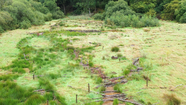
Our PhD students are working hard to capture the promising changes that Natural Flood Management (NFM) installations bring to a landscape. From environmental co-benefits such as enhanced biodiversity and carbon storage to reduced surface water runoff, improved water quality, and greater infiltration, NFM presents itself as a powerful tool for strengthening the resilience of rivers, catchments, and communities to the impacts of climate change.
Watch the amazing drone footage captured by PhD student Mehdi Bagheri-Gavkosh and discover how NFM is helping rewet the landscape, restore the river's natural flow and condition, and create space for wildlife at our Tattiscombe site.
|
Flood Resilience Through Research: NFM Study Published
As climate change intensifies, Natural Flood Management (NFM) is emerging as a powerful tool for building resilience in communities and natural ecosystems. Interest in NFM is growing quickly among scientists, landowners, and policymakers, with data-driven research key to unlocking the full potential of these nature-based solutions.
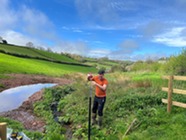
Our DRIP PhD student Mehdi Bagheri-Gavkosh (pictured above) is advancing this research field through both his monitoring and a recent collaborative publication with the University of Exeter. The study reviews current evidence, identifies research gaps, and reinforces a key message: there is no one-size-fits-all approach to NFM. Success depends on tailoring these natural solutions to the unique characteristics of the catchment they sit within.
This research supports DRIP's mission to effectively deliver and promote NFM across Devon, helping create connected networks of NFM features that boost local biodiversity and strengthen community flood resilience. As we look to 2026, healthy and naturally functioning landscapes will be central to the resilience movement. We are excited to see the movement building and proud to help drive it forward.
|
Dates for Your Diary
Book your place at:
Connecting the Culm Forum
When: Thursday 26th March, 7-9pm
Join for an interactive evening of inspirational speakers, engaging discussions, and networking opportunities. Discover how farming practices that focus on soil health can benefit our water systems, support wildlife, and strengthen local community resilience.
Devon Community Resilience Forum (DCRF)
When: Thursday 26th March, 10am-4pm
Come and explore a variety of stands and displays from organisations involved in resilience planning, emergency response, and recovery. It's a great opportunity to learn, connect, and discover practical ways to strengthen the resilience of your community. Booking will open soon, so stay tuned for upcoming details!
Future Focus Weeks and Newsletter Editions
Stay tuned for a series of upcoming Focus Weeks! You can follow these campaigns, along with flood-related tips, project updates, and useful information, on our social media channels (linked below).
January: Smart Technology and Digital Tools for Resilience
February: Wetlands Week
March: Treescapes for Water Management
Follow us on social media:
Next Newsletter: April 2026
DRIP is part of the £200m Flood and Coastal Innovation Programmes, managed by the Environment Agency
|