October 2025
The government has said that Devon’s current two-tier council system, which sees services split between the county council and eight district councils, must change.
They want simpler 'unitary authorities' to be responsible for all local services in one area, so that they are more efficient and responsive.
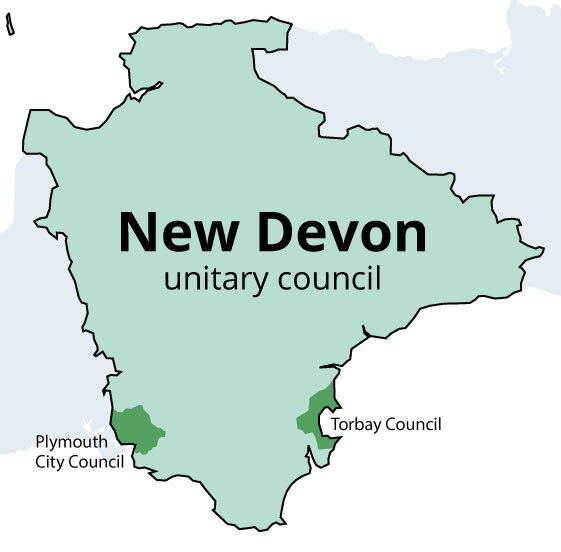
Our leading option is to create a single unitary ‘New Devon’ to replace the current two-tier system of eight district councils and the county council, and work alongside Plymouth and Torbay’s existing unitary authorities.
It is the most logical option for a simpler, stronger and more resilient Devon and comes after many months of extensive research, community engagement, and expert advice.
A new single unitary council for Devon is the best way to protect vital services, give Devon a stronger voice, and avoid unnecessary disruption.
It would make local services easier to manage and more resilient so that they can support those who need it most.
It would also give communities a stronger voice, bringing together representatives from town and parish councils, the police, health services, and other local organisations to help shape decisions.
Shaped by you
Our leading option of a single unitary council isn’t just about changing structures, it’s about building a stronger, more responsive Devon, shaped by the people who live here.
We’ve been out across Devon speaking with residents, and your feedback has been vital in shaping and supporting our leading option to create a single unitary ‘New Devon’.
 More than 7,500 of you have shared your views, either through our online survey or at one of our 27 roadshow events over the last few months. Thank you!
Lots of your feedback strongly supports the principles behind our leading option. Here’s what you told us:
You want decisions made locally and services to reflect local needs
- "Local people, local knowledge, local decisions."
- "We need to feel part of Devon, for which we are proud to live in."
- "Residents want to feel properly represented in decisions."
Many residents told us they want transparency, fairness, and stronger local representation. Concerns about decisions being made too far from home, especially in rural and coastal areas, were common.
Our leading option to create a single unitary ‘New Devon’ takes this into account and introduces Neighbourhood Area Committees to ensure local priorities are heard and give town and parish councils a stronger voice to shape decisions.
The proposed model keeps existing boundaries and celebrates what makes each place unique. Services would be shaped around local strengths and identities, helping communities thrive.
You want simpler, better, more accessible services
- "The less bureaucracy, the better."
- "One system to tick all boxes."
- "We need joined-up thinking."
You expressed frustration with the complexity of the current two-tier system and asked for more joined-up services that are improved with better coordination and investment.
A single unitary council for Devon would mean all services under one roof, in one system and with one point of contact, making it easier to access the services you need.
Simpler governance would also protect and enhance these services, ensuring they remain accessible and responsive to local challenges and opportunities.
You want better value for money and fairness across Devon
- "We pay huge amounts in council tax but get nothing."
- "Northern Devon must not be forgotten."
- "We need local connections, services and representation."
Concerns were raised about overlap, bureaucracy, and stretched resources, and residents in Northern and rural Devon told us they often feel overlooked.
A single unitary council would make smarter use of resources by reducing duplication, improving efficiency, speeding up delivery and freeing up more funding for frontline services.
Our leading option also recognises the unique identify of Devon's communities, and the challenges of rural areas, aiming to balance investment across the county, not just in urban centres.
A new Devon unitary authority could bring a range of improvements for residents, communities, and public services across the county. Here’s how:
-
Easier access to services: A “one front door” approach would make it simpler to access council services online, by phone, or in person.
-
Smarter use of resources: Joining up services would improve value for money, speed up delivery, and support economic growth and housing.
-
Empowering communities: Services would be shaped around local needs and strengths, helping communities thrive.
-
Financial resilience: Streamlining services would reduce duplication, close budget gaps, and deliver savings within two years, without high transition costs.
-
Local democracy protected: Town and parish councils would remain central, keeping decisions close to communities.
-
More responsive and agile: Simpler governance would help the council act quickly in response to local challenges and opportunities.
-
Protecting vital services: Children’s services, SEND support, adult social care, and public protection would be safeguarded and improved.
-
Stronger workforce: A single authority would attract and retain skilled staff, offering more stability and career development.
-
Better partnerships: Closer collaboration with the NHS, police, and voluntary sector would improve outcomes and reduce risks.
-
Respect for local identity: Devon, Plymouth, and Torbay’s unique identities and boundaries would be preserved and celebrated.
-
Minimal disruption: The transition would be carefully managed to ensure clarity and continuity for residents.
What next?
Final proposals need to be submitted to government by Friday 28 November. The Secretary of State will then decide which one(s) will go to statutory stakeholders for consultation during the first half of 2026.
A final decision is expected to be made in the summer, following which any required legislation needs to be passed before a shadow authority is created in 2027, with the new authority ‘vesting’ or commencing from 2028.
|