September 2025
Welcome to our special Stoptober edition of the Smokefree Devon Alliance Newsletter!
This year’s Stoptober campaign from Stop for Life Devon runs from 18th September to 31st October, combining a targeted communications strategy with a wide range of community-based activities.
The campaign includes a “Stoptober Pledge” phase to encourage early sign-ups, followed by a sustained effort throughout October to support residents in setting quit dates and accessing free stop-smoking services.
The team are attending events across Devon, from colleges and foodbanks to community fairs and workplaces, ensuring visibility and accessibility of support.
The campaign also includes targeted outreach to priority groups, including young adults, people in low-income areas, and hosting tailored sessions at venues such as the Freedom Centre and CoLab Exeter.
Communications are being delivered through paid and organic social media, weekly blog updates, and direct outreach via email and SMS.
By working with local partners, GPs, and community organisations, we’re making it easier for people across Devon to access stop-smoking support.
If you want to help to support Stoptober and are looking for materials to share on social media, please access DHSC resources here - Stoptober 2025 | Campaigns | Campaign Resource Centre (dhsc.gov.uk)
If you want to find out more please contact your relevant healthy lifestyles organisation:
• Devon County Council Residents: Stop For Life Devon
Devon Stop Smoking Service | Devon County Council Stop Smoking Service Provided by Best You (stopforlifedevon.org)
0800 122 3866
• Torbay Council Residents: Your Health Torbay
Stop Smoking - Your Health Torbay
01803 422 422
• Plymouth City Council Residents: One You Plymouth
Quit Smoking | One You Plymouth
01752 437177
The problems with physical health that smoking causes are well documented, but there can still be misunderstandings and myths about the relationship between smoking and mental health & wellbeing
Stress – some people smoke as a way of ‘self-medicating’, believing that it helps relieve stress. However, the immediate feeling of relaxation that nicotine can produce is short term only, and withdrawal & cravings are soon experienced. Another cigarette reduces the nicotine withdrawal & cravings, but it doesn’t help to deal with the underlying causes of stress
People with poor mental health are at higher risk of smoking and becoming addicted to nicotine. Smoking can also increase mental illness symptoms including:
- Depression
- Anxiety
- Psychiatric symptoms
- Attention deficit hyperactivity disorder
Tobacco can also reduce the effectiveness of mental health medications
There is a lot of support available to help smokers quit. It’s never too late to give up, and can reduce your levels of stress, anxiety and depression in the long term. Get support from Stop for Life Devon
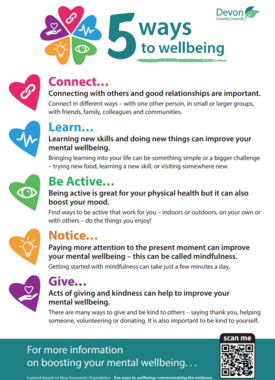
The 5 Ways to Wellbeing are simple steps we can all take to improve our mental wellbeing, and resilience. When giving up smoking, these small steps can help to understand & manage the symptoms of withdrawal, as well as build new habits into daily routines to support positive mental wellbeing
-
Connect – get support from friends & families, and people who can share tips for quitting
-
Learn – get a new hobby, or learn a new skill. These can help build self confidence as well as distract from cravings and old habits
-
Be Active – being physically active will help improve sleep, release mood boosting chemicals, and reduce stress
-
Notice – paying attention to the moment, sometimes called mindfulness, can help increase positive feelings, and understand thoughts.
-
Give – being kind to others is important, but being kind to yourself is important too. Giving up smoking can be hard, so celebrate the successes!
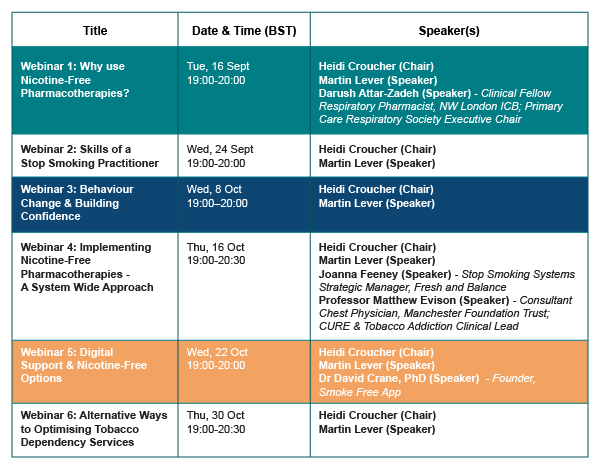
 SCAH are delighted to invite you to our free upcoming promotional six-part webinar series titled Conversations to Cessation (C2C). This series is designed to deepen your knowledge of smoking cessation through nicotine-free alternative therapies. Whether you are a stop smoking advisor, a prescriber in primary or secondary care, or involved with Patient Group Directions (PGDs), these webinars may help strengthen your practice.
Led by expert speakers Martin Lever (Smoking Cessation & Health Conference Joint Lead Convenor) and Heidi Croucher (Founder & Lead Convenor of SCAH), the series offers valuable insights into innovative approaches to treating tobacco dependence, with the goal of improving patient outcomes and transforming clinical practices.
 |
|
|

This Stoptober we are highlighting the fire risks associated with smoking around emollient skin creams and the emerging dangers posed by lithium-ion batteries in vapes.
Smoking and Emollient Creams – a dangerous combination
In our communities, many people are using emollient creams to manage dry skin conditions such as eczema, psoriasis, or pressure sores, which are often prescribed for daily use. This can be particularly relevant for those who are older or less mobile individuals. While these are very beneficial for medial purposes, they do come with associated risks when they are used in conjunction with smoking or high temperatures. This is because while these creams are not always flammable in their container, the residue from these creams when they are used soaks into clothing, bedding, bandages and furnishings which creates a highly flammable environment. This means that naked flames, or ash from a cigarette can cause ignition, which can pose an enormous fire risk to all of those involved.
Tragically we have seen a number of incidents where individuals have been seriously injured or worse, from smoking while using emollient creams.
Our advice:
-
Avoid smoking cigarettes or materials requiring a naked flame if you are using emollient creams – This is especially important when using emollients in bed or when wearing clothing that may have absorbed residue from the product.
-
Wash clothing and bedding regularly and separately to other items - to reduce build-up of cream residues. Always ensure you follow the manufacturers guidance on how to wash your items safely. Ideally washing at a higher temperature can remove emollient, but it may not be fully removed even after washing.
-
Avoid any open flames such as candles, lighters, open fires etc – open flames can cause emollients residue to ignite and cause a fire.
-
Keep your distance from portable heaters – avoid sitting too close to heat sources such as portable heaters.
-
Avoid cooking where possible when wearing clothing that could have emollients residue on them – being too close to a hob or grill can increase the risk of your clothing catching fire.
|
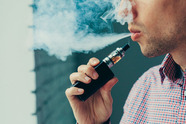
Increased use of e-cigarettes and vapes - staying safe with lithium-ion batteries
As many people are switching from smoking to e-cigarettes or vaping, it's important to be aware of the new fire risks that are associated with the increasing popularity of these devices. These devices contain lithium-ion batteries and if not handled properly, these batteries can pose serious fire risks.
We've seen an increase in incidents where e-cigarettes and vapes have caught fire or exploded, which is often due to:
- Rapid overheating
- Overcharging
- Damaged or faulty batteries
- Exposure to high temperatures
Our advice for vapers:
Vaping might reduce some health risks compared to smoking, but it comes with its own fire hazards. Faulty or counterfeit devices can cause serious fires.
Here’s what to check before buying or using a vape:
- Matching voltage – the charger and battery should be rated for the same output.
- Clear branding – make sure it includes a manufacturer’s name, logo, model, and batch number.
- CE mark – look for it but be cautious; it can be faked.
- UKCA mark – is used to demonstrate compliance with UK safety regulations. Vapes should have both the CE and UKCA mark.
- Safety instructions – the product should come with clear guidance on use and disposal.
- Disposal – never throw vapes or batteries in household waste. Follow proper recycling procedures.
- Avoid fakes – cheap, unbranded products might not meet safety standards.
General safety advice for charging your vape:
- Charge your devices and equipment during the day, instead of at night while you're sleeping, and ensure they're charged away from escape routes.
- Unplug your device after charging and use manufacturer-approved chargers.
- Avoid charging on soft, flammable surfaces, like bedding.
- If a battery shows signs of overheating, swelling or other forms of damage do not use the battery. Dispose of it appropriately and report the defect to the manufacturer.
- Only purchase your device and charging equipment from a trusted seller and check product reviews.
- Recycle your electrical items with care. See the information on the Recycle Your Electricals website to find your nearest recycling centre.
For more information, please visit our website: www.dsfire.gov.uk
|
Here at the Royal Devon we have the Tobacco Dependency Team who can help staff and patients quit. We also have Maternity Smoking Advisors who support people who are pregnant to quit.
To kick off Stoptober, Geoff Williams (Treating Tobacco Dependency Support Worker) will have a stand in the TLC restaurant at RD&E Wonford from 12 – 1.30 on Wednesday 1 October. You will be able to find out your carbon monoxide readings and pick up chocolate and fruit for that alternative dopamine hit! Plus you’ll be able to get tips and tricks to help you quit smoking for good.
For free support from our Tobacco Dependency Team contact Steph and Geoff on 01392 406133 or you can refer patients through Epic.
You can contact the Maternity Smoking Advisor by calling 01392 406301
Let's quit smoking together.
Smokefree Devon Alliance Website
We are reviewing and updating our website to improve it as a source for professionals. Welcome to Smokefree Devon - Smokefree Alliance Devon
Any comments on how the website could be improved are welcome please send comments to publichealth-mailbox@devon.gov.uk
The newsletters will be shared on our www.smokefreedevon.org.uk/ website to be accessible to all in the future. Alliance newsletter - Smokefree Alliance Devon (smokefreedevon.org.uk)
|