Improving flood resilience across Devon
July 2025
Flood and Coast Excellence awards, 2025
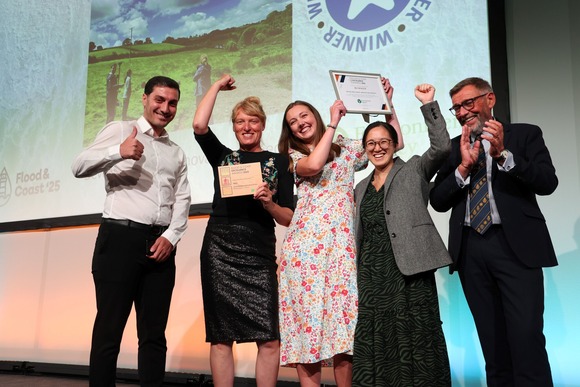
We are excited to share that DRIP has won an award at the Flood and Coast Excellence awards, in the Surface Water Management category. This award recognises the work we have carried out in one of our pilot project communities, Stokeinteignhead, to increase community resilience to flooding. This has involved natural flood management, property flood resilience and a trial surface water flood forecasting alert system. We would like to thank the community and landowner who have been engaged throughout, and the partners we have worked with: University of Exeter, University of Plymouth, Westcountry Rivers Trust, Kisters and JBA consulting. As part of our award submission, we created a new video about our work in Stokeinteignhead, discussing the impact on the community one year later.
Site visit for April DRIP board meeting
 |
|
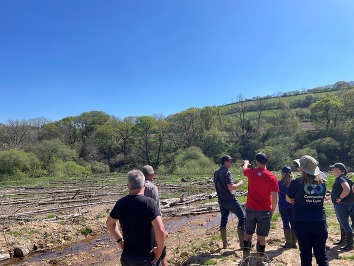
At the April DRIP board meeting, we held a site visit to see the works completed at the Tattiscombe site, led by the North Devon National Trust team. It was great to see how the site is developing since this innovative project to re-connect the floodplain and create a wetland environment was complete. This site is being monitored by our PhD students so we are looking forward to seeing the results of this work. |
This project is joint funded by DRIP and the Government's Species Survival Fund. The fund was developed by Defra and its Arm's-Length Bodies. It is being delivered by The National Lottery Heritage Fund in partnership with Natural England and the Environment Agency.
2025
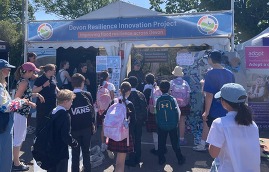
We had a fab time at the Devon County Show, held from 15-17th May at Westpoint Arena. Two of our partners, Westcountry Rivers Trust and Plymouth City Council, joined us on the stall to showcase the range of engagement activities that have been developed throughout the project. Visitors enjoyed playing the ‘Slow the Flow’ water game, exploring the augmented reality sandtable, and crafting puddles to add to our display. We spoke to over 900 people across the three days about how to reduce surface water run off in homes, gardens and the wider landscape, and how to increase their resilience to flooding.
|
Westcountry Rivers Trust (WRT)
Follow the link on the button below to watch the video produced by Westcountry Rivers Trust, talking about their work in rapid response catchments across Devon. Rapid response catchments are landscapes that drain quickly, making them especially vulnerable to flash flooding. These sudden events can damage property, disrupt transport, and pose risks to life. To help address this, WRT are working closely with landowners and communities to implement nature-based solutions that slow the flow of water, reduce flood risk, improve ecology, and build healthier, more climate-resilient catchments
Using historic features for Natural Flood Management (NFM)
NFM strategic group site visit to Stokeinteignhead
 |
|
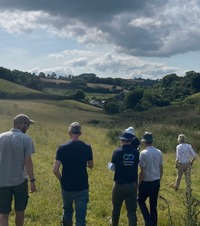
The DRIP team recently hosted a site visit for the Devon, Cornwall & Isles of Scilly NFM strategic group to Stokeinteignhead. The theme of the meeting was to discuss how we can use historic features in the landscape as part of our NFM schemes. Two of examples of this can be seen in Stokeinteignhead, where we worked closely with the County Archaeologist to restore a catch meadow channel and irrigation leats, to increase community resilience to flooding. |
Gale Alexander (Devon County Council) and Charlotte Squire (Devon Communities Together)
Two members of the DRIP team have recently delivered webinars for the Centre for Water Systems at the University of Exeter.
Charlotte Squire delivered a seminar titled: Devon Resilience Innovation Project (DRIP) stakeholder engagement. You can watch her seminar here.
Gale Alexander delivered a seminar titled: What is resilience now? How do we transition from them to us? You can watch her seminar here.
For more regular project updates, follow us on Instagram @devonfloodresilience and Facebook /devonfloodresilience.
DRIP is part of the £200m Flood and Coastal Innovation Programmes, managed by the Environment Agency
Next newsletter: October 2025
|