|
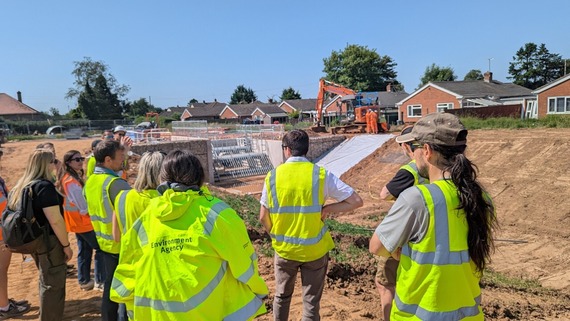
Flood and Water Management Group site visit to the newly installed Flood Alleviation Scheme in Feniton, East Devon
An update from Devon County Council’s Flood and Coastal Risk Management Team.
Find out about what we have been doing over the last 6 months as part of Devon’s Local Flood Risk Management Strategy.
To be a leading authority in the management and reduction of flood risk in the County of Devon. We will work efficiently and collaboratively with our partners and engage with communities to make Devon more resilient to flooding and ready to adapt to climate change by promoting sustainable flood risk management and using natural solutions where possible.
Our team has recently grown. We were excited to welcome our new Flood and Coastal Risk Management Support Officer in April and will be joined by a new Assistant Flood and Coastal SuDS Officer this month.
Following the Local Elections on 1st May, there is a high proportion of newly elected Members, who may not be familiar with Devon County Council’s role in flood risk management. The Flood and Coastal Risk Management team fulfils DCC’s role as the Lead Local Flood Authority. We have several duties under the Flood and Water Management Act 2010, many of which are covered in this newsletter. If you would like to find out more about what we do, please visit our website to find out more. You can also see what we are doing in your area as part of our annual action plan, which forms part of our Local Strategy.
On 3 June of this year the government launched an 8-week consultation on its Investment Reform, which proposes a major update to the current Partnership Funding policy for Flood Defence Grant in Aid. This is where all Lead Local Flood Authorities (County and Unitary Councils), District Councils and the Environment Agency obtain funding for carrying out flood improvements and coastal protection measures. The consultation closes on 29 July.
This consultation is asking for feedback on two main proposals:
-
The first is on a proposed simplified approach to funding new flood resilience projects, and
-
The second is a proposed approach to prioritising flood resilience projects.
The consultation also includes a call for evidence on two wider floods investment areas, seeking views on alternative sources of funding to enable government funding to go further as well as exploring opportunities for English devolution to support flood risk management.
We are hoping the new process will increase our opportunities for funding schemes to tackle surface water runoff in many of our rural locations. Achieving a cost-beneficial scheme has been challenging through the current process.
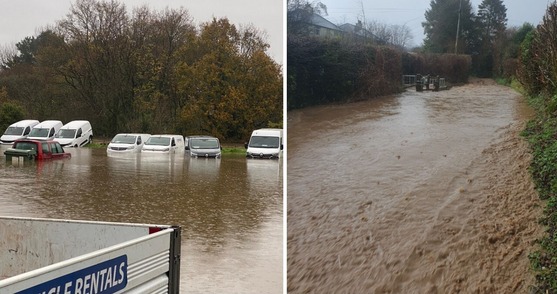
At the end of last year in November, Storm Bert brought significant winds and rainfall to parts of Devon, resulting in the flooding of over 40 properties. Affected areas were widespread across the County, with five commercial units flooding in Newton Abbot and seven residential properties in total in the Lymebridge and Hartland areas of Torridge. In January this year, at least six properties were flooded in the village of Membury in East Devon. When the local threshold is exceeded of over five individual properties flooded in any one location during an event, DCC have a duty to investigate. The team have been busy gathering information from the public and partner authorities and the finished reports will be published on our website.
Left: Flooded industrial units in Newton Abbot, during the event of 24th November (Environment Agency). Right: Bonds Lane, Membury during the flood event of 26th January (Local resident)
As previously reported, the flood prevention initiative originally planned for Colaton Raleigh was temporarily paused following the severe flooding in 2023. This pause allowed us to reassess the scope of the project and extend support to additional properties that were also affected by the flooding – increasing the number of properties from 9 to 25.
To enhance the overall viability and cost-effectiveness of the project, we made the strategic decision to combine this scheme with a separate flood prevention initiative targeting 5 properties in Broadhempston.
By merging the two schemes, we are now able to deliver flood risk reduction measures to a total of 30 properties across both communities. This integrated approach not only maximizes the impact of available resources but also ensures a more resilient and comprehensive response to future flood events.
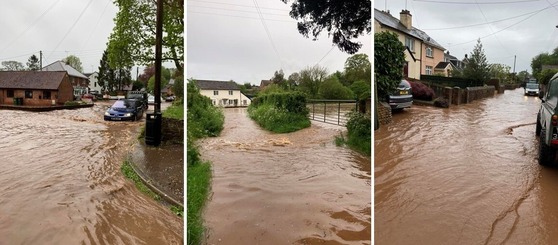
Flooding in Colaton Raleigh May 2023 (local resident)
We are pleased to confirm that the PFR products are now in the manufacturing stage for these two locations and installation is scheduled to begin shortly, with the aim of completing all works by the end of summer 2025. This is very welcome news for the residents who have waited many years to reach this point and have suffered several repeat flooding incidents in the meantime.
The biggest challenge, and reason for the significant delay, was due to the properties being listed buildings and the need to satisfy conservation requirements. As a result, all PFR measures are being custom-made from timber. This bespoke approach ensures that each installation complements the historical and architectural character of the properties, preserving the integrity of these heritage homes. However, this is a time-intensive process, leading to the delay in installation.
Harberton - The baseline modelling exercise is coming to an end, with optioneering ready to commence shortly after. This proactive community is already heavily engaged with us and is keen to move forward with a mixture of Natural Flood Management (NFM), PFR and some small civils improvements. The model will be used to test these prior to any funding application or works commencing.
Kenton Flood Investigations - The baseline modelling is now complete with the report due to DCC by the end of June. We will now commence options testing in the model to attempt to identify cost beneficial, deliverable solutions.
Newton Poppleford - The baseline model for the Burrow Lane catchment is now complete, and the results shared with residents through an in-person engagement session. We are currently in the process of optioneering to determine the most viable and cost-effective engineered solutions. The goal is to progress towards a deliverable scheme that meets the necessary cost-benefit criteria to attract funding through Defra Grant in Aid and Local Levy. Additionally, further NFM measures will be developed through the Environment Agency’s National NFM Programme, particularly the Creating Resilience in the Otter Catchment (CROC) project.
Lydford - A Local Levy bid has been submitted to assist in the delivery of works to better protect 7 residential properties at the old Mucky Duck Pub in Lydford. An existing and significant surface water flow path exists down the steep hill that serves these properties and results in significant internal flooding. If the Local Levy bid is successful, it is proposed to deliver the works this financial year.
Read more about these PFR schemes and other ongoing projects here.
Community flood resilience

Representatives from our team were pleased to attend the latest Devon Community Resilience Forum event at Langtree in Torridge this March, hosted by Devon Communities Together. This was another great opportunity to talk with local community representatives, give advice and signpost to funding and resources to help increase resilience through emergency planning and preparedness. The event focused on the roles of District Resilience Officers, the Police role in flood response and Community Hubs. Attendees also participated in an emergency response exercise for communities. Find out more on the presentations given and topics discussed on the resilience forum website. The next event is due to take place later this year in October in East Devon. Details will follow on the website.
|
Emergency response exercise ‘Preparing for a storm: How would your community respond to an emergency?’
 |
|
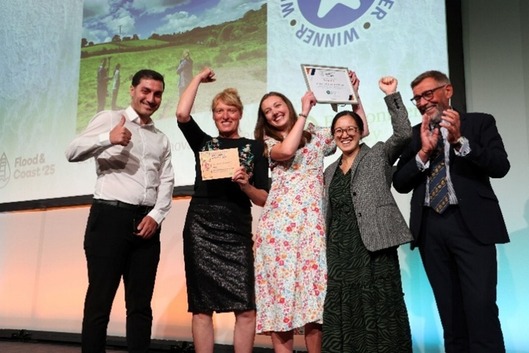
Our DRIP team were excited to win an award at the National Flood and Coast Excellence awards in May. This award recognises the work we have carried out in Stokeinteignhead to improve community resilience to flooding, including natural flood management and a surface water flood forecasting trial. Watch the video about our work in Stokeinteignhead here. |
From left to right: Mehdi Bagheri-Gavkosh (University of Exeter), Gale Alexander (DCC – DRIP project manager), Annabel Beasley (DCC – DRIP project officer), Vivian Pham (Environment Agency), next to the host who presented the award
DRIP is continuing to deliver natural flood management interventions in our target communities across Devon, and trial a range of digital technologies in flood warning and telemetry. We are carrying out extensive monitoring and evaluation of the project as we move into the final two years, with some exciting preliminary data emerging from our PhD student’s research.

Since stepping into the role in January, one of the main priorities of our Marine, Estuaries and Coastal Officer has been a comprehensive governance review of the Exe Estuary Management Partnership. This was prompted by some key shifts that highlighted the need for us to take a fresh look at how the partnership is structured and how we make decisions.
So far, this process has included:
- Researching best practice models from similar partnerships
- Speaking with partners and stakeholders to gather insights
- Reviewing how we manage roles, funding, and community engagement
- Drafting a revised structure aimed at making things simpler, clearer, and more effective
A draft document is now being pulled together that will be shared with the partnership by the end of July.
The Exe Estuary Partnership has really enjoyed continuing to deliver school sessions, offering primary school children an insight into the wonderful world of Estuaries. The broader education offer is being reviewed to ensure it is as impactful and accessible as possible for schools and teachers across the Exe.
Planning is in full swing for this year’s Autumn Forum, taking place in September (date to be confirmed). Our 2025 event will explore two closely linked themes that align with some of our key priorities and how we manage and care for the estuary:
- Local Nature Recovery Strategy (LNRS) – with a spotlight on intertidal and marine habitats
- Codes of Conduct – reflect, review, and refresh how we interact with and within the estuary
Lastly, the future direction of the Devon Maritime Forum is being explored as a result of changes in funding. As we look ahead, we’ll be reviewing the ongoing viability and role the DMF.
|
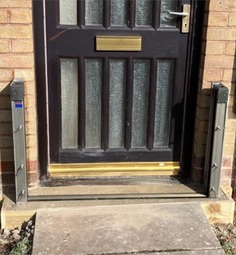
The Devon County Council’s Property Flood Resilience (PFR) funding scheme continues to function as a vital and effective initiative, specifically designed to support individual properties that face a high risk of flooding but are unlikely to benefit from larger-scale, catchment-wide flood improvements.
Offering bespoke flood resilience measures, such as flood doors, air brick covers, and sump pumps, the scheme provides practical, property-level solutions that go beyond the scope of the council’s broader flood mitigation priorities.
Interest and applications for our PFR Funding Scheme continues to be at an all-time high level. Review of applications to ensure that priority is given to those most at need is challenging, especially when taking into consideration the number of communities that have flooded in recent years.
The business case has received formal approval for a two-year period, giving greater certainty for the continued delivery of the programme. It also reinforces confidence within the authority that the initiative will remain operational and effective over the medium term, allowing for sustained progress and measurable outcomes.
|
We hope that the rest of the year will be as dry as possible, but inevitably we are likely to face the impacts of increased intense or prolonged rainfall events.
Being prepared with an emergency kit and plan can help reduce these impacts. The 15th-21st July is Disaster Preparedness Week, the perfect time to think about the actions you can take to prepare if you live in an area at risk of flooding. Find out more about general disaster preparedness here, or flooding specific advice here.
It is important that you continue to report each incident of flooding and flood risk issues because it allows data to be collated to keep track of the overall picture of flooding in an area. Reporting helps authorities to identify recurring issues and can influence maintenance schedules. It can also inform business cases for alleviation works and flood defence schemes, and capture the economic cost of a flood to help attract funding.
Keep up to date with the latest action on the impacts of climate change in Devon, Cornwall and the Isles of Scilly (DCIoS) through the Climate Resilient DCIoS website, which also has the regional climate adaptation strategy and resources. Do also let us know of any stories you have to share!
You can also sign up to the Devon Climate Emergency newsletter.
|