Welcome to our attendance newsletter
We hope this, and future newsletters will keep you informed and up-to-date with news, training and support around attendance. It will also keep you up-to-date with the local authority measures that are being taken to ensure we are all on track with complying with Working together to improve school attendance.
This should be read alongside the statutory guidance documents on parental responsibility measures, children missing education, supporting pupils with medical conditions at school, suspensions and exclusions, alternative provision, summary of responsibilities where a mental health issue is affecting attendance and safeguarding.
We have produced a short video that outlines everyone’s responsibility for improving school attendance, this can be found on our website.
Improving attendance is everyone’s business
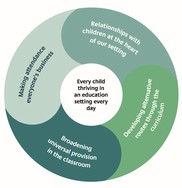
The barriers to accessing education are wide and complex. Some pupils find it harder than others to attend school and therefore at all stages of improving attendance, schools and partners should work with pupils and parents to remove any barriers to attendance by building strong and trusting relationships and working together to put the right support in place.
As schools continue to develop their improvement plans for the next year and take stock of their persistent and severe absence levels, they must use data to identify understand what the challenges are, inside and outside of school, that make attendance at school difficult for some pupils and families.
The foundation of securing good attendance is that school is a calm, orderly, safe, and supportive environment where all pupils want to be and are keen and ready to learn.
|
 |
|
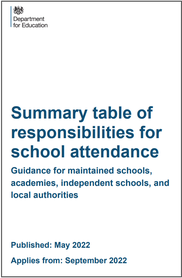
This document summarises the attendance responsibilities for parents, schools, academy trusts, governing bodies, and local authorities which are outlined in the ‘Working Together to Improve School Attendance Guidance’ 2022.
This guidance summary is really helpful to assist colleagues in schools and settings with planning and sharing the importance of attendance related matters with staff and governing bodies. The guidance should be read alongside the statutory guidance documents on parental responsibility measures, children missing education, supporting pupils at school with medical conditions, suspensions and exclusions, alternative provision, and safeguarding.
|
The DfE guidance states that all schools need to have a clear school attendance policy on the school website, which all staff, pupils and parents understand. We have created a Model attendance policy for you to use and adapt to suit your setting.
 |
|
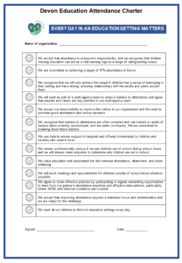
We are asking everyone to pledge their commitment to an education attendance charter , so that everyone is aware of their responsibility for improving attendance.
This charter is not just for staff in education and social care, it includes police, health, community and voluntary sector, local businesses and all local authority staff. Please adopt this charter and share with all your staff as well as upload it onto your organisation’s website.
|

In February the Department for Education released new guidance entitled ‘Summary of responsibilities where a mental health issue is affecting attendance’ Feb 2023.
This document builds on the ‘Working together to improve school attendance’ (2022) guidance and should be read alongside the statutory guidance documents on parental responsibility measures, children missing education, supporting children with medical conditions, suspensions and exclusions, alternative provision, and safeguarding. A list of relevant links to further guidance is available at the end of this document.
The guidance makes clear the expectations placed on school staff as well as academy trustees/governing bodies, parents/carers and Local Authorities (LAs) where there is a pupil experiencing social, emotional or mental health issues that are affecting attendance. This guidance applies to any pupils displaying any social, emotional or mental health issue that is affecting their attendance. It is not only for pupils who have a diagnosed mental disorder, or a disability or special educational need.
The guidance provides a useful summary of responsibilities for parents/carers, school staff, academy trustees and governing bodies as well as the local authority. It also provides examples of effective practice and links to further relevant guidance.
|
As many of you are already aware the Department for Education are trialling getting automatic daily attendance data from schools.
Getting daily attendance data will:
- give schools, local authorities and multi-academy trusts (MATs) access to more up-to-date pupil-level attendance data
- help you meet the new expectations set out in working together to improve school attendance
- not add to your school’s workload
Schools should use the reports to help improve attendance by identifying trends and those pupils who need support, and sharing attendance data with their board, governing body and local authority.
The data will be collected by a company called Wonde.
There will be no costs involved and it will enable you to share your attendance data with us.
Please note the data trial does not replace any data collection currently in place with the local authority. In addition, the data pack due to be released shortly by the local authority will supplement the information provided through this data trial, not replace it.
On 1 March, families of Year 6 pupils found out which secondary school offered them a place for September 2023. But what happens if your child wasn’t offered a place at their top choice school?
Secondary transfer appeals (year 7) and appeals for normal round transfers to studio schools and university technical colleges (year 10).
The deadline for lodging appeals is 31 March 2023 (we will aim to hear these appeals within 40 school days of this deadline).
Appeal hearings are scheduled throughout May and June. Appeals not received by the deadline may have to be heard in September.
Help for Households To help with the cost-of-living crisis the government has launched a website detail a range of support for households. This is available from the link: Help for Households - Get government cost of living support

Code C: Leave of absence granted by the school
Only exceptional circumstances warrant granting a leave of absence. A leave of absence should not be and from certain types of school, must not be, granted unless it has been applied for in advance by the parent who the pupil normally lives with and the headteacher believes the circumstances to be exceptional.
Schools must consider each application for a leave of absence individually taking into account the specific facts, circumstances and relevant background context behind each request.
Where a leave of absence is granted, the school will determine the number of days a pupil can be absent from school. A leave of absence is granted entirely at the headteacher’s discretion.
If the school has arranged alternative provision, Code B should be used – see below
|
|
Code B: Off-site educational Activity
Attending an off-site educational activity that has been approved by the school and supervised by someone authorised by the school.
For pupils of compulsory school age, schools must also record the nature of the activity, examples are:
- attending taster days at other schools;
- attending courses at college;
- attending unregistered alternative provision arranged or agreed by the school.
The educational activity must take place during the session for which it is recorded. Ultimately schools are responsible for the safeguarding and welfare of pupils educated off-site. Therefore, by using code B, schools are certifying that the education is supervised, and measures have been taken to safeguard the pupil. Schools should ensure that they have arrangements in place whereby the provider of the educational activity notifies the school of any absences by the pupil. The school should record the pupil’s absence using the relevant absence code.
This code must not be used for any unsupervised educational activity i.e., when a pupil is at home doing some schoolwork.
|
 |
|
Struggling to complete penalty notice paperwork?
Watch our training videos on YouTube:
|
Safeguarding conference 29 June 2023
SEND conference 8 June 2023
|

