|
Welcome to this week's newsletter, published for adult social care providers, issued on behalf of Devon County Council's Director of Adult Social Care Services and Director of Public Health and NHS Devon’s Chief Nursing Officer.
The vaccination roll-out continues to be a success, but it is just part of the bigger picture in the fight against COVID-19 and we cannot over-emphasise the need for ongoing infection control vigilance.
Remember to make use of the guidance and other advice we do our best to keep up to date on our Provider Engagement website.
Over the coming weeks the second doses of the COVID-19 vaccination will be administered in care homes. Refer to more information on the vaccine on our PEN website. We are therefore encouraging colleagues in care homes to prepare for the second round of vaccinations.
Please make sure your care home has up-to-date lists of all staff and residents, including details of those who were vaccinated first time round, along with those who (for whatever reason) have not yet had a vaccine but wish to have one now (supported by any relevant consent processes).
Locality care home support meetings
During the last year the DCC Market Management Team has held support meetings for care home providers as part of our COVID response.
We have had feedback from providers that they would value meetings on a locality basis. In response to this, we are holding meetings in partnership with assistant directors and other operational and CCG colleagues.
These are currently informal meetings open to all care home providers.
It is an opportunity to hear about market support and to share guidance and best practice.
Next meetings:
- East: Monday 22 March from 9.30am to 10.30am. Joining link.
- West: Wednesday 24 March from 10.00am to 11.00am. Joining link.
If you have any queries or items you would like to have on the agenda please contact us.
New guidance for testing professionals visiting care homes
The guidance strengthens the existing approach for testing professional visitors to care homes in order to reduce risks from their visits. This guidance should be implemented by care homes and professionals by Monday 22 March, if not before.
Care home outbreaks are a reminder of how infectious this virus is
Coronavirus case numbers in Devon are continuing to fall, although the rate of decline has slowed over recent weeks. Positive cases are currently highest in those aged 80 years and older, with rates slightly higher in East Devon.
Cases of coronavirus in Devon may still be low in comparison to the rest of the country, but we're still seeing outbreaks in some settings, including in a small number of care homes, warns Steve Brown, Director of Public Health Devon:
“We are working very closely with those homes to make sure residents and staff are safe, to control the outbreaks, and to reduce the risk of further transmission. Coronavirus is still a very infectious virus, and cases like this are a reminder of how important it is for us still to remain vigilant and to take every precaution to prevent its further spread.”
Watch Steve Brown's weekly update (Friday 11 March) in full here.
A new question on visiting has been added within the ‘Additional Mandatory questions’ section of the infection, prevention and control (IPC) tool for care homes on the CQC website: "Is the service facilitating visits to people living at the home in accordance with current guidance?" Read and find more information about the tool.
The National Care Forum has worked with care providers, residents and relatives’ organisations to develop a set of Partners in Care resources to assist the implementation of the government’s new visiting in care homes guidance.
Care England has also agreed the set of decision-making visiting principles to support care homes with the balance between safety and meeting people’s rights for meaningful contact with loved ones.
When attending your 2nd dose appointments for the COVID vaccine please don’t forget to bring a form of ID ( ie. a driving licence or passport) and proof that you are a frontline health and social care worker (ie. a name badge, letter from your organisation or a wage slip).
NHS England has published an eligibility checklist for health and social care workers that have self-declared for vaccination through the national booking system and arrive at vaccination centres.
New government guidance regarding the ventilation of indoor spaces to stop the spread of coronavirus has been published.
Lateral flow tests show specificity of at least 99.9%
New analysis by NHS Test and Trace shows lateral flow tests have a specificity of at least 99.9 per cent when used in the community.
It's a measure of how good the test is at detecting true negative cases, so for every 1,000 lateral flow tests carried out, there is fewer than one false positive result.
Around one in three people with coronavirus do not have symptoms, which means they could be spreading the virus without knowing. Rapid testing using lateral flow tests detect cases quickly, and all businesses in England can now sign up to the government’s free COVID-19 workplace testing programme.
Community testing sites also offer free rapid lateral flow tests to anyone whose job or volunteering work requires them to leave the house and be in contact with others. Find out more and get a test here.
Households with primary school, secondary school and college-age children, (including childcare and support bubbles), are also encouraged to test themselves twice every week. Home test kits can be collected from national testing centres, or there is home delivery by the NHS for those who can’t collect. Alternatively you can have the test at one of our community testing sites and receive the results within the hour via text and email.
MHRA issued a statement on Monday the 15 March, stating it has not been confirmed that the reports of blood clots were caused by the AstraZeneca COVID-19 vaccine.
Added 'Direct payments and personal health budgets' easy-read (Updated: 11 March 2021)
Added attachment: 'Testing for professionals visiting care homes' (Updated: 11 March 2021)
Added guide to registering test kits for homecare workers (Updated: 10 March 2021)
Explains the additional steps to reduce the risk of catching or passing on COVID-19 in the home (Updated: 10 March 2021)
A short film to allay anxieties and support people with learning disabilities to have the COVID-19 vaccination has been produced by The Turning Tides Project, in partnership with NHS Devon and NHS England, featuring the vaccination site at Lords Meadow Leisure Centre in Crediton.
The government has launched a new social media campaign to tackle misleading and false COVID-19 vaccine information being shared through private message channels and are asking people to follow the SHARE checklist:
• Check - is it coming from an expert?
• Look closely - does the information seem trustworthy?
• Still unsure? Don’t share it
The campaign is fronted by trusted local community figures such as imams, pastors and clinicians in short, shareable videos which include simple tips on how to spot misinformation and what to do to stop its spread, signposting to the NHS for the best source of information.
The NHS in Devon is supporting people from Black, Asian and Minority Ethnic communities to take up a potentially life-saving coronavirus vaccination when they are eligible as part of the national programme.
If you can help reach relevant communities by becoming a vaccination ambassador then please contact NHS Devon via email.
View some of the recent media coverage.
A new film by the NHS in Devon highlights the positive experiences of patients, volunteers and staff across the county’s vaccination centres.
Getting the Coronavirus vaccine - A message from Devon
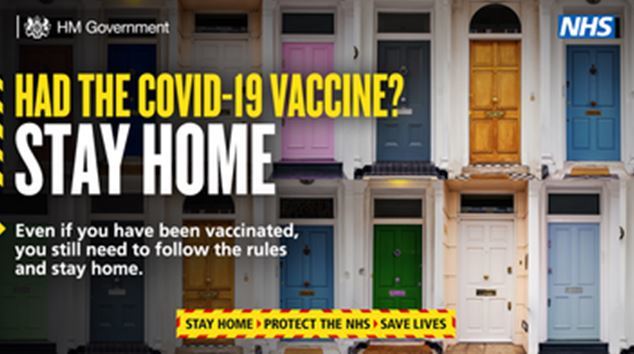
NHS England has produced a series of animated videos, aimed at anyone who has received their COVID-19 jab, to explain why it remains important to follow current infection prevention guidelines after vaccination.
The videos are available in 17 different languages, including Spanish, Hindi, Tagalog and English.
The Care Worker’s Charity (CWC) has launched Mental Health Support for people working in social care.
The CWC are offering up to 10 hours of counselling with a qualified therapist from Red Umbrella for people working in a paid role in the UK social care sector, supporting adult, elderly or disability care, such as:
• Residential care
• Domiciliary/home care
• Supported Living
• Day Care
• Private Care/ personal assistants
You can apply on the charity’s website. Your application will be reviewed within two weeks of submission.
The National Institute of Health Research has commissioned independent researchers at the Birmingham, RAND and Cambridge Evaluation centre (BRACE), to survey care home managers about the use of pulse oximeters and NHS support.
The survey is completely anonymous and can be completed until 6 April. If you’d like more information please contact the study team.
The University of Nottingham has launched a UK-wide clinical trial called PROTECT-CH to identify treatments that can protect care home residents from developing COVID-19.
The study is open to all people living in residential and nursing homes across the UK but to take part their care home must first be part of the study.
If you are a care home manager and want to take part you can complete a short survey
You can read more information about the trial on the PROTECT-CH website
Celebrating success - The Care Company's Painting Projects
The Care Company's Painting Projects started a year ago to combat the negative impact on residents' mental health caused by isolation. The idea was to engage them in activities they would enjoy, bring out their artistic talents and at the same time make it useful and beneficial to the care home. The residents were encouraged to express their feelings through art and here is a selection of paintings by Stevie, Joan, Margaret and Willow (a four year old granddaughter of one of the residents).

Remember to share your good news stories in this newsletter
Revisit previous good news stories
|