 |
|
Did you know the NHS recommends at least 3 hours of daily physical activity for children under 5, and at least 1 hour for those children over 5? Movement isn’t just fun - it’s essential for helping children thrive! |
Why is physical activity so important?
Regular movement supports children’s:
-
Healthy bodies – improving balance, coordination, strength and stamina.
-
Growing brains – boosting memory, focus and problem‑solving skills.
-
Emotional wellbeing – reducing stress and supporting self-regulation after a busy day.
-
Social skills – encouraging teamwork, turn-taking and communication.
-
Confidence – helping children take safe risks and feel proud of new achievements.
What does this mean for wraparound providers?
A recent AXA Health poll showed that British children spend less than 4 hours a week exercising, yet over 14 hours on screens. As Dr John Burke suggests, “…children getting outdoors, playing sport or otherwise being physical, is just as important outside of school hours as it is inside of them.” By weaving small, simple movement opportunities into everyday routines, wraparound settings can create lively, healthy environments where children feel energised and engaged, even when space or winter weather makes things trickier!
Below are some quick, practical ideas to get children moving:
Indoors:
-
Movement zones with scarves, ribbons, soft balls or beanbags for throwing, rolling and catching.
-
Action songs and rhymes (e.g. “Sleeping Bunnies”, “Head, Shoulders, Knees and Toes”).
-
Obstacle courses using cushions, tunnels, hoops and mats.
-
Yoga or stretching circles to support balance, body awareness and calming routines.
-
Small construction challenges (e.g. building tall towers) that involve reaching, stretching and lifting.
-
Mini sports challenges like bottle bowling, table tennis or indoor basketball with soft balls.
-
Dance or movement workshops inspired by popular music or themed routines.
-
Fitness circuits with child‑friendly stations (e.g. star jumps, wall sit and balance holds).
-
Drama and movement games to encourage expression and confidence.
-
Group challenges such as tower‑building or “escape room” style activities that include physical elements.
Outdoors:
-
Chalk trails with jumping, hopping and balancing prompts.
-
Scooters, trikes, or balance bikes, if space allows.
-
Nature movement hunts (e.g. “find something to step over, something to jump off and something to balance on”).
-
Parachute games that encourage teamwork and whole‑body movement.
-
Ball skills stations such as rolling, kicking, dribbling and throwing into targets.
-
Team games like football, rounders, bench-ball or capture the flag.
-
Adventure challenges such as timed trails or scavenger hunts.
-
Skipping, hula hoops, stilts or pogo sticks to encourage skill-building.
-
Loose parts play (tyres, crates, planks, etc) to encourage lifting, building and imaginative movement.
-
Zones for independent choice, for example, children may choose to have a quiet throwing area, space for running games or partner challenges.
Other useful considerations
- What ages do you cater for?
- How can your available space work for both younger and older children?
- How do you keep younger children safe when older ones are active? (e.g. risk assessments, zoned areas and supervision)
- Can you offer active opportunities, both indoors and outdoors, on a daily basis?
- How do you include children’s voices when planning activities?
- How are you ensuring activities are accessible and inclusive for all?
Physical activity doesn’t need to be overly structured or sporty, just regular, playful movement. By building these moments into your wraparound care, you’re helping children grow into strong, confident, resilient and happy learners.
Let’s get them moving!

Nutrition and Safeguarding in your wraparound provision
Creating safe and nurturing environments is at the heart of high‑quality wraparound childcare. Alongside safeguarding children’s physical and emotional wellbeing, providers have a vital role in supporting healthy lifestyles - particularly when it comes to food. When considering your offer of nutritious meals and snacks, how do you know that you are meeting statutory expectations across the Early Years Foundation Stage (EYFS)?
|
Why nutrition matters for Safeguarding
Safeguarding is not limited to protection from harm - it includes promoting children’s welfare in all aspects of care. Providing nutritious, balanced food is a protective measure in itself. It supports children’s:
-
Health and physical development, helping them maintain energy, focus and general wellbeing.
-
Emotional regulation, as predictable mealtimes and supportive environments reduce stress and support positive behaviour.
-
Safety, ensuring allergy management, food hygiene and safe eating practices are consistently upheld.
Creating safer food environments
How do you adopt a whole‑setting approach to food culture? This could include:
-
Clear communication with parents, especially where packed lunches and/or snacks are provided from home. How do you help families understand the importance of balanced options that support children’s wellbeing throughout long days of wraparound provision?
-
Embedding allergy‑aware practice - How do you ensure safe food storage or avoid cross‑contamination? How do you obtain essential information about any special dietary requirements, preferences, food allergies and intolerances that the child has, and any special health requirements?
-
Ensuring hydration is prioritised, with regular prompting and access to drinks, which is especially important for younger children and those less able to self‑advocate.
-
Staffing culture and training – ensuring that staff are appropriately trained (including understanding how to prepare food in a way to prevent choking) and are aware of their role and responsibilities to be able to support snack and mealtimes.
-
Mealtime environment supports children to be seated safely, where snacks and meals can be enjoyed.
Building a 'culture of care'
Safeguarding is everyone’s responsibility and nutrition plays a bigger role than many realise. By offering high‑quality, safe, and nutritious food, wraparound providers help:
- Protect children’s health and wellbeing.
- Build trust with families.
- Create emotionally secure and predictable routines.
- Reduce safeguarding risks linked to hunger, tiredness or unmanaged allergies.
In doing so, settings not only meet statutory requirements but also create environments where every child can thrive.
National Wraparound Programme Funding

The National Wraparound Programme Funding application window is closing soon!
The local authority continues to work towards the government's ambition for all primary school aged children, who want it, to be able to access wraparound provision by September 2026, from 8.00am to 6.00pm.
The Department for Education has confirmed that the Wraparound Programme Funding can now fund ‘partial places’ as long as:
- there is at least 30 minutes provision before the school day.
- after school provision finishes no earlier than 90 minutes from the end of the school day.
- families can access childcare at least three days per week.
To apply for funding for a full academic year (38 weeks), you must:
- Submit your application by Friday 13th February 2026.
- Ensure places can be available from Monday 13th April 2026.
If you are interested in either expanding your current wraparound offer or creating new provision, please email the Sufficiency Team for further information: CS.SufficiencyService@derbyshire.gov.uk.
|
Key information for providers accessing National Wraparound Programme Funding
Department for Education (DfE) - Management Information Survey:
Thank you to those of you who completed the November 2025 Management Information (MI) submission for the DfE. The next submission will take place in January 2026, please see the key dates below:
-
Week commencing Monday 12th January 2026– local authority to disseminate survey
-
Monday 19th January to Friday 23rd January 2026 – spring term reporting week
-
Friday 30th January 2026 – provider deadline to complete the survey
Please ensure you submit your information by the deadline as this is required as a condition of your Wraparound Programme Funding agreement.
Local Authority – Monitoring Forms:
All successful Wraparound Programme Funding applicants are required to submit quarterly monitoring forms regarding their funding spend to the Local Authority. Thank you to those that recently completed a return. The September 2025 to December 2025 monitoring form will be sent to providers in the coming weeks.
We would like to take this opportunity to remind wraparound funded providers that all accounting records including purchase orders, original invoices, receipts and accounts, whether in writing or electronic form need to be kept and made available upon request.
Banners:
All providers funded through the Wraparound Funding Programme will receive a banner to promote their provision during January/February 2026.
The banners are high quality vinyl and are suitable for both indoor and outdoor use. They are approximately 1480mm x 840mm in size. An image of the banner funded providers will receive is shown below:
Families Information Service (FIS) Provider Portal:
Families can search for childcare in their local area and find your setting through the Derbyshire childcare directory Search for Childcare. As a funded wraparound provider, we expect details of your provision to be available and kept up to date as this makes your setting more visible and helps families connect with you more easily. Parents can filter by location, type of provision (e.g. wraparound care, breakfast/after-school clubs), and other criteria.
The ‘FIS Provider Portal’ is a web-based application used by early years and childcare providers to submit updates for the details held on the database.
Providers with existing access to the Provider Portal:
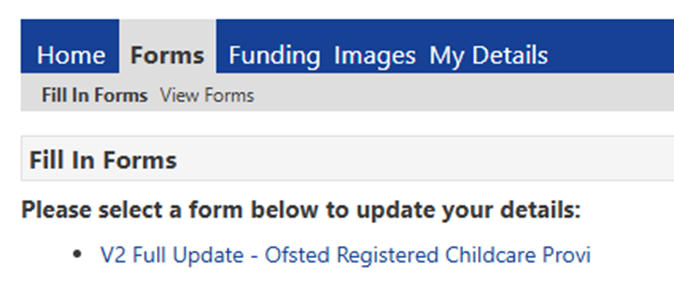
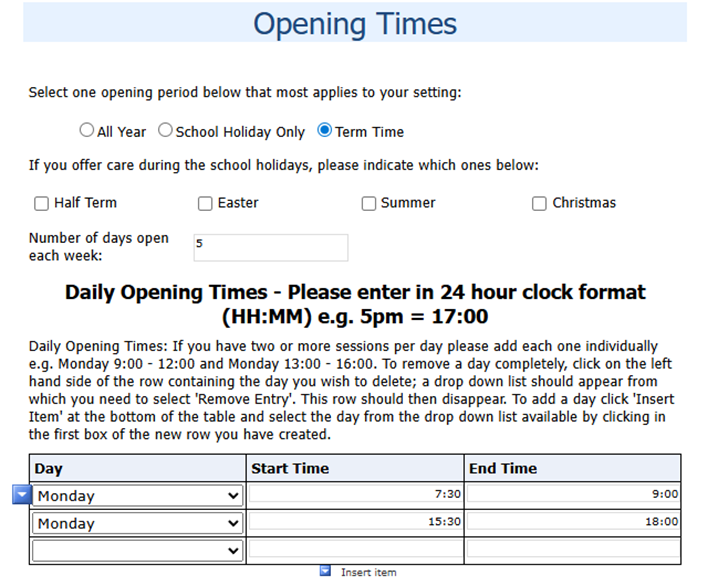
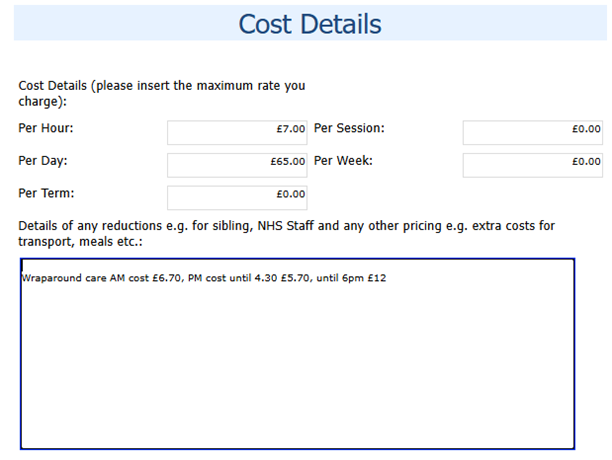
Please login here: Sign In - Provider Portal and go to the ‘Forms’ tab. Complete the V2 Full Update and press ‘submit’ at the end of the form. Any specific wraparound hours can be added to the opening times, and more details can be added to the free text fields. See below for a step-by-step guide:
Step one...
 Step two...
 Step three...
 Providers without access to the Provider Portal:
The Search for Childcare is a free marketing tool to promote your provision, however you can provide details of your provision and request that these are not public – this will mean that they aren’t shown on the Search for Childcare but the local authority will be aware that provision is available.
Please email info.fis@derbyshire.gov.uk with the following information and state whether you would like to make your setting information public and made available on the Search for Childcare:
- Provider name
- Ofsted URN
- Address including postcode
- Manager name
- Manager email address
- Manager telephone number
- Name of person requesting access and email address
If you are a school that offers wraparound provision to pupils of the school only, this can be included in the text.
Promoting your wraparound provision
Boost your visibility online:
A provider website or social media page is a valuable tool to promote and publish information about your wraparound offer. If you have an online platform, please consider the following:
- Is there a specific section for wraparound care?
- Is the information you share user-friendly, and can parents easily find your wraparound care details?
- Does it include session times, charges and contact information?
- Is your information regularly updated?
- If you are a school and do not have on-site wraparound provision, does your website signpost to other local providers?
Resources:
Childcare Works have produced a wealth of information in relation to marketing and capacity development in wraparound care to support providers’ long-term sustainability. Please see a link to these resources below.
Now that the HAF programme has been extended for another three years, we’re gearing up for a full and exciting 2026/27! We aim to build on our relationships with our internal and external partners to deliver a highly successful HAF programme throughout Derbyshire to provide healthy meals, enrichment and healthy lifestyles during the Easter, Summer and Winter holidays.
The Holiday Activities and Food Programme (HAF), known locally in Derbyshire as ‘It’s About Me’, offers funded activity places and healthy meals during the Easter, Summer and Christmas school holidays for school-aged children who receive benefits-related Free School Meals (FSM).
The HAF programme has increased year on year, with existing and new organisations providing a diverse range of holiday activity clubs.
 If you have any questions or wish to find out more information about the HAF programme within Derbyshire, please get in touch with the team at: HAF.enquiries@derbyshire.gov.uk or visit: https://itsaboutmederbyshire.co.uk
Please help us spread the word and ensure that as many of our eligible children are accessing this provision as possible!
The government has confirmed that the current Household Support Fund (HSF) will end on 31 March 2026 and will be replaced by a new Crisis Resilience Fund (CRF) from 1 April 2026. We’re still waiting for full guidance on the new fund, and we’ll update you as soon as we know more about how it will work in Derbyshire. In the meantime, Household Support Fund 7 (HSF7) continues until March 2026, providing grant support for residents facing financial hardship.
Support options include:
-
Grocery vouchers for families eligible for benefits-related Free School Meals.
-
Children’s Professionals Grants, offering financial help for families when other support options have been exhausted.
Key dates for your diary:
-
Final round of HSF grocery vouchers: due to be distributed 23 January 2026
-
Children’s Professionals Grants: open until 27 March 2026 (or until funds run out)
Children’s Services staff and colleagues in partner organisations (wraparound providers, schools, nurseries, charities, etc.) can continue to assess and refer families for grants. Each household can receive up to three HSF grant payments between now and 27 March 2026.
For further enquiries or referrals, please contact: cs.hsfduty@derbyshire.gov.uk
|