Providers:
• Cannot charge parents “top-up” fees (the difference between a provider’s normal charge to parents and the funding they receive from the local authority to deliver funded places) or require parents to pay a registration fee as a condition of taking up their child’s funded place. (A1.30 DfE Statutory Guidance / 13.8 Provider Agreement)
• Can charge parents a deposit to secure their child’s funded place but should refund the deposit in full to parents within a reasonable time scale, for example on their first invoice. (A1.31 DfE Statutory Guidance /13.6 Provider Agreement)
• Must not charge parents an additional amount for items that are required to deliver the Early Years Foundation Stage such as craft materials, toys, books, equipment etc, or an administration/service charge to cover business costs, for example, on-line registers, accommodation, qualified teaching staff, staff training, learning journals, etc. (Section A3 DfE Statutory Guidance / 13.9 & 13.10 Provider Agreement)
• Must not charge parents of funded children higher rates for additional hours or meals that result in them paying more than the settings published hourly/sessional/daily charges. (13.11 Provider Agreement)
• Independent Schools must ensure that any additional charges are voluntary to parents. This may result in waiving the registration fee and uniform charges for funded children in nursery, pre-prep and reception classes. (A1.25 DfE Statutory Guidance / 13.13 Provider Agreement)
• Independent Schools offering the early years entitlements to eligible children in Reception Classes must show the funded hours as free on parent invoices. (A1.33 DfE Statutory Guidance 13.14 Provider Agreement)
The government’s Statutory Guidance for the delivery of Early Education and Childcare states local authorities should:
“Ensure providers are completely transparent about any additional charges, for example, for those parents opting to purchase additional hours or additional services.” (A1.29 & A1.33 DfE Statutory Guidance).
Although the early entitlement hours must be free at the point of delivery, providers can charge for meals, consumables (such as nappies, sun cream, trips etc.), additional hours or additional services. These charges must be voluntary for parents and cannot be a condition of accessing a funded place.
Where parents are unable or unwilling to pay for meals and consumables, Providers who choose to offer the early years entitlements are responsible for setting their own policy on how to respond, with options including waiving or reducing the cost of meals and snacks or allowing parents to supply their own meals, nappies or sun-cream.
Providers must ensure parents are fully informed of the cost for any additional meals, consumables and hours they choose to take prior to commencing their funded place. (A1.25 DfE Statutory Guidance / 13.2 Provider Agreement). This should be reflected in providers’ information to parents.
The local authority will not intervene where parents choose to purchase additional hours of provision or additional services such as dance, music, or language tuition, providing that this does not affect the parent’s ability to take up their child’s funded place. Providers must be completely transparent about any additional charges. (A1.27 & A1.29 DfE Statutory Guidance 13.4 Provider Agreement)
Providers should be fair and transparent about their fees/charges. For example, if your weekly charge is £300 for 50 hours for a child who does not access the funded entitlement, this equates to £6 per hour. Therefore, for a child accessing the early years entitlement, any additional fee paying hours should not be greater than this.
It has been brought to our attention that some providers are including the following items, which is not an exhaustive list, as consumable charges. As these are required to deliver the Early Years Foundation Stage (EYFS), it is not acceptable and providers must not include these in a consumables charge, as this does not adhere to the Statutory Guidance:
Pencils
Felt tip pens
Crayons
Paper and card
Paint
Paint brushes
PVA glue and glue sticks
Books
Puzzles
Educational equipment
Toys
As the following items are administration/service charges to cover business costs, providers must not include any of these in a consumables charge:
Heating and lighting
Hand soap
Paper towels
Toilet roll
Hand gel
Cleaning products
Providers should be particularly mindful of the impact of additional charges on the most disadvantaged parents.
To increase fees without this impacting too greatly on parents, providers should consider making parents aware of the government’s funding schemes such as Tax-Free Childcare. Information on these schemes can be found on: childcarechoices.gov.uk
If parents would like help in determining the support they may be entitled to towards their childcare costs, please signpost them to the Families Information Service who can be contacted via Email: info.fis@derbyshire.gov.uk or telephone: 01629 535793.
Invoices:
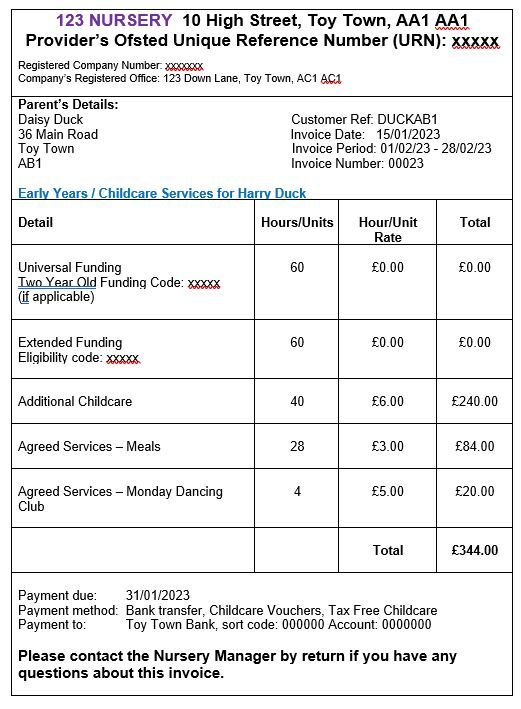
Providers must ensure their invoices and receipts are clear, transparent, and itemised, allowing parents to see they have received their early years entitlement completely free of charge and fully understand fees paid for additional hours or services. Providers must ensure that receipts contain their full details so they can be identified as being issued by a specific provider (A1.33 DfE Statutory Guidance / Provider Agreement 13.12).
Although it is recognised that some early years providers will be utilising an electronic funding system for generating parents’ invoices, the requirements of the government’s Statutory Guidance and local authority Provider Agreement must still be adhered to.
The early years entitlement cannot be deducted as a monetary subsidy from the total fees charged.
Invoices must show the number of funded hours/sessions, the number of paid for hours/sessions (if applicable) and the hourly/sessional rate agreed with parents and as published. The invoice must show the funded hours as free. (A1.33 DfE Statutory Guidance / Provider Agreement 13.7)
Invoices must show the number of meals and snacks in the invoicing period and the rates charged.
Invoices must show the number of itemised charges for additional services, such as trips, extra-curricular activities, for example language, music, or dance tuition.
Example invoice template:
|