Welcome to the 11th edition of the Derbyshire County Council Scams Awareness Bulletin
April 2019 - Edition 11
This bulletin gives details of scams and tricks that our Trading Standards Department, other council staff and partner agencies have been made aware of in recent weeks. Please feel free to share this bulletin far and wide - you can send it to colleagues, family members or friends as it is a public bulletin.
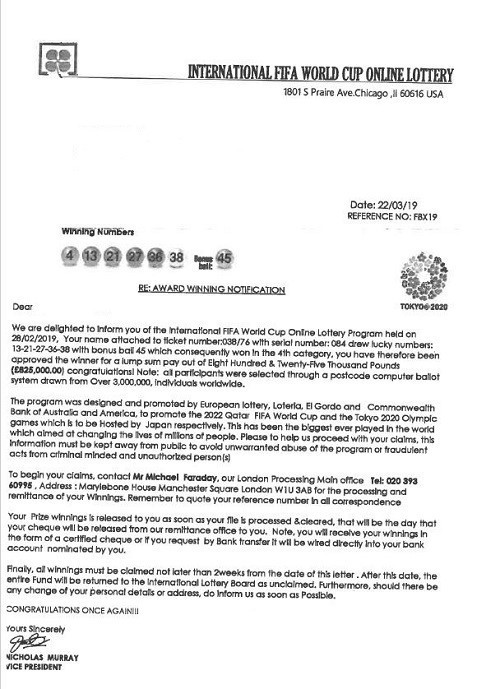
Derbyshire Constabularly have issued a warning after fake lottery letters were sent to Derbyshire residents. The letter states that the recipient has won £825,000 by playing the International FIFA World Cup Online Lottery Program. It claims the scheme was set up to change the ‘lives of the millions of people’ - in reality it is actually a scam designed to steal victims’ cash. Please see the example below.
Derbyshire Constabulary's fraud assessment officer, DC Matthew Newell, said: “We have seen a small number of reports of this scam in the past week. Fortunately the people who have contacted us have not lost any money as a result of the scam." However, others who are more vulnerable or less able to spot these types of letters may not be so lucky.
“I would ask that people keep on the lookout for these letters but also make friends and relatives aware of this scam."
“If you have received a letter and passed on your details please contact Derbyshire Police immediately on the 101 number. Please do not feel embarrassed that this has happened – they have specialist officers who will provide help and support to you.”
If you have received a letter, but not replied, then please report this to Action Fraud by calling 0300 123 2040 or by visiting www.actionfraud.police.uk.
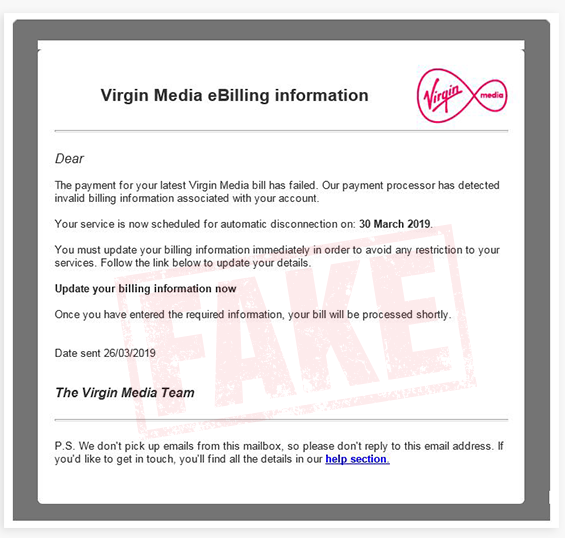
Fraudsters send fake Virgin Media emails threatening "automatic disconnection"
Action Fraud have received over 100 reports concerning fake emails, allegedly from Virgin Media. The emails threaten the recipient with "automatic disconnection" due to "invalid billing information". The links in the emails lead to genuine-looking phishing websites that are designned to steal your Virgin Media login details.
Do not click on these links or attatchments in suspicious emails, and never respond to messages that ask for your personal or financial details - no matter how genuine they may seem!
Derbyshire constabulary have received a number of calls from people across Derbyshire who have been contacted by scam callers alleging to be from HMRC. The calls, which are targeting both mobile and landline numbers, suggest that the recipient owes money to HMRC. They then advise that they can take payment in the form of vouchers, from a company such as Amazon, Google Play or iTunes. In some cases callers can be intimidating and aggressive and will even threaten arrest. These calls are being received from several 0300 numbers, which are official HMRC numbers that have been cloned for the purpose of these scam calls. If you receive such a call, do not trust the number displayed on your phone. Hang up and call HMRC directly from the contact details on their website.
Tammy Barnes, Fraud Protect Officer for Derbyshire police, said: “Phone scams are widely reported, and generally attempt to target elderly and vulnerable people. HMRC is a well-known brand, which criminals abuse to add credibility to their scams. “If someone calls you claiming to be from HMRC saying that you will be arrested, that we are filing a lawsuit against you, or even that you are owed a tax refund, and asks for information such as your name, credit card or bank details then it is a scam. “If you can’t verify the identity of the caller, we recommend that you do not speak to them.” There are a number of simple steps that can help keep you safe from this, and other similar, scams:
Recognise the signs - genuine organisations like banks and HMRC will never contact you out of the blue to ask for your PIN, password or bank details.
Stay safe - don’t give out private information, reply to text messages, download attachments or click on links in emails you weren’t expecting.
Take action - forward suspicious emails claiming to be from HMRC to phishing@hmrc.gsi.gov.uk and texts to 60599, or contact Action Fraud on 0300 123 2040 to report any suspicious calls or use their online fraud reporting tool.
Remember, HMRC will never ask for payment in the form of a voucher, such as Amazon, Google Play or iTunes.
A spokesperson for HMRC said: “We will call people about outstanding tax bills, and sometimes use automated messages; however this would include your taxpayer reference number. If you are uncertain of the caller hang up and call HMRC directly to check – you can confirm our call centre numbers on GOV.UK if you are unsure. For tax credits we do not include your details in any voicemail messages.”
If you are in doubt about a call you receive, call HMRC back from a different phone and if using a landline always listen for a dial tone before making a call. Alternatively, speak to a family member or a friend and discuss the call. You can also contact Derbyshire Constabulary via our social media accounts or calling 101. If you receive a call of this nature please report it to Action Fraud on Fraud 0300 123 2040 or www.actionfraud.police.uk.
An ongoing TV Licensing phishing campaign, first identified by the National Fraud Intelligence Bureau (NFIB) in September 2018, continues to be reported to Action Fraud in high numbers. Fraudsters are sending the public fake TV Licensing emails that are designed to steal their personal and financial information. Since April 2018, Action Fraud has received over 900 crime reports with victim losses totalling more than £830,000.
Is the TV licence email I have received a scam?
There are a number of ways to check whether or not an email you have received might be from fraudsters. Action Fraud says should check:
The sender's email address - does it look like one TV Licensing would use?
The subject line - anything such as "action required" or "security alert" should be treated with suspicion
Spelling and grammar - grammatical errors suggest it is likely to be a scam
The style - scammers often take real emails and amend them, so be wary of emails that seem too familiar or casual
The link - does it go through to the official TV licensing website.
How you can protect yourself:
Don’t click on the links or attachments in suspicious emails and never respond to messages that ask for your personal or financial details.
Don’t assume a phone call or email is authentic, even if someone knows your basic details (such as your name or address). Remember, criminals can spoof phone numbers and email addresses to appear as companies you know and trust, such as TV Licensing.
Your bank will never call and ask you for your PIN, full banking password, or ask you to transfer money out of your account.
What to do if you’ve fallen victim:
Let your bank know as soon as possible and monitor your bank statements regularly for any unusual activity.
If you suspect your identity may have been stolen you can check your credit file quickly and easily online. Use a reputable service provider and follow up on any unexpected or suspicious results.
If you have been a victim of fraud or cyber crime, report it to Action Fraud at actionfraud.police.uk, or by calling 0300 123 2040.
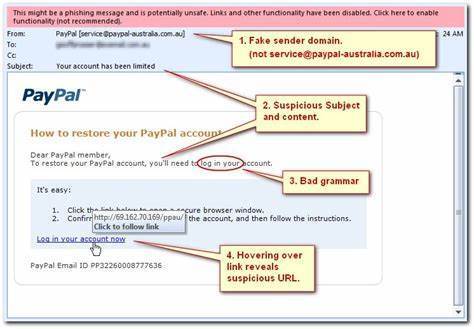
This is an example of a generic phishing email which redirects you to a fake website; once on the site, the user is tricked into giving sensitive information. For example, the link takes you to a fake site that looks like your bank, and you try to log in with your username and password. The scammer has now captured your login info, and in some cases, they will proceed to redirect you to the real website and you will be none the wiser. For an ongoing list of phishing alerts, check out FraudWatch International’s page.
The link may also take you to a website that infects your computer with malware like ransomware or a keylogger (a “virus” that captures everything you type into your computer like passwords and credit card numbers). Or it might even download the virus directly without going to a web page. Malicious web pages are the most common way that computers get infected and this scamming method is only increasing in popularity. It’s hard to tell which emails are real and which ones are fake as it is often in the interest of fraudsters to make their emails seem as genuine as possible. If a suspicious - looking email dropped into your emails, would you be able to tell fact from fiction?
A number of residents have recently approached Jobcentres in the Derbyshire area to report that they have received a text claiming to be from UC/DWP asking them to click on a link and provide their bank details. These texts are fake and DWP would never ask for bank details in a text message.
Text message scamming is known as shmishing and it is the new phishing. Due to the rising populatity of smatphones, the British market is now saturated with mobile devices which all have fast internet connectivity, a malicious link sent via SMS can yield the same result as it would if sent via email. This new technique is very sophisticated and therefore extremely hard to spot. The fraudsters are spoofing a mobile number, with a message coming in to a string of legitimate texts you’ve already got from your bank. Texting is the most common use of smartphones. Recent figures show that adult mobile users aged 18 to 24 send more than 2,022 texts per month - on average, that's 67 per day - and receive up to 1,831.
You should also follow these safety tips:
Never give out personal or financial information on the phone or by email. Your bank, the police or any other organisation will never ask you for these in full
Never allow someone remote access to your computer following a cold call
Don’t rely on caller ID – numbers can be spoofed by fraudsters to make it look like they’re calling from a trusted number
Your bank, the police or any other company, will never call to ask you to transfer your money out of your account for security reasons
Be wary of all cold calls claiming to be from banks, police, or other trusted organisations – if you have any concerns, call back on an independently verified number
Beware the sim card scam: how with terrifying ease fraudsters can empty your bank account... just by fooling your mobile phone provider.
Fraudsters trick providers into transferring phone numbers onto other Sims
They do this to steal six-digit verification codes sent by text from your bank
They will already have stolen information such as your username and password
When Ryan Finnegan received a text message out of the blue from Tesco Mobile thanking him for calling its customer service department, he phoned back his provider immediately. He was told he could be the victim of fraud, but was assured nothing had changed with his account. Later that same day, he was sent an email from TSB banking confirming his registration to its internet banking service. Ryan knew something was wrong, because he had opted not to bank online years before. Shortly afterwards, his mobile phone network signal disappeared. His wife checked their joint account balance and discovered it had been emptied of £2,500. "This was everything we had. I had no idea how we were going to feed our two children and pay the bills,' he says.
Ryan was the victim of a so-called Sim swap scam. This is where fraudsters trick your network provider into transferring your mobile phone number on to another Sim card.
I received a call from a mobile number and the caller claimed to be from 26 Broad Street, Reading (this is the actual address of HSBC bank). When I pushed them for company name they claimed to work for Microsoft technical support. They said that my PC had downloaded malicious viruses.
They proceeded to ask me what the computer was displaying on the screen and then what button was next to that (windows). He told me to press the 'windows' and 'R' key simultaneously. At this point I began to get suspicious, so I told them they were trying to scam me and then I hung up on them.
When I tried to call the same number back a few days later, the number was no longer in service.
Washing machine insurance
A Derbyshire County Council Home Care client had informed a care worker that she had received a call yesterday from a lady who asked her to give her card details as she needed to insure her washing machine. The client told the caller she did not have her card but the caller said 'yes you do, it is in your purse and you need to pay this insurance'. The client then told the caller that a relative had her card the caller hung up. Please
Trading Standards urge vigilance this coming Easter Bank Holiday weekend:
Trading Standards are warning all residents to be on their guard if approached by anyone cold calling at their homes offering any type of property maintenance or gardening services. Rogue traders are individuals or groups of people who cold-call householders, often targeting vulnerable residents, claiming to be a bona fide business and purporting to offer services, most commonly buildings maintenance and repair. When employing these doorstep callers, the concern is that after agreeing to work for a nominal cost, the resident is then informed that there is a lot more work required, and the costs escalate. The long Bank Holiday weekend can be an opportunity for these rogues to catch more people at home and offer work.
If work needs to be done on your property, known and reputable traders should be used. Visit the Derbyshire Trusted Trader website to find a reliable trader: www.derbyshire.gov.uk/tt
Phishing emails:
Two of the most common forms of this scam involve PayPal and Apple. During the scam, you are sent an official-looking email saying that access to your account has been temporarily blocked or that there was a questionable payment.
You've won the lottery! Or maybe not:
The scam works by promising a huge prize from a sweepstake or lottery that you never entered. The prize could be money or a holiday. Of course, in order to claim your prize, you will first need to pay a very small fee. These scammers are good at convincing you the fees are legitimate. They say that there are government taxes, maybe insurance, bank fees, or money for the courier. It all sounds quite reasonable. Meanwhile, the scammers make money as long as you continue to pay those incessant financial details that stand between you and your non-existent winnings.
Many of these scams use legitimate lotteries as their front. If you do superficial research, everything seems okay. But if you dig even a little, the scam usually surfaces. The easiest way to protect yourself is to remember that if you did not enter a lottery or a sweepstakes, then I'm sorry but you probably didn’t win it.
Offering to pay more than the asking price for the things you are selling?:
You have decided that you’re going to make a few extra pounds by selling stuff on Craigslist, Amazon, or eBay. You get an email from an interested party saying that they are willing to pay you more than your asking price for the item in question.
Why are they willing to pay more?
Because they need it shipped overseas and they’ll give you extra money to cover the cost. Any extra cash they say can be sent to them along with the item they’ve purchased. If you take the bait, a money order arrives in the mail shortly. You deposit it into your account and have the cash in hand to send the item on its way. The only problem – a few days later you get a phone call from your bank telling you that the money order was fake. They demand that you pay back the money immediately. At this point, the item you thought you sold is long gone, you owe the bank a lot of money, and you there might be criminal penalties for using a fake cashier’s check or a money order.
Disaster Relief Scams:
Disasters move honest individuals to dig into their wallet, often donating online. By now, you should be suspecting a scammer to rear his or her ugly head. They are the enemy of goodwill.
You’ll receive a touching and heart wrenching email that requests a donation. It even includes a handy link to a site where you can make donations via your bank account or credit card. It’s easy to guess what happens next.
The bottom line is to never make a donation via an email link. That’s not how these donations are made. Go to the site you want to give to by typing the URL into the address bar with your own fingers.
Contact the Age UK Derby and Derbyshire Information and Advice Line on tel: 01773 768240. Age UK also have a downloadable guide on recognising and dealing with all kinds of scams.
Derbyshire Scamwatch is a project funded by the Police and Crime Commissioner for Derbyshire. The aim is to raise awareness, particularly amongst older residents, of the potential harmful effects of mass-marketing, internet, doorstep and telephone scams and to provide one-to-one advice and support where potential scam/fraud victims are identified.
The Think Jessica website has lots of information and advice about all different types of scams and tricks.
Sign up to receive the Scams Awareness Bulletin by email(you'll be asked to provide your email address, set a password and then you can select the Scams Awareness Bulletin from the social care and health section).
Tell a trusted friend, relative or neighbour.
This bulletin is compiled by the Adult Care
Information Team