 If you've still got a bit of Christmas shopping to do or you're planning to hit the January sales, follow these top tips to ensure your money stays safe:
1. If you're still waiting for a few Christmas presents to arrive be wary of fake missed delivery slips asking you to call a number to re-arrange delivery. Always check it's genuine as the number may be a premium rate number and cost a small fortune.
2. Criminals may be preying on your good will this festive season to trap you into falling for their scams. Creating bogus charities is a way of extracting your money and personal information from you. Always check who you are talking to is who they say they are and check that the charity they are working for is legitimate.
3. Don’t let fake products ruin your festive fun! Beware of unrecognisable online sellers and make sure that the website/store is genuine. See advice from the Intellectual Property Office to shop safely online.
4. If buying online don’t pay for goods or services by bank transfer unless you know and trust the person. Payments via bank transfer offer you no protection if you become a victim of fraud.
5. If you're using a online shopping app make sure you’ve installed the latest software & app updates. Criminals use weaknesses in software to attack your devices and steal information, such as your payment details.
Action Fraud have further information on avoiding online fraud this Christmas and New Year.
|
Cyber criminals are attempting to blackmail unsuspecting victims by claiming to have used the victims' password to install spying malware on the victims' computer. The criminals claim they’ve recorded videos of the victim watching adult material by activating their webcam when they visit these websites. What makes this scam so convincing is that the email usually includes a genuine password the victim has used for one of their online accounts. We believe criminals obtain the passwords from data breaches.
What to do if you get one of these emails?
Don’t reply to the email, or be pressured into paying. The police advise that you do not pay criminals. Try flagging the email as spam/junk if you receive it multiple times. Perform a password reset as soon as possible on any accounts where you’ve used the password mentioned in the email. Always use a strong, separate password for important accounts, such as your email. Where available, enable two-factor authentication (2FA). Always install the latest software and app updates. Install, or enable, anti-virus software on your laptops and computers and keep it updated. If you receive one of these emails, report it to Action Fraud’s phishing reporting tool. If you have received one of these emails and paid the ransom, report it to your local police force.
Research from Financial Conduct Authority (FCA) estimates more than 10 million UK adults have received an unsolicited pension offer in the last year. Those who did fall victim to a pension scam lost an average of £91,000 each to fraudsters.
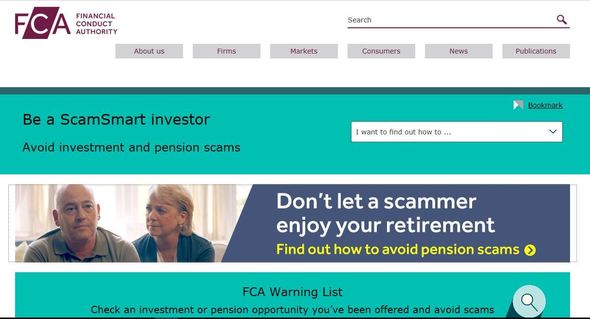
The Financial Conduct Authority (FCA)’s ScamSmart website, allows people to check pension opportunities they have been offered and find out more about avoiding scams.
The FCA report there has been a five-fold increase in visits to the website following the launch of a joint campaign by the FCA and the Pensions Regulator (TPR) to raise awareness of pension scams.
 HMRC Tax Credits overpayment scam letters
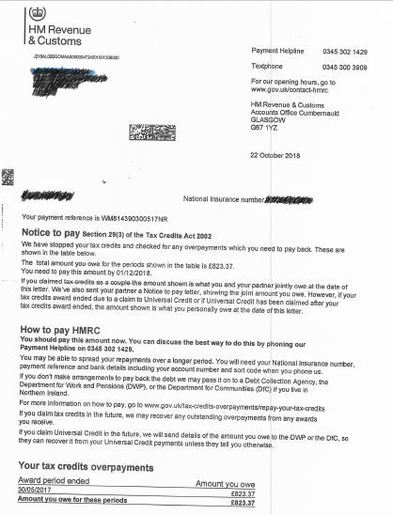
A number of Derbyshire residents have received very convincing letters purporting to be from HMRC that state they must pay back an overpayment of Tax Credits.
The letter (right) looks very similar to official HMRC letters. However, the letter asks for bank details which HMRC would never do as they already have claimants bank details saved on their system.
When Derbyshire County Council staff contacted the Tax Credits department of behalf of a client, they confirmed the letter was fake and the client didn't owe any money.
The advice is to contact HMRC if you receive a letter like this.
|
HMRC phone scam
"I received a phone call alleging they were HMRC and that a lawsuit was being taken out against me.
The phone number was 01618509219. This turned out to be a scam"
Cold callers in Matlock
From DCC care worker: "I have had a report this morning that one of my service users in Matlock answered his door yesterday to a man who had pulled up in a white van. (Possibly someone else sat in the van but can’t be 100% certain). The man asked the service user if he remembered him from 3 years ago when he retiled his roof. The service user didn’t. He then went on to say that he thinks it looks like it could do with being repaired again and that he could do it for him for £500. The service user told him that he has carers and someone else who deals with his finances. The man then went on to question who he would be leaving his house to when he passes away to which the service user said goodbye and closed the door.
I have since had another report that a similar thing happened in the Darley Dale area yesterday as well but the man was offering to re-tarmac the gentleman's drive. Luckily both service users declined".
Fake emails from BT
A bulletin reader sent copies of emails from BT. The first purported to be notification of an invoice being raised and asked the user to follow a link and 'log in'. However the sender's email name was 'BT Care' but the actual email address was hardaker33@btinternet.com
The second email was a BT survey which again asked the recipient to click on a link and log in. The sender on this occasion was 'BT Consumer' but the actual email address was j.oconnell@btinternet.com
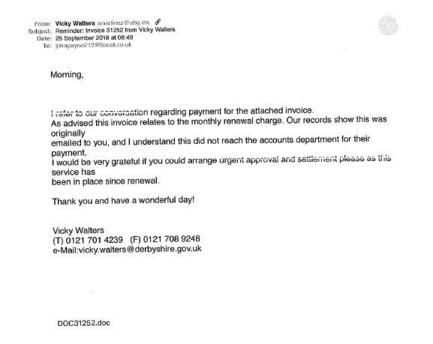 Scam invoice from Derbyshire County Council
A member of the public contacted Derbyshire County Council about an invoice they had received by email that purported to be from the council. The sender of the invoice stated they were from Derbyshire County Council and quoted a @derbyshire.gov.uk email address in their email signature. However the email itself was sent from a Mexican email account and the telephone number quoted was a non-Derbyshire number. DCC confirmed this is a scam and residents should ignore any similar emails or contact Call Derbyshire on tel: 01629 533190 if they are unsure.
|
Fake school book offer / bailiff scam
Earlier this year a small local business owner spotted an offer advertised in a locally produced printed directory of local businesses (the type that are put through your letterbox). The advert displayed the logo of the Police Federation (as a partner organisation) and offered the business the opportunity to purchase books about drugs for their local school in exchange for charitable tax relief. The local business paid £4000 for books that they planned to donate to their local secondary school. The books never arrived.
A few months later the business received a call from someone who said they were from the organisation that supplied the books. The caller stated the business had not paid for the books and must pay straight away to avoid further action. The business refused as they had already paid and hadn't received any books. The caller then bombarded the business with calls and stated that the bailiffs were on their way to the business owner's home and would take possession of their cars if the bill wasn't paid. The caller kept ringing back and applying more and more pressure. They only stopped calling after the business owner consulted the police and a solicitor. The business owner said that although they knew they didn't owe the money, the calls were very convincing and caused them a lot of stress. It is believed the use of the Police Federation logo was fraudulent.
 Would your team or community group like to become Friends Against Scams?
The short Friends Against Scams training course takes no more than an hour and can be delivered presentation style to groups. The training will teach you more about the different kinds of scams and how to avoid them. It will also help you recognise if people you work with, support or simply know are falling victim to scammers.
If you'd like to book a training session please contact Alex Shore on tel: 01629 531310 or email adultcare.info@derbyshire.gov.uk
Alternatively you can become a Friend Against Scams by completing the online eLearning course. If you work for Derbyshire County Council you can complete the training on the Derbyshire Learning Pool and it will be added to your training record.
|
Action Fraud has seen a sharp increase in reports about fake TV Licensing emails:
Email offering a TV Licence refund - the email states that the refund cannot be processed due to “invalid account details” and provides a link that leads to clone website designed to steal personal and financial details.
Email asking recipients to update their details - the message states that the receiver’s billing information records are out of date, and again includes a link to a clone of the real TV licensing website.
Always question unsolicited requests for your personal or financial information in case it’s a scam. Never automatically click on a link in an unexpected email or text.
Natwest Bank Scam Support - do you bank with Natwest? The bank have a dedicated officer who can support customers of the bank with any scam, fraud or internet security queries. You can contact Charlie Proctor on tel: 07552 259819 or email: charlie.proctor@natwest.com
Alerts have been issued by police and HM Revenue and Customs amid reports of phone scam calls claiming to be from HMRC and asking them to settle bills using Goggle or iTunes vouchers. more
Millions of customers at big name mobile operators are at risk of falling victim to a scam that allows criminals access to their bank accounts via phones, an investigation has unearthed. more
Thousands of fraud reports have been received by the tax authority from students at university and colleges across the UK. Fake emails, which use university addresses in a bid to appear legitimate, may tell people that they are owed money and encourage them to send their personal details. more
 Get advice from Citizens Advice Consumer Service, tel: 03454 04 05 06 or visit: www.adviceguide.org.uk.
Report scams and suspected scams to Action Fraud or tel: 0300 123 2040.
Send potential postal scams with a covering letter to Royal Mail at FREEPOST Scam Mail, email: scam.mail@royalmail.com or tel: 03456 113 413.
Report unsolicited marketing calls to the Information Commissioner's Office or tel: 0303 123 1113.
Register phone numbers with the Telephone Preference Service or tel: 0845 070 0707.
The Mailing Preference Service (MPS) is free and can help reduce unsolicited mail by calling 0845 703 4599.
Contact the Age UK Derby and Derbyshire Information and Advice Line on tel: 01773 768240. Age UK also have a downloadable guide on recognising and dealing with all kinds of scams.
Derbyshire Scamwatch is a project funded by the Police and Crime Commissioner for Derbyshire. The aim is to raise awareness, particularly amongst older residents, of the potential harmful effects of mass-marketing, internet, doorstep and telephone scams and to provide one-to-one advice and support where potential scam/fraud victims are identified.
The Think Jessica website has lots of information and advice about all different types of scams and tricks.
Sign up to receive the Scams Awareness Bulletin by email (you'll be asked to provide your email address, set a password and then you can select the Scams Awareness Bulletin from the social care and health section).
Tell a trusted friend, relative or neighbour.
|
Falling victim to a scam/s can be very upsetting. If you or someone you know has been scammed and you need support you can contact:
Derbyshire Victim Services offer free and confidential support to victims of crime, tel: 0808 612 6505.
Think Jessica is a Derbyshire-based charity set up to help and support people affected by scammers and also to highlight the effects on victims.
Age UK Derby and Derbyshire which can provide a wide range of support for local older people and carers. Residents can call the local service, tel: 01773 768240.
The Derbyshire Trusted Befriending Network helps isolated and vulnerable adults find befriending services. For more information contact the network coordinator, email befriending@sdcvs.org.uk or tel: 01283 219761.
|