Welcome to our latest fraud newsletter. This month we've got a range of advice and cover a number of topics - all of which we hope will be of interest and useful.
Among the crime types we're focusing on, we're taking a look at the issue of doorstep frauds and the work of our partners in Trading Standards.
They use the information you give them to investigate unfair trading and illegal business activity, like rogue traders and scams.
Elsewhere, we have some details of two initiatives involving different generations and our expert detectives who are out-and-about all-the-time advising people on how to protect themselves against crime such as fraud and cyber offences.
Our partners at Take Five to Stop Fraud have some advice about invoice fraud, to tie in with the end of the financial year; and we also have details from Action Fraud, who are offering tips on social media and email hacking.
Please, as always, share any information you think might help others protect themselves from crime. Or, better still, get them to sign up to our newsletter. Details of how to do so are at the foot of this edition.
|
Spotlight on Trading Standards
What do Trading Standards do?
If you think a business has broken the law or acted unfairly, you can report them to Trading Standards.
Trading Standards use the information you give them to investigate unfair trading and illegal business activity, like rogue traders and scams.
What are Scams?
Scams come in many different forms, including email, post, telephone or in person by someone making false promises to scam potential victims out of money.
Doorstep scams are crimes carried out by bogus callers, rogue traders and unscrupulous sales people who call, often uninvited, at people's homes under the guise of legitimate business or trade.
 Warning indicators of doorstep crime:
Red light warning indicators for doorstep crime are:
- Person or business cold calling at various properties touting for business.
- No paperwork is given and there are no cancellation rights.
- Money is requested 'up front' before any work has been carried out.
- Trader does not complete the work and consumer cannot contact them.
If you or someone you know needs assistance in dealing with a rogue trader:
You can contact Trading Standards on the numbers below, depending on which is your local council.
- In Cumberland - phone: 01946 505005
- In Westmorland and Furness - phone: 01539 713594
Protect your online accounts from hackers and enable 2SV: Action Fraud issue new warning about social media and email account hacking
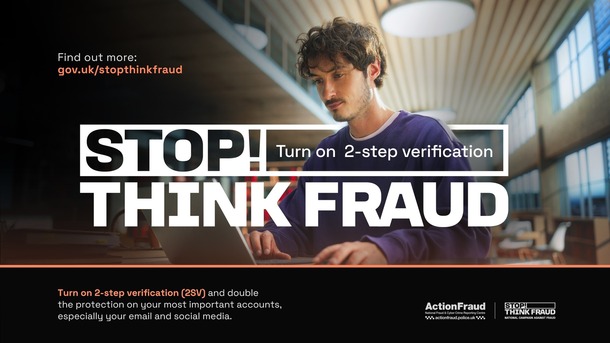 Data shows there was a rise nationally of social media and email account hacking in 2024, with a total of 35,434 reports made to Action Fraud, compared to 22,530 reports made in 2023.
Action Fraud, the national fraud and cybercrime reporting service, has launched a campaign, supported by Meta, to encourage people to take an extra step of online protection by enabling 2-Step Verification for each online account they have. The warning comes as reporting shows nearly £1m was lost to hackers last year.
The most common motives for social media hacking were either investment fraud, ticket fraud or theft of the targeted account.
Adam Mercer, deputy director of Action Fraud, said:
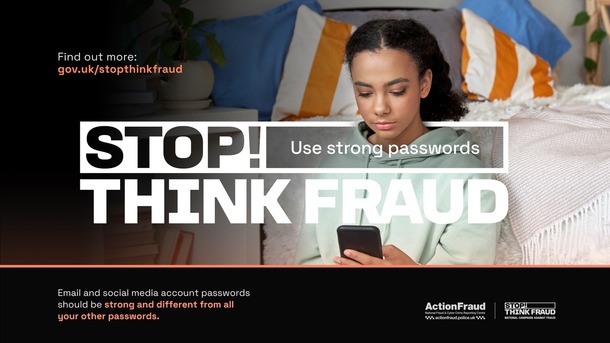
“Follow Stop! Think Fraud advice and protect yourself online: enable 2-Step Verification on each online account you have – this will help prove your identity and stop fraudsters trying to steal or access your valuable information. Secure your social media and email accounts by ensuring each password is strong and uses three random words. Remember to never share your passwords with anyone else.”
In the reports made to Action Fraud, there were various different methods of hacking highlighted, these include:
On-platform chain hacking
This is when a fraudster gains control of an account and begins to impersonate the legitimate owner. The goal is to convince people to reveal authentication codes, including one-time passcodes, that are sent to them via text. Many victims of this type of hacking believe it’s a friend messaging them, however the shared code was associated with their own account and the impersonator can now use it to access their account.
Leaked passwords and phishing
The other common method of hacking is when account details are gained via phishing scams, or the use of leaked information used from data breaches, such as leaked passwords. This becomes prevalent as people often use the same password for multiple accounts, so a leaked password from one website can leave many of their online accounts vulnerable to hacking.
What can you do to avoid being a victim?
-
2-step verification (2SV) will keep criminals out of your account – even if they know your password. Turning on 2SV gives your most important accounts an extra level of protection, especially your email and social media accounts. It can be turned on in a matter of minutes – time well spent to keep the fraudsters out.
-
Email and social media passwords should be strong and different to all of your other passwords. A good way to make sure your passwords are ‘long enough and strong enough’ is to combine three random words to create a unique password which is easy to remember.
Report suspicious emails by forwarding it to: report@phishing.gov.uk
Find out how to protect yourself from fraud at: https://stopthinkfraud.campaign.gov.uk
Advising students so they can stay free from fraud
 |
|
Our officers spent a lot of time out-and-about in the community and visiting places where their advice might come in useful.
One of our economic crime specialists recently visited University of Cumbria campuses to help keep students free from fraud.
Detective Constable Claire Keyes visited the Fusehill Street campus in Carlisle as well as speaking to students at Lancaster.
She offered advice and tips on steering clear of fraud as part of National Student Money Week.
|
Invoice Fraud - What You Need to Know
What is it?
Invoice or mandate scams happen when criminals pose as your builder, solicitor, tradesperson or someone from a trusted organisation and provide you with new or amended bank account details. You’re then tricked into sending money to the account, which is controlled by them.
These scams often involve a criminal intercepting emails, gaining access to your supplier’s email account or pretending to be from them (also known as spoofing).
 How to spot an invoice and mandate scam?
- You receive new bank details from an existing service provider (such as a builder, solicitor or other tradesperson) that are different to the account details you hold
- You receive duplicate or more frequent invoices for a product or service than the genuine service provider normally sends
Children pass on their digital skills to older generation at community internet safety event
Children were able to pass on their digital skills to pensioners at a community internet safety event recently held in Grange-over-Sands.
Year five pupils from Grange C of E Primary School brought along their school iPads to the weekly coffee morning at the town’s Methodist church and were keen to pass on their expertise at the event, facilitated by Fibrus Broadband.
They sat down with people at the church’s weekly coffee morning to show how they use online tools and apps at school, including Digimap, which allows them to switch between Ordnance Survey maps going back more than 150 years, revealing how the local area has changed over the decades.
The pupils had also produced posters and lists of tips for staying safe online which ranged from advice about choosing passwords to warnings about catphishing.
One nine-year-old clearly enjoyed explaining what she had learned about in school. She said: “I spoke with them about the dangers of being on the internet and explained to them what catfishing is and we talked about online bullying too.”
Cumbria Police also supported the event with Detective Constable Jon Hill, of the cyber and digital crime unit, taking time to sit with pensioners and other visitors to the coffee morning to talk through their concerns.
He said: “Events like today are hugely important because we can answer people’s questions and give them the confidence to challenge things they see online - whether that’s fraud attempts, phishing emails or being wary of clicking on links.
“I’ve been able to have lots of useful conversations with the people here, giving them better knowledge of the kind of threats and risks out there.”
Tips on various types of fraud - all in one place
 Our officers have put together a range of advice, tips and reference points for more information - all on the types of fraud you may encounter.
It covers threats such as attempts to get your personal information, your cash - and what may happen if you are contacted by phone, online or on the doorstep.
You can visit our one-stop advice toolkit for straightforward tips on minimising your risk of falling victim to fraud here: Fraud Prevention Toolkit | Cumbria Police
What to do if you have been the victim of fraud
The first thing you should do if you’ve been a victim of fraud is to contact Action Fraud. You can report a fraud via their online fraud reporting tool, or by calling them on 0300 123 2040.
If there is a crime being committed right now or if you are in danger you should call the police on 999.
If debit or credit cards, online banking or cheques are involved, your first step should be to contact your bank or credit card company.
If you have any friends or family who you feel would benefit from receiving this newsletter, please direct them to our website where they can sign up.
|