|
Welcome to the January edition of the Cumberland Safeguarding Children Partnership (CSCP) Newsletter.
Within this Newsletter, you will find useful information from across the partnership and from our partner agencies relating to Safeguarding, which is aimed to support Practitioners and Professionals in their role.

This report presents the Cumbria Child Death Overview Panel (CDOP) Annual Report for 2024/25. The report provides information regarding the tragic deaths of children within Cumbria during 2024/25, the children who were reviewed by CDOP during this time and a summary of the Business Plan for CDOP.
The Report also provides an overview of the local changes in governance and CDOP review processes, which are likely to impact on Cumbria CDOP.
To read the full report, please click on the link below:
Cumbria Safeguarding Children Partnership - Child Death Overview Panel Annual Report 2024-2025
|
The CSCP is delighted to announce that we are holding a Safeguarding Week from 9 - 13 March 2026.
Safeguarding Week is a dedicated time to raise awareness, refresh knowledge and strengthen our collective responsibility to protect children and young people in Cumberland.
Timetable of Training
During the week, we have a full programme of training, which can be accessed by Practitioners from all organisations.
The timetable of training available during the week is shown below:
|
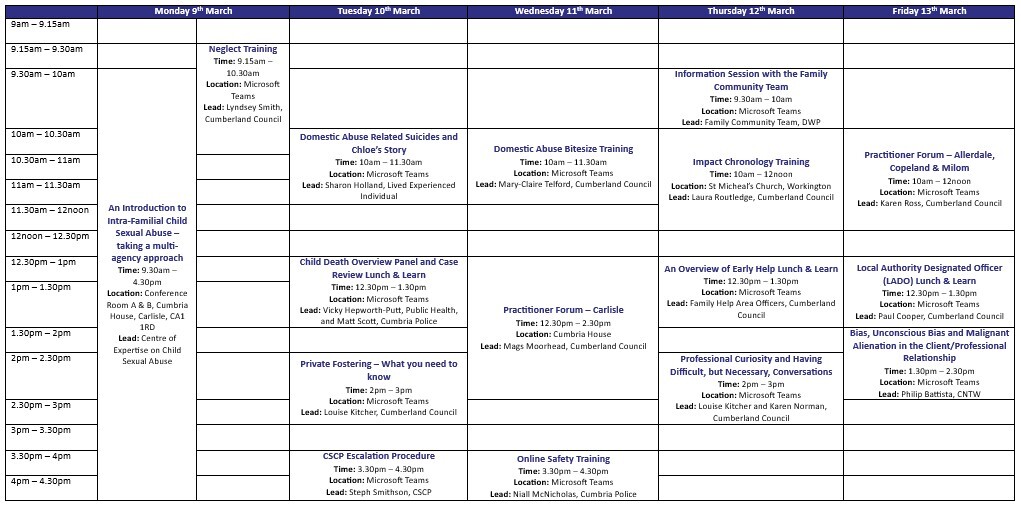 Details of the Sessions and How to Book
For more information about each of the sessions being delivered, and how to book, please visit the CSCP website CSCP Safeguarding Week 2026
We encourage you to book quickly, as the sessions will be popular.
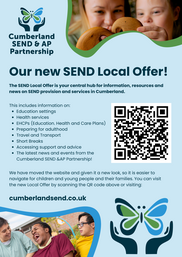
The SEND Local Offer is a resource that all Local Authorities must have. It compiles local SEND information, provision, and resources in one place – ‘setting out in one place information about provision they expect to be available across education, health and social care for children and young people in their area who have SEN or are disabled, including those who do not have Education, Health and Care (EHC) plans,’ (SEND Code of Practice, 2015).
We hope that Cumberland's new Local Offer will become a central hub for children and young people with SEND and their families for all information, resources and news about services and provision in Cumberland. We have chosen to move the website for several reasons, including:
- The new site offers easier navigation, making it simpler for families and professionals to find information and resources they need. We consulted with families on how the new website should look and feel following Local Government Reorganisation in Cumbria, and have co-produced the new site with SENDAC, the statutory parent/carer forum for Cumberland.
- The site uses the same platform as the Family Hub website, meaning there is more consistency and familiarity across websites hosted by Cumberland Council.
- The new site platform is simpler and easier to update, so we can keep information and resources as up to date as possible.
You can access the new site here: https://cumberlandsend.co.uk/cumberland-send
Any feedback about the new Local Offer can be provided here: https://consult.cumberland.gov.uk/cumberland-send-local...
What do I need to do?
To make the transition to our new Local Offer website as smooth as possible before and after the launch on the 26th January, we would ask our colleagues in schools to please do the following:
- Disseminate this message to any colleagues who it may be relevant to, who may use or refer to the Local Offer in their work.
- Review any webpages your organisation has that may link to the old Local Offer and please update these to the new link. There will be a redirect on the old site for a limited time.
- Review any paperwork, including letter templates etc. that may link to the old Local Offer and please update these to the new link.
- Print copies of the new Local Offer poster above (attached and available to download here) and display these in communal spaces where children and young people and/or families can access it.
- Include news of the new Local Offer in any communications to parents/ carers and families. We have written a summary at the end of this letter that can be used.
Thank you for your cooperation as we make this change. Any feedback about the new Local Offer can be provided here: Cumberland SEND Local Offer Feedback | Let's Talk Cumberland
|
Children's Mental Health Week 2026
Children's Mental Health Week 2026, organised by the charity Place2Be, runs from 9 - 15 February 2026, with the theme 'This is My Place', focusing on the importance of belonging and encouraging inclusive environments for children's wellbeing.
Look out for our 5 Minute Briefings being published during that week, for more information
|
Safer Internet Day - 10 February 2026

Safer Internet Day 2026 will take place on 10 February 2026, with celebrations and learning based around the theme ‘Smart tech, safe choices – Exploring the safe and responsible use of AI’.
Look out for our 5 Minute Briefing being published on 10 February, for more information
|

Cumberland Safeguarding Children Partnership have a range of training sessions on offer.
Please visit our training page on the website for all eLearning/face to face courses offered to professionals and volunteers working with children, young people and their families who live in Cumberland.
|
Learning from Practice - Thematic Training Event
A Local Learning Review (LLR) is undertaken when a child or children have suffered abuse or harm, but the circumstances do not meet the full criteria for a Rapid Review or Local Child Safeguarding Practice Review.
Cumberland and Westmorland and Furness Safeguarding Children Partnerships have developed, as part of their training offer, thematic training events via Microsoft Teams. The events will cover thematic themes from both local and national learning.
Further Awareness of the Safeguarding Environment (formerly known as Safeguarding Level 2)
This training package bridges the gap between the online, Level 2 Safeguarding Training delivered via the CSCP’s Learning Management System, and the “Understanding the Levels of Need” (Level 3 Safeguarding Training) for Designated Safeguarding Leads.
The course is designed to help participants understand more about their safeguarding responsibilities, capturing the voice of the child, professional curiosity and how to make a referral. Along with providing participants with up to date information about general safeguarding topics, such as allegations against staff, domestic abuse, online safety and child exploitation.
This “Further Awareness of the Safeguarding Environment” Training can be completed by any professionals or practitioners who work directly with children and young people, whether this is frequent or infrequent.
Designated Safeguarding Leads and Deputy Designated Safeguarding Leads should complete this course before undertaking the “Understanding the Levels of Need” Training (Level 3 Safeguarding Training).
Understanding the Levels of Need (Formerly known as Safeguarding Level 3)
This course develops a common understanding of risk management and provides support to Designated Safeguarding Leads and Deputy Designated Safeguarding Leads, so they are clear about:
- the thresholds for access to services which support the actions needed to improve the outcomes for children
- understanding roles and responsibilities
- identifying exemplars of good practice
- individual responsibility when working with children, young people and families
- responsibility of different agencies; and
- the tools in place to support professionals in their role
Reflective Supervision in Education Settings
The aim of our Reflective Supervision in Education Settings training workshop is:
- To understand the importance and benefits of regular supervision
- To give participants the knowledge and tools to be able to undertake effective reflective supervision
- To consider the barriers to providing supervision and how to overcome them
- To share good practice
Child Exploitation
The CSCP recommend that anyone working with children should complete Child Exploitation (CE) Level 1 eLearning as mandatory training. For more details and how to access the eLearning training, please click here.
Those practitioners who work more closely with children and young people, and are involved in their safety planning, should complete Child Exploitation (CE) Level 2 training. Further dates are to be confirmed in due course.
Impact Chronology
The CSCP are delivering training on Impact Chronology. The following session will be a face to face workshop and the aim of the session is to enable practitioners to develop skills in using Impact Chronologies.
How to Support Children & Families through Early Help - Signs of Wellbeing Training
The aim of this training is to increase knowledge and enable practitioners to work more effectively with children, young people and their families using Early Help, and identify needs early to give all children the opportunity to thrive and succeed.
Child Mental Health
The Children’s Society and The University of Manchester have published a briefing summarising discussions and findings from a workshop on building better policies for girls’ mental health. The workshop included participants from across the civil service, academia, and the third sector. The discussion identified practices that should be sustained and strengthened including: whole school approaches that prioritise listening to girls; co-production with young people; and the use of shared language around girls’ mental health across sectors. The briefing highlights some of the complex challenges girls are facing such as pressures rooted in gender stereotypes, sexism and misogyny, and underscores the need for greater collaboration to address these. It also emphasises the value of bringing varied policy perspectives together around a shared commitment to building better policies for girls’ mental health.
Read the briefing: Building better policies for girls’ mental health
See also on NSPCC Learning: Child mental health: recognising and responding to concerns
|
Child Protection
Policy Lab, in collaboration with the Department for Education (DfE), is holding an online debate to help shape the development of the future Child Protection Authority (CPA) in England. The debate will explore how a future CPA can support front-line practitioners in their role. The debate will run from Monday 19 to Friday 23 January 2026 and professionals across the child protection system are invited to take part.
Join the debate: Complete the short consent form (MS Forms)
Find out more: Read the information sheet and privacy notice
Mental Health
Social Media
The UK government has launched a consultation on children's use of social media to protect young people's wellbeing and ensure safer online experiences. The consultation will seek views on various measures, including: the right minimum age for children to access social media, including a potential ban for children under a certain age; ways to improve the accuracy of age assurance for children; restrictions on addictive features of social media; and further interventions to support parents in helping their children stay safe online. Immediate action will include Ofsted checking school mobile phone policy on every inspection, with schools expected to become phone-free. The government will respond to the consultation in the summer. The NSPCC has published a response highlighting the role of social media and online communities in children’s lives and calling for technology companies to be held to account.
Read the news story: Government to drive action to improve children’s relationship with mobile phones and social media
Read the NSPCC’s response: A social media ban would punish teenagers for tech platform’s failures
Online Safety
The Royal College of Paediatrics and Child Health (RCPCH) has published a new web page on screen time and online harms bringing together key resources to help inform conversations with families and guide practice. The resources include screen guidelines for children under five as well as guidance for parents on online harms.
Visit the page: Screen time and online harms: resources for members
See also on NSPCC Learning: Preventing online harm and abuse
Domestic Abuse

Ofsted, Care Quality Commission (CQC), His Majesty’s Inspectorate of Constabulary and Fire & Rescue Services (HMICFRS), and His Majesty’s Inspectorate of Probation (HMIP) have published a joint report looking at the multi-agency response to children who are at risk from, or are victims of, domestic abuse. The report sets out key findings from six joint targeted area inspections (JTAIs) in England. It focuses on unborn babies and children up to 7-years-old affected by domestic abuse, exploring: responses at the point of identification; assessment, planning and decision-making; protection and support; and prevention. The report highlights examples of good practice including support for unborn babies demonstrated by midwives and the involvement of schools and early years providers at a strategic level. However, it also finds that children’s experiences are inconsistent and they are not always recognised or supported as victims of domestic abuse in their own right. The inspectorates are calling for improved multi-agency working and information sharing.
Read the news story: Children not always recognised as domestic abuse victims in their own right, inspectorates warn
Read the report: The multi-agency response to children who are victims of domestic abuse
See also on NSPCC Learning: Protecting children from domestic abuse
|
|