|
Welcome to the November edition of the Cumberland Safeguarding Children Partnership (CSCP) Newsletter.
Within this Newsletter, you will find useful information from across the partnership and from our partner agencies relating to Safeguarding, which is aimed to support Practitioners and Professionals in their role.
To assist practitioners to establish what CSCP Training they should complete, to allow them to have the necessary safeguarding knowledge to undertake their role, the CSCP have created a new “What Training is Right for Me” document, which can be accessed here.
The document details the training that the CSCP deliver, along with who the training should be completed by, how frequently the training should be completed and whether the training is mandatory.
Before booking CSCP Training, Practitioners are encouraged to review the What Training is Right for Me document, to ensure that the training they wish to book is designed for their role.
|
Professionals continue to be able to seek Advice and Guidance from Cumberland Children’s Advice and Support Service (CCASS), but this cannot be done anonymously. The team are available to discuss concerns, share information, and support decision-making.
You can either complete a Single Contact Form or ring the CCASS Team on 0333 240 1727 and inform the family of your intention to discuss their child/children with CCASS. A record of the discussion will be added to the child/children’s social care record. If the child/children do not currently have a record, one will be created. Following the consultation, written feedback, outlining the discussion and the agreed outcome, will be provided.

Neglect is one of the strategic priorities across our Safeguarding Partnership and within Cumberland Children’s Services. We are, therefore, having a relentless focus on practice improvement in this area, to ensure that children and young people in Cumberland that experience neglect are provided with timely and effective support.
This relentless focus includes the creation of new Neglect Champion roles.
What does being a Neglect Champion entail?
- You will attend quarterly in person Neglect Champion meetings, where we will share good practice, research and resources relating to neglect and will plan on how this will be shared and included into training across the partnership.
- You will be part of delivering neglect training or workshops, either within your own organisation or wider partnership (dependant on what you feel comfortable with) to promote best practice.
- You will share good practice examples relating to neglect with the Practice Champions Group.
- You will champion best practice regarding neglect within your organisation and throughout the wider partnership.
Upcoming sessions are on our website here and are also shown below:
- Monday 2 February 2026 (10.00 to 11:30am) Carlisle
- Tuesday 5 May 2026 (10.00 to 11:30am) Workington
- Tuesday 8 September 2026 (10.00 to 11:30am) Carlisle
- Tuesday 1 December 2026 (10.00 to 11:30am) Whitehaven
If you are interested in becoming a Neglect Champion, please email childrensacademy@cumbria.gov.uk
|

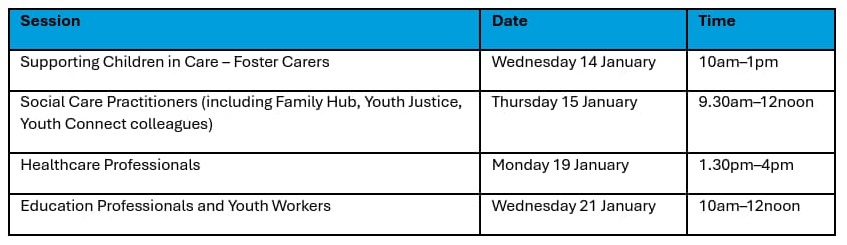
We are delighted to be working with YGAM to offer a full programme of fully funded, CPD Certified, Gaming and Gambling Harm Prevention Workshops for foster carers, education professionals, youth workers, social care practitioners, and healthcare professionals.
The topics covered within the workshops include:
- Influences on young people
- Blurred lines between gaming and gambling
- How to spot the signs of harm
- Microtransaction
- Mental health and wellbeing
- Where to get help and support
Over a two week period, YGAM will be delivering a range of workshops for different professional groups, as shown below:
|
 Attendance at these sessions is free and you are encouraged to book as soon as possible, as these sessions will be popular.
You can book your place in the following link: Book your place on CSCP YGAM Training
For more information, please click on the link below:
Gaming and gambling harm workshops for CSCP - flyer
Cumberland Youth SAFE (Substance Awareness For Everyone) Team (formerly Youth Substance Misuse) are delivering a FREE, interactive Alcohol Awareness Workshop designed especially for Professionals working with young people of secondary school age.
Cumberland Youth SAFE Team know how important it is to equip young people with the knowledge and confidence to make safer choices and therefore, have partnered with the Daniel Spargo-Mabbs Foundation and The Well Communities Cumbria, to develop powerful new ‘lived experience’ videos, bringing real stories to life and highlighting the impact alcohol misuse can have on young people and their families. These videos, tailored for ages 11 to 17, are designed to be used by any practitioner, not just substance use specialists.
During the workshop, you will:
- Learn how to use these new resources effectively in your classroom or setting
- Gain practical tools to spark meaningful conversations with young people
- Hear about local support services available across Cumberland
- Have the chance to ask questions directly to a trained Substance Use Specialist
- Feel more confident supporting young people to stay safe and informed
📅 Date: Thursday 4 December 2025
⏰ Time: 3:30–4:30pm
💻 Where: Microsoft Teams
To book your place, please email Abi.macrae@cumbria.gov.uk
Cumberland Safeguarding Children Partnership have a range of training sessions on offer.
Please visit our training page on the website for all eLearning/face to face courses offered to professionals and volunteers working with children, young people and their families who live in Cumberland.
|
Further Awareness of the Safeguarding Environment (formerly known as Safeguarding Level 2)
This training package bridges the gap between the online, Level 2 Safeguarding Training delivered via the CSCP’s Learning Management System, and the “Understanding the Levels of Need” (Level 3 Safeguarding Training) for Designated Safeguarding Leads.
The course is designed to help participants understand more about their safeguarding responsibilities, capturing the voice of the child, professional curiosity and how to make a referral. Along with providing participants with up to date information about general safeguarding topics, such as allegations against staff, domestic abuse, online safety and child exploitation.
This “Further Awareness of the Safeguarding Environment” Training can be completed by any professionals or practitioners who work directly with children and young people, whether this is frequent or infrequent.
Designated Safeguarding Leads and Deputy Designated Safeguarding Leads should complete this course before undertaking the “Understanding the Levels of Need” Training (Level 3 Safeguarding Training).
Upcoming training dates are shown below:
- Wednesday 3 December (9.30am-12.30pm) - Wigton
- Monday 12 January 2026 (9.30am-12.30pm) - Carlisle
- Thursday 29 January 2026 (9.30am-12.30pm) - Workington
- Tuesday 3 February 2026 (9.30am-12.30pm) - Whitehaven
- Thursday 26 February 2026 (1.30-4.30pm) - Carlisle
- Tuesday 3 March 2026 (9.30am-12.30pm) - Millom
- Tuesday 24 March 2026 (1.30-4.30pm) - Wigton
- Thursday 2 April 2026 (9.30am-12.30pm) - Workington
- Wednesday 15 April 2026 (1.30-4.30pm) - Carlisle
- Wednesday 13 May 2026 (1.30-4.30pm) - Whitehaven
- Tuesday 9 June 2026 (9.30am-12.30pm) - Carlisle
- Tuesday 7 July 2026 (1.30-4.30pm) - Millom
To book your place, please click here
Understanding the Levels of Need (Formerly known as Safeguarding Level 3)
This course develops a common understanding of risk management and provides support to Designated Safeguarding Leads and Deputy Designated Safeguarding Leads, so they are clear about:
- the thresholds for access to services which support the actions needed to improve the outcomes for children
- understanding roles and responsibilities
- identifying exemplars of good practice
- individual responsibility when working with children, young people and families
- responsibility of different agencies; and
- the tools in place to support professionals in their role
Upcoming training dates are shown below:
- Tuesday 9 December (9.30am-12.30pm) - Carlisle
- Tuesday 20 January 2026 (1.30-4.30pm) - Whitehaven
- Thursday 12 February 2026 (9.30am-12.30pm) - Wigton
- Wednesday 25 March 2026 (1.30-4.30pm) - Millom
- Wednesday 22 April 2026 (1.30-4.30pm) - Carlisle
- Tuesday 5 May 2026 (9.30am-12.30pm) - Workington
- Monday 15 June 2026 (1.30-4.30pm) - Wigton
- Thursday 16 July 2026 (9.30am-12.30pm) - Carlisle
To book your place, please click here
Alcohol Awareness Workshop
Cumbria Constabulary Partnership Responsibility to Police Missing Children Procedure
Cumbria Constabulary, with the support of the Local Authority, are updating their Missing Persons Policy and Procedures, in line with national guidance. Changes are due to go live from January 2026.
The changes to be made are focused on ensuring a proportionate response by Police on receiving a report of a missing child. Sometimes, Police involvement in the first instance may be disproportionate, negatively impact on a child's life or relationships with professionals and, on occasion, may lead to unnecessary criminalisation of that child, should they commit a criminal offence on being located by Police.
Identified risks to all children will continue to be fully assessed during the initial call to Police. Where it is deemed proportionate, it may be that reasonable actions available to the parent or carer are to be carried out prior to Police Officers being deployed. This is in accordance with the children who go missing from care framework and approved Police professional practice.
To provide you with the required skills and knowledge prior to changes being implemented, an event is being held, and we encourage Education, Children Services and care placement personnel to attend.
The Police will provide an overview of changes to their procedures, invite discussions around safety planning and provide an insight into the role of the Police METCOs (Missing, Exploited, Trafficked Coordinators).
- Thursday 11 December 2025 (10am-12noon) - Carlisle (limited spaces)
To book your place, please click here
Reflective Supervision in Education Settings
The aim of our Reflective Supervision in Education Settings training workshop is:
- To understand the importance and benefits of regular supervision
- To give participants the knowledge and tools to be able to undertake effective reflective supervision
- To consider the barriers to providing supervision and how to overcome them
- To share good practice
Upcoming training dates are shown below:
- Thursday 4 December 2025 (1.30pm-3.30pm) - Carlisle
- Thursday 5 February 2026 (10.00am-12.00pm) - Workington
To book your place, please click here
Child Exploitation
The CSCP recommend that anyone working with children should complete Child Exploitation (CE) Level 1 eLearning as mandatory training. For more details and how to access the eLearning training, please click here.
Those practitioners who work more closely with children and young people, and are involved in their safety planning, should complete Child Exploitation (CE) Level 2 training.
Upcoming training dates are shown below:
- Further dates to be confirmed
To book your place, please click here
Domestic Abuse
Cumberland Council are delivering an online 90 minute Domestic Abuse Bitesize session, open to all learning settings. There will be two sessions every half-term.
The session covers an introduction to:
- What is Domestic Abuse
- Babies, Children and Young People as Victims
- The Victims Code 2021
- Prevalence of Domestic Abuse
- Controlling and Coercive Behaviour and the Power & Control Wheel
- Typologies of Domestic Abuse
- Stages of Domestic Abuse
- Impact of Trauma
- Domestic Abuse Related Death Reviews
- Risk Assessment
- Local offer
Upcoming training dates are shown below:
- Thursday 11 December 2025 (3.30-5.00pm) - Microsoft Teams
To join the online session, please find meeting link below
Join the meeting now
Meeting ID: 339 307 143 793 2
Passcode: 7sx7eo7X
Need help?
Impact Chronology
The CSCP are delivering training on Impact Chronology. The following session will be a face to face workshop and the aim of the session is to enable practitioners to develop skills in using Impact Chronologies.
Upcoming training dates are shown below:
- Thursday 12 March 2026 (9.15am to 12.15pm) - Workington
To book your place, please click here
How to Support Children & Families through Early Help - Signs of Wellbeing Training
The aim of this training is to increase knowledge and enable practitioners to work more effectively with children, young people and their families using Early Help, and identify needs early to give all children the opportunity to thrive and succeed.
Upcoming training dates are shown below:
- Friday 5 December (9.30am-3.30pm) - Carlisle (FULLY BOOKED)
- Friday 6 February 2026 (9.30am-3.30pm) - Whitehaven
- Friday 6 March 2026 (9.30am-3.30pm) - Carlisle
- Friday 1 May 2026 (9.30am-3.30pm) - Whitehaven
- Friday 5 June 2026 (9.30am-3.30pm) - Carlisle
To book your place, please click here
Why Language Matters
The NSPCC's Why language matters blog explores the importance of including babies in safeguarding language, the importance of acknowledging the needs and experiences of children in early years, and how professionals can start to include babies in their safeguarding language.
Key points:
- Babies have unique needs that are different from older children and these need to be understood and recognised so babies can be supported and protected.
- When babies are not included in the language of safeguarding, such as in legislation and guidance, this creates a ‘baby blind-spot’ and impacts service provision for babies.
- When we talk about ‘children and young people’ we should be saying, where appropriate, ‘babies, children and young people’. This change in language also needs to come with a change in practice.
|
Responding to Child Abuse

NSPCC Learning has published the latest blog in its Why language matters series. The blog explores some of the problems with using the term ‘alleged’ in safeguarding and child protection work, highlighting how the term can imply that professionals don’t believe what a child has shared and how it can create barriers to children sharing their experiences. The blog outlines the importance of using simple, factual language when recording what a child has shared.
Read the blog: Why language matters: why we should avoid using the term ‘alleged’ when talking about child abuse and neglect
|
Speak Out Stay Safe Resources

NSPCC Learning has updated its Speak out Stay safe resources which aim to equip children with the knowledge they need to stay safe from abuse and neglect. The updates include: new toolkits for home educators and practitioners in alternative provisions; supplementary lesson plans to follow the existing programme for primary schools; and follow-up lesson plans for pupils who have additional needs.
Access the resources: Speak out Stay safe
|
|