
Happy Wednesday!
|
|
The latest from the WELL Team:
|
|
 |
Maximising the Impact of Teaching Assistants (Cohort 2)
2025/26
Thank you to those schools that have already expressed an interest in joining the Maximising the Impact of Teaching Assistants (MITA) programme Cohort 2 (2025/26) with leading expert Sally Franklin.
If your school would be interested in joining Cohort 2 of this programme or would like to find out more, please keep the below dates 'held' in your calendars and email WELL@cumberland.gov.uk before Friday 4th April and we will contact you directly to confirm next steps.
MITA (Cohort 2) Training Dates:
- DAY 1 (HT / SLT) - Thursday 2nd October 2025
- DAY 2 (HT / SLT) - Thursday 20th November 2025
- INSET DAY (TAs) - Tuesday 6th January 2026
Cohort 1 MITA schools, please see the MITA section of this WOW for further updates on the programme.
|
Evaluating your WELL-funded work
As we are approaching Easter, this might be a good opportunity to review your 'How well are we implementing' and 'Final Outcomes' columns of your WELL Implementation Plan and to consider any rectifications that may be needed for the summer term.
Further details of the approach we will take to evaluate your WELL-funded work, including the support that will be available, will be shared after the Easter holidays to give plenty of time to undertake this.
If you haven't already done so, we suggest to timetable in when you are going to collect evidence to support this evaluation.
|

'WELL Work in Action' Visit from Dale
Thank you to the school that has invited Dale in to visit and see your WELL successes in action.
If any other schools would like to take up this offer and invite Dale into school for a visit, please email WELL@cumberland.gov.uk and we will arrange this with you.
|
 |
|
What's new from ERA?
|

Addressing Disadvantage - Enfield Council
As part of our continuous work to identify the latest research into supporting pupil achievement in schools, please find a link to a recently published report from Enfield Council which contains some useful case studies and a helpful RAG rating tool.
|
'Coaching Conversation'
Dale and the ERA team would like to invite implementation leads and teams to a 'coaching conversation' at the ERA building (CA14 4ES), to support implementation work in school.
If you would like to arrange a time to meet with Dale and ERA, please email WELL@cumberland.gov.uk and we will follow this up with you.
|
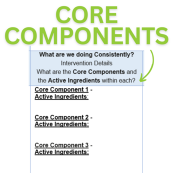
Sharing Core Components
Best bets for success
One of the most challenging aspects of implementation planning, is identifying the core components – separating the 'what' from the 'how'.
It can be tricky and the evidence is clear that it is worth the grappling with. The more sophisticated this becomes, the stronger the impact on teaching and the stronger the impact on pupil outcomes.
We will be offering some further expert PD in this aspect for leaders in our schools and more details about this will be shared in WOW soon.
|
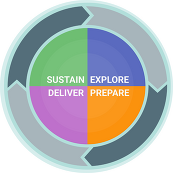
'Core Components' WELL School Learning
On a recent visit to one of our schools, the school has invested in whole staff PD around Questioning, using the Great Teaching Toolkit. This planned action was in the 'How and When' column of their plan.
During the visit, we were shown a working wall that leaders, teachers and teaching assistants used, where the core components/active ingredients for effective Questioning had been agreed and written onto large sheets of paper. These included agreed, consistent pedagogical 'Questioning' techniques, such as 'Cold Calling' (a no hands up approach to be used in lessons) and use of 'Think/Pair/Share'.
It was clear from lesson visits, that all teachers and TAs knew what the agreed ingredients/components of Questioning were, and all were applying these in lessons. What was also powerful was seeing that the working wall of core components is reviewed collectively on a termly basis, following monitoring and feedback conversations.
This process, has identified that while 'Think/Pair/Share' was understood, in practice, more time was being spent on 'Pair, Share' than 'Think'. This collective reflection enabled the school to refine the core component further and to place a greater focus on activating thinking for the following term. The word “Think” had been circled and underlined on the working wall, as the key component to collectively focus on for the following term.
In another one of our schools, an initially identified core component that all teachers would use individual whiteboards to promote whole class engagement and to support formative assessment was refined, following monitoring, to all teachers to use whiteboards, ensuring sufficient thinking time is given to students. This was because in some cases, this was not happening.
The more we can clarify the core components, the easier it becomes to monitor and to evaluate whether they are having the impact intended, and whether they are clear enough, or whether they need further refinement.
|
Examples of Core Components for WELL School priorities:
  Emotional Literacy Support Assistant (ELSA)
Do you have an ELSA, or will you have one this year after WELL training?
To support line managers in WELL schools, the following core components merit consideration as part of pastoral implementation strategy:
- The ELSA has a clear timetable for their work, which includes protected time for planning as well as intervention (it is recommended that ELSAs have at least one day a week for ELSA related work).
- All staff understand the process for seeking ELSA support for a pupil, and do not seek ad-hoc support for pupils who are being challenging in class.
- The referral system using the correct paperwork is used consistently so that the line manager and ELSA can identify and prioritise.
- The ELSA has protected time to attend half-termly supervision provided by the EPs.
- ELSAs are working with pupils who they can support towards achieving SMART targets.
- Intervention programmes with an ELSA last 8-12 weeks and impact monitored.
- ELSA work occurs at a consistent time each week, and other responsibilities must not cut into this time or be prioritised over ELSA time.
- A quiet area is protected for ELSA sessions, and the ELSA has space to store resources in this space or nearby.
- ELSAs work on a confidential basis with pupils, unless there are safeguarding concerns, and ELSAs will explain this to all the pupils they work with.
- Liaison with parents is undertaken by pastoral lead, SENDCo/line manager, not the ELSA.
- ELSAs feed back suggestions and strategies to teachers, so that interventions can be supported within the classroom and new skills transferred.
- All staff support evaluation of the ELSA intervention on a six-monthly basis.
 Writing Focus
Do you have a focus on Writing as part of your WELL/School Improvement Plan?
If so, and this includes a priority to develop sentence construction, moving from transcription to composition, the following are helpful core components to consider within implementation plans:
- All sentence level work includes discussion - explicitly talking about language choices and their impacts.
- Encourage pupils to debate, argue and justify their choices with peers, focusing on the effect on the listener or reader.
- Select sentences from authentic texts - Integrate reading and writing by demonstrating how actual writers make language choices.
- Use pictures and or short videos as a prompt for pupils to create and write sentences.
- Pupils practice saying their sentences aloud with a partner or an adult before writing them down.
- Break down example sentences with the class, pointing out the features being taught (reading as a writer). Then demonstrate how to write sentences and explain your thinking out loud (writing as a reader).
- Model and create a habit of noticing. Encourage curiosity and attention to language and sentence structure choices and how they shape meaning.
- Break writing tasks into short chunks.
- Focus on the different ingredients of strong writing and on reinforcing the basics of sentence construction.
- Concentrate on developing ideas, vocabulary, spelling, punctuation, grammar, tense and handwriting.
INSET Day Session (Cohort 1)
Monday 1st September 2025
Please look out for a direct email this week from WELL@cumberland.gov.uk about the MITA INSET Day session for Cohort 1 schools of this project, taking place on Monday 1st September 2025 at Energus, Lillyhall.
Please respond to this communication by Thursday 3rd April, to support our planning of logistics for this session.
|
2025/26 Training Cohort
We are pleased to say 43 more Teaching Assistants and support staff in WELL Schools are being trained as Emotional Literacy Support Assistants (ELSAs) this term.
To support our scoping of a potential 2025/26 ELSA cohort, please email to express an interest in training an ELSA next academic year.
|
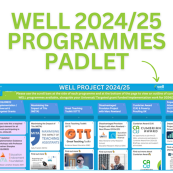
Annual Events Planner and Programmes Padlet 2024/25
The WELL Programmes Padlet outlines all of our high quality professional development programmes available for 2024/25.
All WELL Events and upcoming training sessions are detailed in the WELL Annual Events Planner.
|
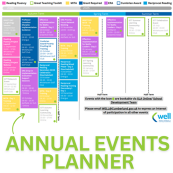
Events on the Annual Events Planner with a 'green dot' are bookable via SLA Online/ School Development Team. For all other events, please email WELL@Cumberland.gov.uk directly to express an interest.
The Annual Events Planner is a live link and will be updated throughout the year.
|
Sign up for certain WELL Events in the following ways:
- Registered users can book through our online system SLA Online
- By emailing the School Development Team at school.development@cumberland.gov.uk
- By calling the team on 01228 221315 / 221316
Thank you for taking the time to read WOW.
Do you have any feedback for WELL on Wednesdays?
Is there information missing from this newsletter that you would like to see or have a suggestion of how we can improve engagement? We would love to hear from you. Please email WELL@cumberland.gov.uk with all comments.
To find this WOW and all previous versions - please visit our website.
|