28th of April 2025
..The Mental Capacity Act 2005

Background
The Mental Capacity Act 2005 (MCA) is designed to protect and empower individuals who are aged 16 or older who may lack the capacity to make their own decisions about their care and treatment. It also gives those who care for them a clear framework within which to work.
The MCA Code of Practice supporting the legislation must be followed by anyone making decisions on behalf of another adult, whether in a paid or unpaid role. The underlying philosophy of the MCA is to ensure that any decision made, or action taken, on behalf of someone who lacks capacity to make the decision or act for themselves is made in their best interests.
|
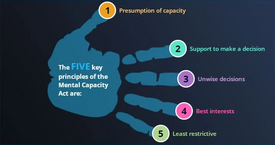
Section 1 of the Act sets out the five 'statutory principles'- the values that underpin the legal requirements in the Act. The Act is intended to be enabling and supportive of people who lack capacity, not restricting or controlling of their lives. It aims to protect people who lack capacity to make particular decisions, but also to maximise their ability to make decisions, or to participate in decision-making, as far as they are able to do so.
- A person is presumed to have capacity unless proven otherwise.
- The person cannot be treated as lacking capacity until all practicable steps have been taken to help them make the decision without success.
- An unwise decision is not to be taken as a lack of capacity.
- All actions taken on behalf of a person lacking capacity must be taken in their best interests.
- Before doing something, consider whether the aim could be achieved by using a less restrictive intervention.
|
How to determine capacity
In order for a person to be unable to make their own decisions they must meet the two stage test of capacity. This states that:
-
There must be an impairment of, or disturbance in, the functioning of the mind or brain; AND
-
This impairment or disturbance must be sufficient to prevent the person making that particular decision.
In order to determine whether (2) is met, it is necessary to apply the following test. Can the person:
- Understand the information relevant to the decision.
- Retain the information long enough to make the decision.
- Use or weigh-up the information to come to a decision.
- Communicate their decision.
It is important to clearly document the decision and the steps taken to reach the decision.
Anyone caring for or supporting a person who may lack capacity could be involved in assessing their capacity. Someone who knows and understands the person well could be best placed to do the assessment. However, in cases involving complex or major decisions a professional opinion from a general practitioner or a specialist may be required.

Assessing a person's capacity
You should refer to the MCA Code of Practice for information on how to assess a person's capacity. You can also access CSAB's flowchart to support you to assess capacity.
"Remember-Capacity is Time and Decision Specific"
|
You can view the CSAB Mental Capacity Act recordings by clicking the links below::
Mental Capacity Act - Making Unwise Decisions
Mental Capacity Act - Executive Functioning
Mental Capacity Act - Reasonable Adjustments

Best Interest Principles
One of the key principles of the Act is that any act done for, or any decision made on behalf of a person who lacks capacity must be done, or made, in that person's best interests. That is the same whether the person making the decision or acting is a family carer, a paid care worker, an attorney, a court- appointed deputy, or a health care professional, and whether the decision is a minor issue - like what to wear - or a major issue, like whether to provide particular healthcare. As long as these acts or decisions are in the best interests of the person who lacks capacity to make the decision for themselves, or to consent to acts concerned with their care or treatment, then the decision-maker or carer will be protected from liability.
Principles;
- The person's wishes, feelings, beliefs and values must be taken into consideration.
- The person must be involved in the decision as much as they are able.
- The views of others involved in their care must be considered.
- Consideration must be given as to whether the person might regain capacity and whether the decision could be postponed until then.
- All the relevant circumstances must be considered.
- Judgements must be made in an equal and non-discriminatory way.
- When decisions involve life sustaining treatments, decisions cannot be made with the purpose of bringing about a person's death.
|
Want to know more?
You can access further information and resources via the CSAB website where there is an area dedicated to The Mental Capacity Act.
|
|
 |
|