|
The leading body for maternity and newborn safety investigations in England |
|
|
A bi-monthly bulletin for stakeholders, clinical and non-clinical staff working in maternity and neonatal care and patient safety.
In this edition:
- Annual Report 2025/26 and recommendations published
- New blog: Learning with compassion
- Update for trusts: changes to the MNSI draft report review process
- Safety spotlight: Migrant women’s experience of NHS care
- Safety spotlight: Interpretation in obstetric emergencies
- Upcoming webinars
|
|
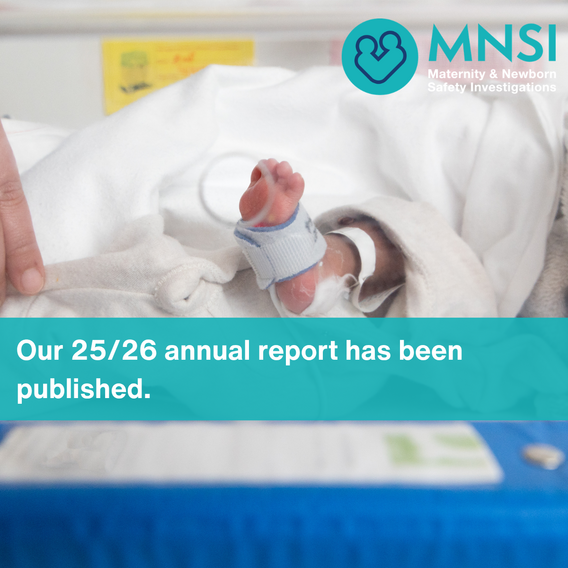
Our annual report for 2025/26 was published in October.
Between April 2025 and March 2026, we completed 618 investigations and made recommendations to 128 healthcare organisations. The report also highlights improvements and innovations in how we share learning, including:
-
Launching our two-year programme strategy (2025-2027), sharpening our focus on prevention and partnership.
-
Developing our SPARC coding framework, enabling deeper thematic analysis of investigation findings.
-
Expanding the COMPASS pilot, now running across 29 NHS trusts, to capture how organisational culture affects safety.
-
Using our health equity tools (HEART and HEWS), which explored inequalities in 100% of maternal death investigations.
-
Sharing examples of system wide impact including venous thromboembolism and neonatal exchange blood transfusion.
-
Co-creating of a proposal to establish a family voices group to embed lived experience across the programme. This is currently within its recruitment phase.
Sandy Lewis, our Programme Director, said: “Over the last year MNSI has continued to develop the work it undertakes with families, trusts and NHS staff to make maternity and newborn care in England safer. I would like to thank families for sharing their experiences, trusts for working with us to implement learning, and NHS staff for your openness to meaningfully implement safe care.”
|
|
Lou Pye, Deputy Director (Operations), has written a blog sharing what we have learned from supporting families after a patient safety event. Every family’s experience is different. However, families consistently tell us they want to feel listened to, respected and involved throughout an investigation.
The blog sets out practical ways to support families well, including:
-
listening without interruption and letting families tell their story in their own words
-
giving clear, honest information and one consistent point of contact
-
taking a trauma-informed approach
-
sharing what was learned, so families know their involvement has helped make care safer.
When families look back, they rarely talk about processes or policies first. They remember the person who listened, who remembered their baby’s name or who made them feel included.
Our programme Directions require us to share draft investigation reports with everyone who contributed, including the family. We can then capture any comments or concerns before we finalise the report. Since May 2026, this has been called the draft report review process (previously known as the factual accuracy process).
Currently, we share draft reports with trusts first, then with families. Earlier this year, we piloted sharing them with both at the same time. The pilot went well and helped us improve the information we give families and trusts, and how we ask for comments.
From Monday 16 November 2026, we will share draft reports and the new feedback form with trusts and families at the same time. Any draft reports already in review on that date will follow the current process.
Following feedback, our investigation teams will be able to share the report with the trust first if they decide it is better for the family. If this happens, we will let trusts and families know.
We welcome any feedback on this updated process, so please share it with your link MNSI investigator. It will help to inform our next evaluation.
|
|
Our first safety spotlight for November focuses on migrant women and their experience of NHS care.
We have completed several investigations where the organisation and delivery of NHS maternity and neonatal care has not been clearly explained to migrant women. Access to care can be affected when women and their families do not understand how and when to seek help. We have also found that staff may not always recognise when women are migrants, particularly if they speak English or have moved from a developed country.
We have posed seven safety prompts covering the identification of migrant women, sharing information in their preferred language, and working with local communities to improve access to and understanding of care.
Our second safety spotlight this month focuses on interpretation services during an obstetric emergency. This spotlight arose from an investigation where a woman whose first language was not English, was given telephone interpretation when an emergency caesarean birth was recommended. The interpreter did not convey the urgency of the situation to the woman. Staff could not be sure she understood, and the extra time taken to communicate with her delayed the baby’s birth.
We have posed four safety prompts on national guidance, the quality and accuracy of interpretation services, using feedback to improve them, and procurement standards.
|
|
-
Topic to be confirmed - January
-
Impacted fetal head – Tuesday 23 February 2027
-
Family engagement – Tuesday 23 March 2027
-
COMPASS – April (date to be confirmed)
Registration links and webinar updates will be shared on our LinkedIn and website.
|
|
|
|