|
The leading body for maternity and newborn safety investigations in England |
|
|
A monthly bulletin for stakeholders, clinical and non-clinical staff working in maternity, neonatal care and patient safety.
|
|
Shaping the future of MNSI: a new three year strategy
Work has begun to develop a new three-year strategy for MNSI.
This strategy will guide the future direction of the programme and set out a clear roadmap for how we will continue to drive improvements in maternity and newborn safety across England.
We will be shaping the strategy in collaboration with the women, birthing people and families we work with, alongside NHS staff, key stakeholders from healthcare, patient safety and government, as well as our own team.
Sandy Lewis, director of the MNSI programme, said:
“We want this strategy to be ambitious and forward-thinking, with our core purpose of improving maternity and newborn safety at its heart.
"Shaping the strategy in collaboration with mothers, birthing people, their families, and other key individuals from across the maternity, newborn and patient safety sectors will ensure that we incorporate the perspectives of those with lived experience, alongside the expertise of maternity, newborn and patient safety professionals.
“This strategy, which will reflect recent changes to the healthcare landscape, will act as a guiding compass for MNSI, ensuring we develop the programme to meet the changing needs of maternity and newborn care and patient safety.”
We expect to publish the final strategy in autumn 2025 and will keep you updated through this bulletin and our LinkedIn page.
To find out more or to get involved, please contact: Enquiries@mnsi.org.uk
|
|
|
Midwives play a vital role in ensuring the safety of women, birthing people and their babies. To mark International Day of the Midwife 2025, Katherine Hawes, deputy director of the MNSI programme, and Rebecca Daniels, lead midwifery clinical advisor, have reflected on the critical contribution of midwives to patient safety in a new blog post.
The blog explores the importance of close collaboration between midwives and other maternity professionals, including obstetricians, neonatologists and anaesthetists in delivering safe care. It also highlights the role midwives play within MNSI in shaping safety prompts that are clinically robust and practical to implement across maternity and newborn services.
You can read the full blog by clicking the button below:
|
|
Reviewing and actioning laboratory test results
MNSI has undertaken investigations where laboratory test results have not been reviewed and actioned meaning that women who require either follow-up investigations or referral to specialist services have not been identified.
When a woman who had received emergency care in early pregnancy was reviewed prior to her discharge home from hospital all the available laboratory test results were not considered as part of the clinical review. This led to the woman being assigned to an incorrect care pathway and the necessary follow-up was not arranged.
|
|
To ensure that women requiring either follow-up investigations or referral to specialist services are identified in your service, consider the following:
- What systems are in place to ensure that all laboratory test results are reviewed and actioned?
- Are staff consulted to gain an understanding of any barriers that they face when using the current system aimed at identifying women requiring either follow-up investigations or referral to specialist services?
|
|
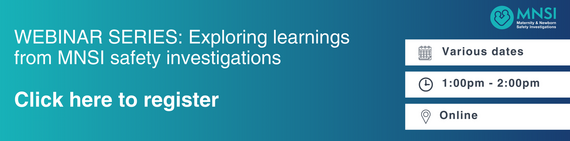
The second series of MNSI webinars is now underway. These sessions share key learning from our safety investigations and provide insight into the themes, tools, and findings emerging from our work. Each webinar supports wider system learning and aims to contribute to safer care across maternity and newborn services.
The upcoming webinars will look at MNSI’s Health Equity Warning Score (HEWS) and the Health Equity Assessment and Resource Toolkit (HEART), factors affecting safe care in midwifery units and umbilical cord management.
MNSI is piloting a new tool, COMPASS (Culture of Organisations and its iMpact on PAtientS’ Safety), designed to support a more consistent and objective approach to understanding how organisational culture affects patient safety.
Developed by Chris McQuitty, clinical fellow, and Nicki Pusey, maternity investigation team leader, COMPASS provides a structured process for MNSI staff to articulate, analyse and share observations about safety culture during investigations. The tool is currently being trialled across 12 NHS trusts.
COMPASS builds on work by the Patient Experience Library, which reviewed a decade of reports from major healthcare inquiries, including investigations into maternity care at East Kent and Morecambe Bay. Their findings were published in a report, earlier this year, Responding to Challenge, highlighting how cultural issues within organisations often underpin avoidable harm.
Read more about the tool below:
|
Earlier in May, Louise Roe, maternity investigator at MNSI, presented at the Chartered Institute of Ergonomics and Human Factors (CIEHF) 2025 Conference.
Her presentation focused on the development of MNSI’s Local Rationality Question Tool. The tool supports our maternity investigators to understand why a decision, action or inaction made sense to maternity and newborn staff involved at the time of a maternity or newborn safety incident. The tool aims to ensure that MNSI investigations focus on developing system-wide learning, reducing the possibility of making individual staff feel blamed or interrogated during the investigation process.
Louise’s blog 'Why it made sense at the time: Local rationality questions for healthcare investigations' is available below.
Maternity Safety Conference, 22 May, Manchester, England
Awareness Days
World Patient Safety Day, Wednesday 17 September 2025
Baby Loss Awareness Week, 9 - 15 October, 2025
|
|
|
|
|