|
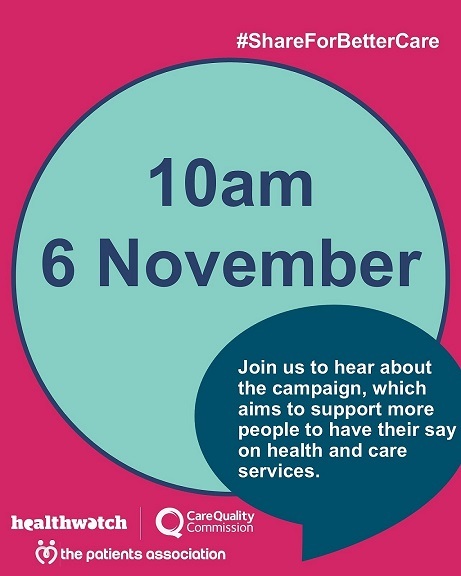
Top righthand corner text reads: #ShareForBetterCare. Centre on image text reads: 10am 6 November, text under in a speech bubble reads: Join us to hear about the campaign, which aims to support more people to have their say on health and care services. Left hand corner has the following logos: healthwatch, the patients association and Care Quality Commission.
Patients' experiences can provide vital lessons for health and care services, helping them understand what is working and what needs improvement. However, not everyone knows how to speak up about their care, and health and care services could be better at telling people how they can provide feedback and why this matters.
The Patients Association is hosting a webinar on Wednesday 6 November 10-11 a.m. to discuss this issue.
Join the CQC, Healthwatch England, and the Patients Association to:
- Hear about their campaign, which aims to support more people to have their say on health and care services
- Understand the barriers that exist to giving feedback and potential solutions
- Listen to patients explain first-hand their experience of providing feedback and how this improved their care
- Discuss the current ways people provide feedback and what more can be done to ensure patients' voices are heard.
With the NHS currently consulting on its 10-year plan to reform, it's never been a better time to discuss how we can ensure patients have a stronger voice today and in the future.
 'Help build a service fit for the future' Change NHS campaign poster.
The NHS has been there for us for over 76 years. But to make sure the NHS is here for the next 76 years, doing all it can to support the health of everyone, they need your help.
They want to have the biggest ever conversation about the future of the NHS.
It doesn’t matter whether you have a lot or a little to say. Your views, experiences and ideas will shape a new 10 Year Health Plan for England.
This is open to everyone. If you are a member of the public or someone who works in health and care in England, go to start here, to tell us how the NHS needs to change.
If you are contributing as a representative of an organisation, complete the organisation questionnaire. This is an early opportunity to share your insights as we begin an extensive programme of engagement to develop the 10 Year Health Plan.
If you register your email address, NHS will stay in touch to seek your views as the 10 Year Health Plan develops.
 Photograph of older people having tea
‘Thriving in Residential Care’ is groundbreaking new research from My Home Life England, part of City St George’s, University of London, which reveals the diverse experiences of older people living in care homes across the UK.
One of the largest ever qualitative research studies on older people’s experiences of living in residential care, the research identifies some challenges, but reveals proportionally many more benefits of living in a care home.
The insights, heard directly from older people, care teams and families, shine a light on six key ways that older people can thrive in a care home, if the conditions are right.
Find out what supports older people to live well and thrive in residential care.
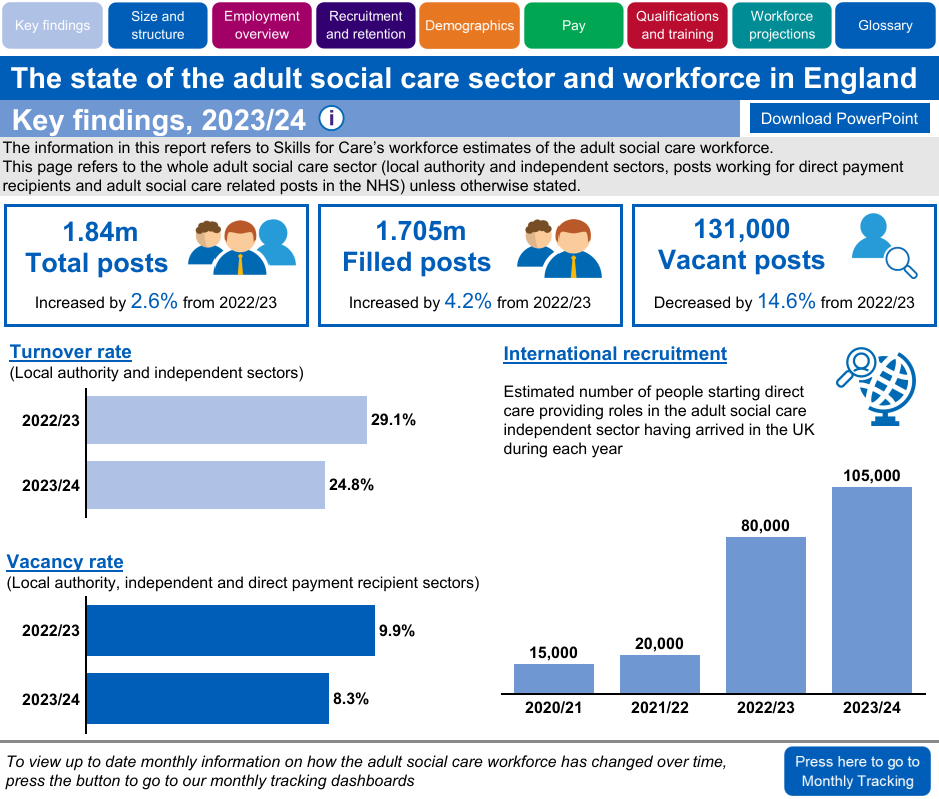 Skills for Care’s new report highlights key workforce trends, including recruitment, retention, pay, and demographics and workforce projections. The report also explores factors impacting CQC ratings.
Key findings include:
- 1.705 million filled posts and 131,000 vacancies, bringing the total to 1.84 million—the highest on record.
- Turnover rates for care workers (29.9%) and registered managers (19.4%) were at their lowest since 2017/18.
- The proportion of male workers increased to 21%, up from 18% historically.
- The local authority and independent sectors workforce’s average age, which had been rising, dropped to 43.7 years in 2023/24
- These changes have been influenced by an increase in international recruitment. Internationally recruited workers were more likely to be male (29%) and an average age of 34.1.
These findings rely on data from the Adult Social Care Workforce Data Set, which helps providers access training funding and manage records.
 A illustration of people, all with speech bubbles above their heads
The Institute for Employment Studies are researching workforce inequalities in health and social care and want to hear from you! They want to understand how employees with certain characteristics are unequally treated while at work, including discrimination, bullying or harassment, not being fairly considered for promotion, or not being able to get issues like these recognised or resolved when they arise.
The survey takes 20 minutes to complete and will provide evidence of how workforce inequalities are experienced and observed in the health and social care sector. The survey can be accessed here. The survey will close on 10 November. If you have any questions, please contact workforce-inequalities@employment-studies.co.uk.
 Logo images of: The Care Provider Alliance, DSPT, Better Security. Better Care. Digital Care Hub.
Care providers need to store and share information securely, on paper and digitally. It's essential to delivering person-centred care, based on good information. And it’s a legal and regulatory requirement.
Digital Care Hub are working with the Care Provider Alliance and their Better Security, Better Care team to understand the data protection and cyber security challenges you face. They will work with them to deliver free support on the key issues. To help them with this, please complete this short survey
You may be aware but a reminder of Digital Care Hub's new resources below:
|