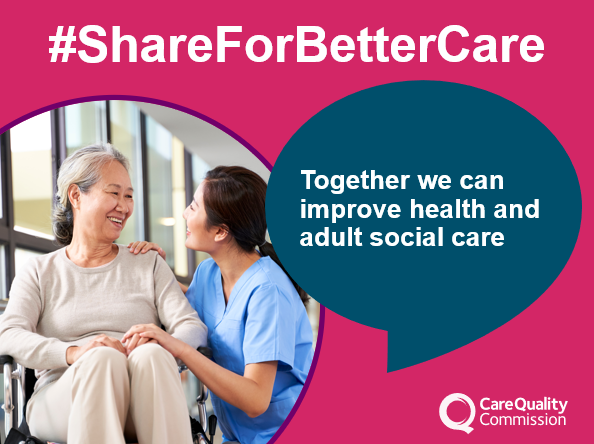
 Text at the top of the image reads: "#ShareForBetterCare", under text an image of a nurse talking to an older woman in a wheelchair, right-hand side of the image text reads in a speech bubble: "Together we can improve health and adult social care". Right-hand corner text reads: Care Quality Commission
In the coming weeks we will be launching our new campaign 'Share for Better Care' alongside Healthwatch England, the Race Equality Foundation, National Dignity Council, and the Royal Association for Deaf People.
The campaign, which aims to increase the range and volume of care experiences that people share with us, builds on the success of our Because We All Care campaign which we ran between 2020 and 2023.
The Share for Better Care campaign centres around research and audience insight and focuses on engaging people whose voices are seldom heard, especially people from
- people from minority ethnic communities
- autistic people and people with a learning disability
- disabled people with physical or sensory impairments
- lower-income groups.
We will provide a campaign toolkit for you to help support the campaign.
If you’d like to get involved by sharing a story about the importance of feedback where you work – please get in touch.
 Illustration of patient studying medical checkup list with doctor
One of our core ambitions is to ensure that the services we regulates have a stronger safety and learning culture.
Through our new quality statements, we're looking to assess both ‘safety through learning’ and ‘learning culture’.
To ensure we take the best approach to assessing providers on this topic and to ensure we're able to give providers the best quality information on what good likes in this area we'd like your feedback through this short survey.
 Older man and healthcare worker going through medical reports during home visit
In December 2023, the Department for Health and Social Care (DHSC) announced legislation to make visiting and accompanying a fundamental standard of care.
Visiting is crucial to the health and wellbeing of those receiving care as it ensures that people remain connected with loved ones and their community. They should also have people to support and advocate for them when they are at their most vulnerable.
The new legislation will come into force on 6 April 2024. DHSC is running a series of online information sessions via Teams, with support from CQC colleagues. These will explain what the legislation requires you to do as a provider and you will be able to ask any questions you might have about the guidance.
Sessions take place on:
- Tuesday 19 March and Wednesday 3 April for care home providers
- Monday 25 March and Tuesday 2 April for hospital providers
- Wednesday 27 March for hospice providers
Use this registration form to sign up for a session. Teams invites will be sent a few days before the session. For any queries, please contact the team on visiting@dhsc.gov.uk
 Illustration of a magnifying glass looking at a pound sign
The Department for Culture, Media and Sport (DCMS) is running a £25.5 million funding package to help voluntary, community, and social enterprise organisations in England improve their energy efficiency.
Eligible organisations can able to apply for 1) an independent energy assessment and 2) capital grants to install energy efficiency measures.
The scheme is open to frontline community organisations across England. Groundwork UK, who are delivering the scheme, are particularly keen to hear from small and medium organisations with significant concerns around energy who are directly supporting individuals and communities with critical needs, especially those related to the rising cost of living.
Examples include:
- Services that address poverty, including by providing food, warmth, emergency supplies or personal grants
- Shelter, accommodation and housing for those most in need
- Advice for people experiencing financial, housing or legal challenges
- Services that address specific physical and mental health issues
- Education, training and employment services that improve employability
- Community hubs or centres, out of which a number of these services operate
Organisations are encouraged to apply as soon as possible.
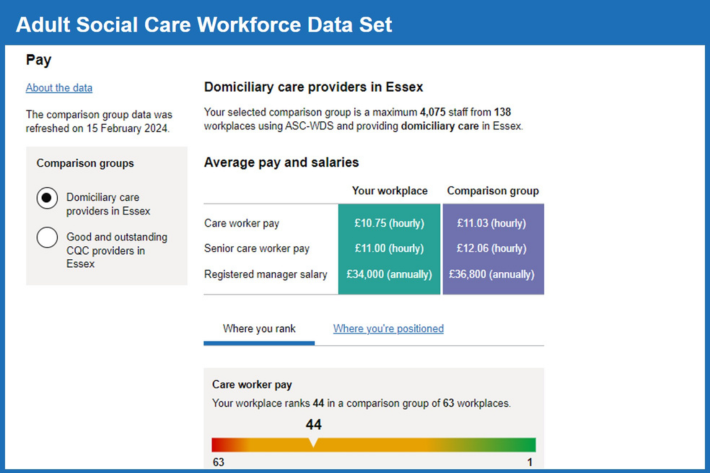 Screenshot of the new benchmarks feature
Skills for Care has added two new quarterly tracking dashboards to their workforce intelligence. One gives an estimate of the number of people who have been recruited internationally to start a care-providing role. It shows trends and a breakdown across service types and regions. The other shows filled posts, starter rate, turnover rate and vacancy rate, broken down by integrated care board area.
Inside the Adult Social Care Workforce Data Set (ASC-WDS), there is also a new place to track your individual data. The new look of the benchmarks area allows you to compare your workforce metrics against similar providers in your local area, or specifically those who are ‘Good’ or ‘Outstanding’. You can view data on pay rates for different job roles, vacancy and turnover rates and the percentage of staff still in their role after 12 months. There are lots of other benefits in using ASC-WDS too.
|