|
NHS England has published the first NHS workforce equality, diversity and inclusion (EDI) improvement plan. It supports the objectives of the forthcoming Long Term Workforce Plan by setting out actions to improve the culture of our workplaces and the experiences of our workforce.
The plan sets out 6 measurable actions for NHS organisations to address inequalities across the 9 protected characteristics in the Equality Act 2010.
Addressing all forms of discrimination and inequalities, will enable our workforce to use their full range of skills and experience to deliver the best possible care to people.

Sean O’Kelly, CQC’s Chief Inspector of Healthcare, said: “How providers are promoting EDI across their workforce and ensuring that staff are treated equitably provides vital insight into an organisation’s culture. We've seen first-hand through our inspection and monitoring that it also has a strong link with the quality of care provided.
“The actions set out in the NHS EDI Improvement Plan will help to further instil values and behaviours which create a more equal, diverse and inclusive health service, and ensure fair treatment and opportunity for everyone working in NHS services. They also align with the specific areas we look at as part of our well-led assessments – so how trusts are meeting the 6 high impact actions is something we'll consider as evidence when reviewing a trusts culture and leadership – highlighting where we find good practice as well as scope for improvement."
|

In collaboration with clinicians and academics from Staffordshire and London South Bank universities, NHS Resolution has launched its first eLearning module. It responds to ‘significant avoidable harm that can occur during the antenatal and postnatal care of mothers and their babies’ which was flagged by its Early Notification Scheme.
The free resource is designed for maternity services clinicians, and aims to:
- deepen understanding of NHS Resolution’s role within the healthcare system
- develop understanding of the law of negligence as applied to clinical aims
- explore how clinical decisions and actions can lead to avoidable harm.
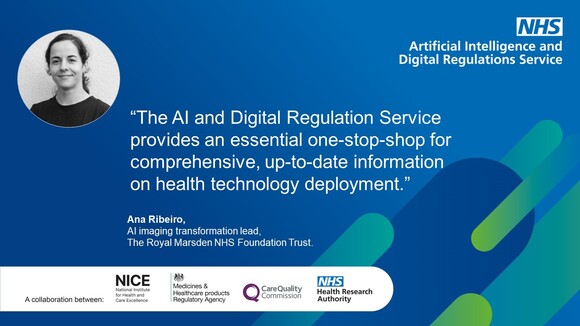 Pull-quote and headshot photo of Ana Ribeiro, AI imaging transformation lead, The Royal Marsden NHS Foundation Trust: "The AI and Digital Regulation Service provides an essential one-stop-shop for comprehensive, up-to-date information on health technology deployment". Collaborative partner logos shown at the bottom.
A new online advice service to help the NHS and wider care system adopt and make use of new digital and AI technologies launched this month.
The AI and Digital Regulations Service provides guidance for NHS and social care adopters and digital health innovators.
The service offers:
- a website providing centralised, curated and up-to-date regulatory content for both developers and adopters of AI and data-driven technologies; and
- access to specialist support for both developers and adopters from the service partners.
The service is a multi-agency collaboration between CQC, the National Institute for Health and Care Excellence, the Health Research Authority and the Medicines and Healthcare products Regulatory Agency and is funded by the NHS AI Lab.
The site provides comprehensive guidance at each stage of the adoption pathway all in one place. The service can also respond to individual enquiries, making connections with relevant services or system partners.
Director of Technology, Anthony Snape, said, “The use of AI in health and care settings is increasing and developing rapidly. This exciting service is an example of how CQC is instrumental in driving technology-based change that ultimately brings improvements in how we ensure that people experience safe, effective, compassionate, high-quality care.”
The Department of Health and Social Care (DHSC) has launched a consultation on the Oliver McGowan Code of Practice on statutory learning disability and autism training.
This code of practice outlines how CQC-registered health and social care providers can meet the legislative requirement to ensure their staff receive training on learning disability and autism, appropriate to their role. This requirement has been in force since 1 July 2022 – further information on this requirement can be found on our website.
We believe it’s essential that autistic people and people with a learning disability have access to safe, high-quality care. We have engaged closely with DHSC on the implementation of the training requirement and the development of this code of practice.
The consultation is open until 19 September 2023. If you’d like to respond, please visit the government’s website for further information.

We're always keen to hear from you to help us to shape how we work. Sign up to our online participation platform CitizenLab today, to share your ideas and feed back on live projects.
Currently, we'd love to hear from you about:
With support from RSM research consultants, we’re reviewing the improvement support offer across the health and care landscape. This focuses on the sectors we regulate.
As part of this, RSM is looking to interview health and care providers in England who have accessed or received improvement support.
Closing soon
We want to explore the successes and challenges you've experienced when looking after your workforce, and invite you to share them with us via our short survey by 30 June 2023
Through our work on innovation, a number of questions have come up, which we think it would be helpful to answer. We’ve developed a set of questions which we'd like to shape further. Please use this survey to share your responses by 30 June 2023
|