Provider collaboration in urgent and emergency care
We have published the full findings of our provider collaboration reviews of urgent and emergency care in eight areas of England in October 2020. The report shares the overall learning from the review, which falls broadly into the themes of ensuring access; tackling inequalities; governance and shared planning; safety and staff skills; and use of technology.
The report also looks forward to next winter and beyond. It identifies that the main challenges for systems are how to:
- Develop and build on relationships
- Share important information
- Plan staffing across the system
- Understand inequality
- Embrace technology
Visit our website to read the report and news story.
COVID-19 Insight: Issue 9
This month's insight report looks at the impact of the pandemic on urgent and emergency care services and pharmacy services in NHS trusts.
We look at inspections of emergency departments, which took place in winter 2020. We identify the key factors affecting services' ability to provide a good standard of care in emergency departments:
- Changes to the environment
- Onward capacity from the emergency department to other parts of the hospital
- Delayed transfer of care
- Staffing levels and absence
- Leadership and governance
- What systems were in place to mitigate risk.
The report also shares how chief pharmacists and medicines optimisation leaders in NHS trusts assured themselves of safe medicines practice during the pandemic.
Ted Baker, Chief Inspector of Hospitals, said: "Lessons from this winter must be learnt and planning for next winter must start now to ensure these hard-learnt lessons to the current crisis are not lost. We have seen some good examples of how systems are working together to respond to the exceptional pressure they continue to face. However, we continue to find significant problems of access and capacity in urgent and emergency care services, and whole systems need to work together to make further improvements if providers are to manage future pressures better".
Visit our website to read the report and news story.
Protect, respect, connect - decisions about living and dying well during COVID-19
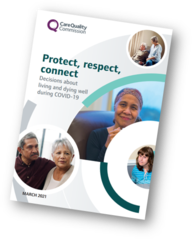
We were commissioned by the Department for Health and Social Care, under section 48 of the Health and Social Care Act 2008, to conduct a special review of Do Not Attempt Cardiopulmonary Resuscitation (DNACPR) decisions taken during the COVID-19 pandemic.
Our interim report published in December 2020 found that a combination of unprecedented pressure on care providers and rapidly developing guidance may have led to decisions concerning DNACPR being incorrectly conflated with other clinical assessments around critical care.
We have now published our final report, Protect, respect, connect –decisions about living and dying well during COVID-19, which shares our full findings and recommendations.
You can read our full press release, report and easy ready on our website. You can also read a blog from Dr Rosie Benneyworth, Chief Inspector of Primary Medical Services and Integrated Care, in which she discusses the findings and the importance of good end of life care planning.
|
Updated guidance on meeting the duty of candour
We have updated our guidance for providers on Regulation 20 - the duty of candour. This is to make it clear what providers must do to meet the requirements of the regulation and the circumstances in which it must be applied.
The regulation puts a legal duty on all health and social care providers to be open and transparent with people using services, and their families, in relation to their treatment and care.
The guidance will support providers in all sectors to fully understand the duty and know what they have to do to carry it out. In turn, this will have a positive impact on people using those services. Visit our website to see the guidance.
New evidence log for inspection reports
We are trialling a new approach to presenting the evidence we have used in our inspection reports. The new ‘evidence log’ will replace the evidence appendix which was previously included with inspection reports. It will be introduced in the next few weeks.
The purpose of the evidence log is to provide a list of the evidence used in an inspection to help you understand how we have reached our judgement. This approach will be used for all inspections in all sectors across the NHS and independent health.
The evidence log will be shared with you alongside the summary report and can be reviewed as part of the factual accuracy process.
We’re keen to hear your feedback on this approach. We will be sharing details of how you’ll be able to feedback through our digital engagement platform in due course, and we also welcome comments directly to your relationship owner.
Survey: sexual safety in ambulance services
We are undertaking a piece of work to understand the approach taken by ambulance services in England to ensure the sexual safety of patients and staff, and any opportunities to strengthen this.
Ambulances can be closed environments, which can increase risks to sexual safety. We are aiming to raise awareness about this risk and drive improvement by highlighting a need for preventative measures to be implemented and through helping to share learning and good practice.
To inform this work, we will be contacting NHS ambulance trusts and private ambulance providers asking them to complete a short survey. The findings will be presented at a workshop later this year, supported by NHS England Safeguarding, the Association of Ambulance Chief Executives, and the Independent Ambulance Association.
Please look out for the survey, which will be sent by email in the coming weeks.
State of Care evaluation

We'd like to know your thoughts on our State of Care report published in October 2020, please complete the survey here to provide your feedback.
Many of you will know that the pressures in social care were heightened in 2020 due to the pandemic. We have seen the hard work that has gone into keeping people safe in care settings, and providers collaborating to support this work. Social care staff have persevered through this time and supported residents and people that use their services in new and additional ways to their role.
We would value your thoughts on the findings from State of Care 2019/2020, please use the survey to provide your feedback. We've also included some questions on our COVID-19 Insight Reports to understand your thoughts on them.
Please complete the survey by Monday 5 April 2021.
|
Fast-track practising privileges for consultants
As we move through the changing phases of the coronvirus pandemic, we have reviewed our guidance on fast-track practising privileges for consultants to take account of patient safety demands on services and their staff.
Visit our website for more information.
Evaluating CQC's transitional regulatory approach

From October 2020 CQC introduced it's transitional regulatory approach. The purpose of this approach was to ensure we continued to deliver our core purpose of keeping people safe as well as support providers of health and social care during the pandemic.
To help us continue to develop our approach and understand what we may need to change we would like to hear your views on our transitional approach through this short survey.
|
NHS Providers publishes regulation survey report
A new report by NHS Providers on trusts’ experience of NHS regulation highlights strengths and weaknesses in the approaches taken by Care Quality Commission (CQC) and NHS England and NHS Improvement in response to the COVID-19 pandemic. Based on findings from its annual regulation survey, it concludes that both organisations implemented welcome changes in response to the onset of the pandemic, scaling back their activity to allow trusts to concentrate their full efforts on patient care.
Ted Baker, Chief Inspector of Hospitals, said:
"I am pleased to see that the majority of trusts completing the survey welcomed CQC’s response to the pandemic, and that our decision to pause routine inspections to focus on areas of critical risk resulted in reduced regulatory burden and helped trusts to concentrate efforts on the COVID-19 operational response.
“Like many of those surveyed, we recognise that there are important lessons that can be learned from the pandemic. COVID-19 has made everyone involved in health and social care think differently and that includes CQC and NHS England and Improvement in our role as regulators. For CQC, it has demonstrated the clear potential for a more flexible and proportionate risk-based approach that also maintains the rigour of our oversight and ensures people have access to safe high-quality care.
“I would like to thank everyone who responded to the survey as well as all those who have fed back to us directly. We are committed to listening to providers and their staff and will continue to use their feedback to inform developments in our approach going forward."
Improvements to CQC notifications

We are making changes to our notification forms to make them easier for you to use and improve the quality of information collected.
In the last month we have made improvements to the SN16 Death Notification available through the CQC portal. We have made it more comprehensive to allow us to better capture and report on data around vulnerable communities, and making it easier for you to use.
Using the CQC portal will ensure the best experience when submitting a notification to CQC. If you are submitting a notification using a form, make sure you are using the latest version by downloading from our website each time you submit a notification.
Visit our website for information about what you need to notify CQC about and how you can do it and we’ll let you know through this bulletin as more forms are updated.
|
Latest COVID-19 vaccination news
You can find all the latest news on the COVID-19 vaccination programme on the GOV.UK website. Including the latest guidance, bulletins and lots more.
Information on UKAS accreditation for providers of commercial coronavirus testing can be found on our website.
Human Tissue Authority: Important regulatory changes regarding the import or export of human tissues and
cells between Great Britain (GB) and the European Economic Area (EEA)
The Human Tissue Authority (HTA) is the regulator of human tissue, cells and organs in the United Kingdom. Their regulatory oversight extends to the use of human tissues and cells for human application (patient treatment).
Regulatory changes came into effect following EU Exit. These changes apply to establishments based in GB that send (export) or receive (import) human tissues or cells between GB and a country in the EEA. If you wish to continue these activities from 1 July 2021, you may require a HTA licence.
Who is affected?
If you import or export human tissues and cells for human application, you will need a HTA licence. Examples of human application include:
- using bone, pericardium, and dermal tissue products in dentistry;
- bone products used for orthopaedic treatment;
- amnion tissue products used as barriers in wound healing;
- skin grafts used to replace damaged skin tissue; and
- corneal grafts used in ocular surgery.
Please note that the above list is not exhaustive and other activities may apply.
The types of organisations that might be impacted include dental practices, dental surgeries, organisations performing cosmetic or orthopaedic procedures, and commercial distributors, who may not have required a HTA licence before EU Exit.
The changes also apply to the import and export of tissues and cells that form the starting material for Advanced Therapy Medicinal Products (ATMPs).
Next steps
Please complete this short survey which will help the HTA determine which activities are impacted.
If you think your establishment is affected by these changes, please contact the HTA as soon as possible for advice or visit the HTA website. You can also call them on 0207 269 1900.
Other information
If your establishment requires a HTA import or export licence as a result of EU exit, you are not required to pay a licence fee for these activities in 2021/22. The HTA will announce 2022/23 licence fees in December 2021.
CQC podcasts: Sexual safety through empowerment

Listen back to our recent podcast episode that discussed our 'Sexual safety through empowerment publication' and Skills for Care's new guidance on supporting personal relationships.
You can find all our podcast episodes on Soundcloud and most other major podcast providers.
|
All CQC offices are closed
Please do not send post - visit our website for details on how to contact us.
Guidance for providers and professionals working in healthcare services
Accessibility resources to help you communicate about COVID-19


Follow us on Twitter!
Follow @CQCProf on Twitter to get regular updates about the work we are doing with professionals and provider organisations in England.
|
|