 |
|
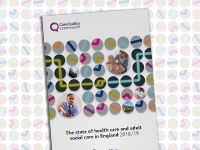
State of Care 2018/19
This year's annual assessment of the state of health and social care in England shows that quality ratings have been maintained overall, but people's experience of care is determined by whether they can access good care when they need it.
State of Care considers the pressures faced by health and social care as a whole, but this year focuses particularly on inpatient mental health and learning disability services, the area where CQC is seeing an impact on quality.
Visit our website for a summary, download the full report, and access an easy read version. A blog from Chief Executive Ian Trenholm introduces the key findings, while Chief Inspector of Hospitals, Prof Ted Baker, discusses some of the findings relating to NHS and independent services.
|
Urgent and emergency care survey
We have published the findings of a survey of more than 50,000 people who received urgent and emergency care from services provided by 132 NHS trusts across England. The survey covers type 1 (A&E departments) and type 3 (urgent care centres or minor unjury units run directly by an NHS acute hospital trust) services.
The majority of people were positive about most aspects of urgent or emergency care they received, however the results suggest there is scope for improvement in a number of areas, including:
- waiting times
- help from staff with pain control
- information provision when leaving A&E or the urgent care centre
For more information, including results for individual trusts, visit our website.
New supporting information for inspectors and Mental Health Act reviewers addresses the risk factors of closed environments
We are giving inspectors and their managers new supporting information about how to identify and respond to 'closed cultures' in services.
People are more at risk of abuse and human rights breaches when a service has a closed culture. This new supporting information includes risk factors and warning signs of closed cultures in health and social care settings and how inspectors and their managers should consider and respond to these.
For more information on the purpose of the information and why we are releasing this information now please see the news story on our website.
New blog post by Interim Deputy Chief Inspector of Adult Social Care Rob Assall-Marsden
Interim Deputy Chief Inspector of Adult Social Care, Rob Assall-Marsden, has also written a blog to update on our restraint, seclusion and segregation in hospitals and care services work. The blog also discusses the information on closed cultures.
Read the blog here.
Correction: Earlier this month we issued this section of the bulletin with the title 'New blog post by Interim Chief Inspector of Adult Social Care Rob Assall-Marsden'. We apologise for this error and can confirm the correct job title for Rob Assall-Marsden is Interim Deputy Chief Inspector.
Independent cosmetic surgery services - emerging concerns
We have inspected 65 services that provide solely cosmetic surgery and/or hair transplant surgery. This represents just under two thirds of those currently registered. These inspections have identified some good individual practice. But they have also found some common areas of concerns.
Professor Ted Baker, Chief Inspector of Hospitals, has written to all independent cosmetic surgery providers highlighting these emerging concerns and clarifying the standards of patient care the CQC expect and patients deserve. It also reminds providers of their responsibility to deliver safe and effective services.
More information, including the letter in full, is available on our website.
Displaying use of resources ratings
We have improved the way that use of resources and combined ratings are displayed on our website, in our inspection reports and on trust ratings posters. As a result, trusts that have had a use of resources assessment must display their use of resources and combined rating alongside their other CQC ratings under Regulation 20A.
Trusts are only required to display the overall quality rating on their website, but they must display all ratings on posters. Updated ratings posters are now available, and we ask that trusts make any necessary changes as soon as possible.
Guidance on the display of ratings, how to download CQC ratings posters and how we enforce the regulation is available on our website.
Cannabis-based medicinal products
In November 2018, the law changed to allow cannabis-based medicinal products to become Schedule 2 controlled drugs, making them available on prescription. Most cannabis-based medicinal products are unlicensed medicines in the UK, apart from some products with a marketing authorisation, which are licensed for certain health conditions.
We have published an interim policy position that outlines our registration requirements for providers who may prescribe cannabis-based medicinal products.
No change to CQC Fees Scheme in 2020/2021
We've previously written to all providers to update them that our fees scheme will not be changing next year.
This means that, for most providers, their fees will remain the same as in 2019/20, providing their registration or size does not change. NHS trusts, NHS GPs and community social care providers may see a small change to their fees from April 2020 (up or down), because each provider’s fee is calculated by looking at their size against the total size of the sector, both of which change year-on-year. However, the total fees collected for each sector will not change.
You can find more information on our fees scheme, guidance and calculator on our website at www.cqc.org.uk/fees
Other news
- We have signed a memorandum of understanding with the National Police Chiefs' Council. The MoU will see an established framework for the sharing of information where incidents of avoidable harm have occurred to people using health and social care services.
- The Royal College of Nursing has published Standing up for patient and public safety, a report setting out the impact of poor staffing levels on patient safety.
- World Homelessness Day was marked on 10 October, serving as a day to draw attention to homeless people’s needs. With this in mind, we wanted to remind those who come into contact with homeless people about the legal duty to refer. Guidance from the Department of Health and Social Care provides an overview of the duty and helps NHS trust staff understand how to make a referral to a local authority.
 |
|
Join our digital engagement platform
To help us make sure we are an effective and efficient regulator we want your views on how we develop the way we work. One way you can share your views is on our digital engagement platform, signing up is quick and simple and there is loads for you to comment on.
|

Follow us on Twitter!
Follow @CQCProf on Twitter to get regular updates about the work we are doing with professionals and provider organisations in England.
|
Did this bulletin work for you?
|