 |
|
We’ve been working with the Department of Health and Social Care (DHSC), British Institute of Learning Disabilities and NHS England to see what a better system for people at risk of segregation in a hospital would look like. We’d now like your feedback on our ideas for next steps. If you have any questions about this work email RSSthematic@cqc.org.uk. The survey closes 1 October 2019.
Read more about this work
|

Public Health England (PHE) have a new mental health campaign launching on 7th October. Can you help support them and raise awareness?
PHE want everyone to feel more confident in taking action to take care of their mental health and wellbeing. They're promoting a range of self-care actions to promote good mental health and tackle common problems, as well as signposting wider resources and services for those in greater need.
Sign up to the campaign resource centre for updates and access to campaign materials - make sure you tick “mental health” in the signup process.
View and download what’s already available here.
|
We're inviting innovators and services to look at how they can work with the regulator as they develop new approaches to care. The first wave opened for interest in August this year, this second wave will include two rounds running side-by-side, exploring:
-
Community care at home teams (supporting personal assistants)
We have started to see a new type of homecare service that does not fit with how CQC currently regulates homecare agencies. This can be delivered by groups of personal assistants or agencies seeking to give a greater level of support to the carers they introduce.
-
Artificial Intelligence and its use in radiology and diagnostic services
How machine learning algorithms support diagnostic and imaging services.
Trialling sandboxing is part of our work to encourage innovation, quality and safety.
October is Speak Up Month, which means organisations throughout England will be making a special effort to raise awareness of speaking up and their willingness to listen to workers. Last year over 100 events took place with other activity including short films, podcasts, blogs and work with local media. Keep track of what's going on #speakuptome
Read more about the National Guardians Office.
|
We're inviting Health and Wellbeing Boards in England to tell us whether their local system to support children and young people with mental health problems matches the recommendations made in our Are we listening? report.
The report, published in March 2018, was a review of children and young people’s mental health services and included recommendations for national, regional and local action. Now we're following up on the recommendations by asking Health and Wellbeing Boards in England to complete a self-assessment process by responding to a series of questions that address key findings or recommendations.
The All-Party Parliamentary Group (APPG) on Social Care have a new report out looking at social workers. The APPG say high quality, sustainable social care is they key to a healthy and dignified society, yet care workers are too often overlooked in terms of investment, training, pay and value. They think the oversight is impacting workers and the vulnerable people who rely on their work.
We've updated our memorandum of understanding (MoU) agreement with the Department of Health and Social Care (DHSC) around the inspection and monitoring of independent termination of pregnancy services. The agreement sets out how we'll work together with the DHSC’s Healthy Behaviours Team to safeguard the wellbeing of people using independent termination of pregnancy services in England. This includes a formal commitment to share information with each other when we become aware that a service may be providing termination of pregnancy services without being appropriately registered or licensed.
The Institute for Public Policy Research (IPPR) has published The ‘make do and mend’ health service: Solving the NHS’ capital crisis, a report on PFI private finance initiatives (PFI) investments. The report finds that the NHS faces a PFI postcode lottery as some trusts are forced to spend up to £1 in every £6 on PFI payments, with worrying consequences for patient safety. The report identifies safety hazards, sewage leaks and falling ceilings as ‘major risks’ at hospitals as part of the legacy of PFI.
The Local Government and Social Care Ombudsman has found problems with nearly two out of every three adult social care complaints it has investigated in the past year. The report focuses on the cases they looked into during the year and provides a preview of real-life experiences at the front line of adult care. Their report shows they're investigating more complaints than previous years - and that they're finding fault on average in every two out of three cases.
Health Education England (HEE) have a new business Plan for 2019/20, setting out how it'll meet the changing needs of the NHS and provide the workforce needed now and in the future.
HEE outlined its plans to focus on three strategic long-term goals. They are:
- The future workforce – delivering the future health and care through high quality education and training.
- The current workforce – developing and transforming staff to work in response to new technologies and changing patient needs
- Quality and patient Safety – improving the quality of the learning environment to improve safety
The Professional Standards Authority (the Authority) have released research that analyses the incidents of sexual misconduct by health and social care professionals. The report was funded by the Chair in Human Resource Management and Organisational Psychology at the University of Glasgow. The findings show perpetrators are predominantly male and that patients are predominant target group, with vulnerable individuals a significant subcategory. Read more findings in the report.
71% of autistic adults in England aren't getting the support they need. This could mean that many autistic adults aren’t getting help to do things other people take for granted, like socialising, managing money or getting out and about. The findings come from the All Party Parliamentary Group on Autism (APPGA) and the National Autistic Society's look into the impact of the Autism Act, 10 years after its introduction. They found there's not enough care, support and understanding for autistic people. This has devastating consequences such as isolation and mental health problems.
NHS Providers claim that only 39% of NHS trust leaders think the overall regulatory approach adopted by NHS England, NHS Improvement and the Care Quality Commission (CQC) is working well. They say their new report highlights that the changes taking place nationally and regionally are a real opportunity for the regulators and national bodies to streamline their approaches and consider the culture, behaviours and processes that underpin how they carry out their duties.
Eight healthcare professional regulators have jointly published an annual report on whistleblowing disclosures. The report follows a new legal duty which came into force in April, requiring all prescribed bodies to publish an annual report on the whistleblowing disclosures made to them by workers.
The regulators included in the report are: General Chiropractic Council, General Dental Council, General Medical Council (GMC), General Optical Council, General Osteopathic Council, General Pharmaceutical Council, Health and Care Professions Council, and Nursing and Midwifery Council (NMC).
NHS Providers have launched a campaign to rebuild the NHS and create a 21st century health service with a properly-funded and well-designed system of investment.
The campaign is calling for long-term funding to match the NHS Long Term Plan, a commitment to bring the NHS’ budget in line with comparable economies, and a system for prioritising, accessing and spending NHS cash based on need.
 |
|
As part of our drive to improve our bulletins we're making sure we've got the right people and groups receiving our bulletin. If you don't remember signing up to receive the bulletin and would still like to, then sign up to make sure you still receive it.
In the next few months we'll only be sending our bulletin to those who have actively signed up to receive our news and updates. If you signed up in the last year, it’s unlikely you'll need to sign up again.
|
However, if you signed up a few years ago, we'd be really grateful if you refresh our memory and let us know that you'd still like to receive it.
If you don't sign up, you may miss out on our future updates on health and social care. Make sure you're signed up!
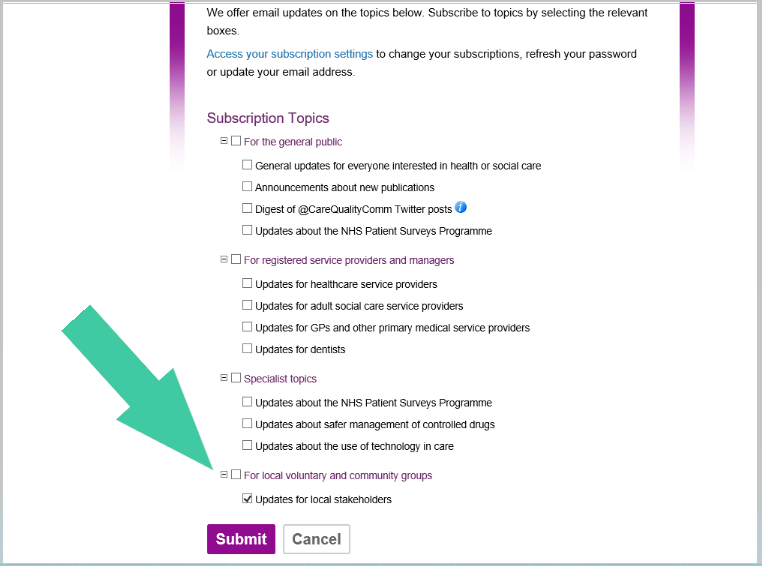
 Click this link and make sure to select Updates for Local stakeholders
|