
We’ve got a new digital participation platform and we’re inviting you and your members to join. We’re committed to involving you in our work and listening to your views. You’ve told us that sometimes it can be challenging or costly to travel to and attend our events and that you find our existing Public Online Community a bit difficult to navigate. We hope this new digital platform will provide an accessible, easy way for you to share views and ideas with us and allow us to involve you in more of our work. This is a pilot so we’ll be collecting views throughout – let us know what you think, what works well and how we could make it even better!
At the moment, we're asking for feedback on our new format for the Monitoring the Mental Health Act Report and our guidance on how we regulate services for people with a learning disability and/or autism. Sign up and get involved.
|
CQC and the Healthcare Safety Investigation Branch (HSIB) have a new Memorandum of Understanding agreement. It sets out how we will work together to encourage the safety and wellbeing of people receiving NHS care in England. The HSIB was established in April 2017 to carry out investigations into patient safety concerns in NHS-funded care across England. They make recommendations to improve healthcare systems and processes.
With local elections coming up you may have heard about public bodies, like CQC, having to respect a pre-election period, which put some limits on what we’re allowed to do in the time before an election. We’ll still be carrying out inspections of health and adult social care services across the country, including planned and follow-up inspections, as well as those that are in response to concerns. Read more about what this period means for us and other public bodies here.
NHS Digital has a new Social Care Digital Pathfinders Grant which offers organisations that provide and commission adult social care services a chance to win a share of £4.8 million to roll out their local digital projects on a wider scale. Those chosen will begin with a four month development phase, followed by a 13 month implementation phase if development is successful. To apply you should have already started a scheme in your area or be able to show where support is needed.
 |
|
Alzheimer's Disease International, a worldwide group of associations, has launched a survey on attitudes towards dementia which will form the basis for the World Alzheimers Report 2019 to be released in September. Take part now, ten minutes of your time will benefit people with dementia all over the world.
|
The Public Administration and Constitutional Affairs Committee (PACAC) has a new report looking at the performance of the Public Health Service Ombudsman (PHSO) in 2017/18. The report shows that progress has been made by PHSO but highlights areas where the Ombudsman needs to get better. PHSO make final decisions on complaints that have not been resolved by the NHS in England, UK government departments and other public organisations.
Skills for Care have a new online guide to help adult social care employers make improvements across their service. The guide offers a full toolkit to help your organisation deliver high quality care and support to meet regulatory standards. It was created to help the 17% of adult social care services in England delivering care that didn’t meet our fundamental standards. Even when a service is already meeting those standards, ongoing improvement is a key part of gaining and keeping a good or outstanding rating.
The Joint Committee for Human Rights (JCHR) has said that painful techniques and solitary confinement should banned. Their new report says that these practices must be stopped as they can lead to emotional and physical harm and are not in line with human rights standards. The Joint Committee on Human Rights is made up of twelve members, from both the House of Commons and the House of Lords, who look at matters about human rights in the UK.
Many hospital bed days in England are taken up by people who are fit enough to be discharged, but who haven’t been able to find an appropriate care home to meet their recovery needs. The NHS, working with councils, reduced the number of lost bed days by 20% last year. The Capacity Tracker is one of a number of tools being used to reduce unnecessary delays that prevent people leaving hospital. The tracker allows staff to see how many vacancies there are in local care homes to help people to get the right care or return home as quickly as possible.
The General Pharmaceutical Council, the independent regulator for pharmacists, has updated its guidance for pharmacy owners to help make sure that people can only get medicines from online pharmacies that are safe and clinically appropriate for them. The guidance explains what pharmacy owners should do before deciding whether they can provide a service safely and effectively at a distance or online, rather than in the traditional face-to-face way.
Vital child health information will be available to health professionals and parents at the point of care, thanks to a new live national service which has been launched by the NHS. Parents and health professionals can get information digitally and use it to make decisions on care and treatment, using the National Events Management Service, which securely shares information on key health interventions for children.
The Medical Defence Union, the leading medical defence organisation in the UK, has advised GP practices to update their rules to make sure patients can still access medical treatment facilities if they have assistance dogs. Reasonable adjustments should be made for people with guide or hearing dogs, or those with other animals that help with their conditions.
NHS England has announced the roll-out of a scheme offering specialist stop smoking referrals to pregnant women to reduce stillbirths as part of its Long Term Plan. The scheme was introduced in 2015 and has seen 20% fewer babies dying at birth.
The Department of Health and Social Care (DHSC), has announced that the NHS-funded nursing care weekly rate per patient will increase by 4.7% to about £165 for the financial year. Registered nursing care is funded by the NHS for eligible nursing home residents.
Marie Curie have a new report looking at NHS figures which shows that patients in England spent 1.7 million unnecessary days in hospital in 2018. The main reasons for this were a lack of care and nursing home places and a lack of home care packages. NHS England’s Delayed Transfers of Care data shows the number of days patients spend in hospital after they are ready to be discharged.
The Women and Equalities Committee has a new information on tackling inequalities faced by Gypsy, Roma and Traveller communities. The report discusses CQC’s role in ensuring quality care is provided to Gypsy, Roma and Traveller service users. The report was sent to the government with several recommendations.
 |
|
What are you hearing?
We want to hear what you’re hearing!
You can provide vital local information that helps CQC decide where to inspect.
You can send us your enter and view reports, surveys, comments from the public and any other feedback you gather.
|
This intelligence can help detect changes in quality at a service, either good or bad. You don’t need to wait until we’re inspecting a service to provide this information to us either, you can send us what you’re hearing at any time.
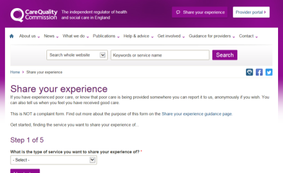
You can do this via the share your experience form on our website.
You can also call our national customer service centre on 03000 616161 or provide it to your local inspection team.
|