|
|
State of care
On 10 October we published State of Care, our annual assessment of health and social care in England.
This year’s report shows that the quality of care has been maintained despite some very real challenges – a testament to the hard work and dedication of staff and leaders. However, as the system continues to struggle with increasingly complex demand, access and cost, future quality is precarious.
|
Have your say on the fees we charge providers in 2018/19
The consultation about the fees we propose to charge registered providers in 2018/19 is now open until midday on Thursday 18 January.
Our proposals for 2018/19 seek to make sure that our fees scheme continues to distribute fees in a proportionate way for all registered providers.
You can find the consultation document and respond via the online form by visiting the consultation page on our website.
Changes to DBS certificate validity period
Individuals applying for registration currently have to provide a CQC countersigned DBS
(Disclosure and Barring Service) certificate that has a six-month validity
period. Following feedback from providers on burden and cost, we
have extended the validity period to 12 months. This came into effect on 16 October 2017. Please note, the changes
will still allow CQC to request a six-month DBS certificate
should there be any safeguarding concerns. More information on DBS checks can be found on our website.
 CQC completes initial review of mental health services for children and young people
In January the Prime Minister asked CQC to conduct a review of
quality and access across the system of mental health services for children and
young people. This report marks the first phase of that review.
The first phase of the review has found that the system as a
whole is complex and fragmented. As a result, too many children and young
people have a poor experience of care and some are unable to access timely and
appropriate support.
Gaps in continuity of care that can occur during the transition
from children's services to adults' services was a major concern for the
children and young people we spoke to.
In the next phase of
our review, we will look at what could be done to make it easier to improve
access and quality.
|
 Emergency department
survey 2016
The results of the latest emergency department patient
survey show that most people report a good experience of emergency care and describe
positive interactions with doctors and nurses.
However, responses to questions
about waiting times, access to pain relief and discharge arrangements were less
positive. Visit our website to see the full national results, as well as
individual results for each trust.
|
Hospices offering more ‘Outstanding’ care than other services regulated by CQC
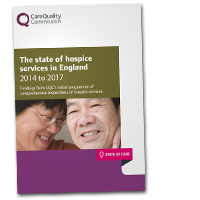
Hospice care across England has the highest percentage of services rated ‘Outstanding’, according to CQC’s State of Hospice Services in England, 2014 to 2017.
In particular, inspectors found that hospice leaders and frontline staff displayed a strong commitment to providing truly person-centred, compassionate care and support to people using their services, and their loved ones, as well as developing strong relationships with other services in the area.
However there is more to be done to make sure that everyone, regardless of their background or circumstances, has access to high-quality end of life care.
|
|
 |
Second next phase consultation response published
We have published the response to our second next phase consultation, which provides information about:
- Improvements to the structure of registration and CQC’s definition of ‘registered providers’.
- How CQC will monitor, inspect and rate new models of care and large or complex providers.
- Changes to the regulation of primary medical services and adult social care services.
- Updated approach to the fit and proper persons requirement.
Later in 2017/18 we will publish our final next phase consultation. This will include proposals for how we will regulate and rate independent healthcare services, which will come into effect during 2018/19.
First local system reviews published
We have published the first of 20 targeted reviews of local
authority areas looking specifically at how older people move through the
health and social care system.
The review found that the health and social care system
in Bracknell Forest was working effectively with an integrated approach that
was having positive outcomes for older people. In Halton we found a
strong commitment and a shared vision across the local authority and the
clinical commissioning group to serve the area’s people well.
Other news
CQC's annual report on activity relating to our enforcement of the Ionising
Radiation (Medical Exposure) Regulations 2000 in England has been published. The report gives a breakdown of the number and type of notifications we received from healthcare providers when patients received exposures of radiation that were ‘much greater than intended’ during 2016. Visit our website for more information.
The National Audit Office (NAO) has published its report examining how CQC is supporting people to get safe, high quality and compassionate care in England and encouraging improvement. The report finds that CQC has “improved as an organisation”, noting that the introduction of CQC’s five-year strategy in April 2016 included a move towards a more intelligence-driven, targeted and risk-based approach to regulation.
The NAO has published its report on its investigation into the NHS’s response
to the WannaCry cyber-attack that affected it in May 2017, and the impact on health
services.
The National Institute for Health and Care Excellence (NICE)
has published new draft guidance: Learning
disabilities and behaviour that challenges: service design and delivery.
The King’s Fund and the Health Foundation have launched a report entitled Making the case for quality improvement:
lessons for NHS boards and leaders.
NHS Improvement has worked with NHS Providers and the Faculty of Medical Leadership and Management to develop a resource capturing eight high impact actions to improve the working environment for junior doctors.
As part of Health Matters, Public Health England is holding a teleconference on preventing infections and reducing antimicrobial resistance on 13 November from 12.45-1.30pm. Register your attendance on the PHE website.
Follow us on Twitter!
Keep up with our work with professionals and provider organisations in England by following us on Twitter @CQCProf
|