Independent investigation announced into CQC's actions in relation to Hillgreen Care Ltd
On Thursday 27 July The Times published an article alleging that CQC was involved in the 'cover up' of the rape of a resident in a service for people with learning disabilities in November 2015. The article also questioned the nature and timeliness of CQC's enforcement actions against the provider.
In response, CQC's Chief Executive Sir David Behan has commissioned an independent investigation which will report publicly to the CQC Board and identify what happened; what we should have done differently; and recommendations to strengthen our future work.
You can read more here.
 Healthwatch reports on the experiences of people living in care homes and using home care services
Healthwatch has published two reports that explore the experiences of people who are living in care homes or using home care services.
Between
January 2016 and April 2017, local Healthwatch staff and volunteers across
England visited 197 care homes across 63 different local authority areas to find out what day to day life is like for many of those living in care homes. Their findings are published in the report 'What's it like to live in a care home?'. You can read the report here.
The report 'Home care services: What people told Healthwatch about their experiences', analyses the experiences of 3,415 people, their families and front line staff across 52 local areas between August 2015 and June 2017. You can read the report here.
|
Risk of death and severe harm from ingestion of superabsorbent polymer gel granules
A Patient Safety Alert has been issued around the risk of death and severe harm from ingestion of superabsorbent polymer gel granules.
Superabsorbent polymer gel granules are widely used in health and social care, typically as small sachets in urine and vomit bowls. On contact with liquid, the small sachet opens and the granules absorb, expand and solidify the liquid. This can protect people's bedding and clothing and reduce the risk of slipping on liquid.
If the gel granules are put in the mouth they expand on contact with saliva risking airway obstruction. This has happened where people have mistaken the sachets for sweets, or sugar or salt packets, but some incident reports also describe attempts of deliberate self-harm.
The alert asks providers to review their overall approach to using these products. Read more here.
Get involved with upcoming Public Health England campaigns
Public Health England are launching two campaigns this October and we encourage you to support both initiatives by sharing key messages with your local community.
Stay Well This Winter - 9 October
The campaign will encourage at-risk groups to get their free flu vaccination and to take simple, easy-to-achieve actions to stay well this winter. This includes speaking to their pharmacist at the first signs of feeling unwell, heating their home to at least 18°C and keeping active indoors on cold days.
Keep Antibiotics Working - 23 October
Keep Antibiotics Working aims to increase awareness of antibiotic resistance to support local doctors and pharmacists in reducing inappropriate prescribing.
Visit the Campaign Resource Centre for more information and webinar recordings for both campaigns.
Paraffin-based skin emollients on dressings or clothing: fire risk
Emollient cream including water based products can contain varying concentrations of paraffin. The paraffin in these products
can be absorbed into clothing and bedding and accumulate to concentrations
where they can act as an accelerant in a fire.
The risk from emollient creams
is increased by the fact that washing below 60°C will not remove
paraffin from the affected material. Paraffin may also become ingrained in any
medical device including wheelchair batteries, hoists, defibrillators and oxygen
apparatus. The highest risk is to older people and people who smoke and/or require
supplemental oxygen.
The Medicines and Healthcare products Regulatory Agency has issued advice for professionals:
- Advise people not to: smoke; use naked flames (or be near people who are smoking or using naked flames); or go near anything that may cause a fire while emollients are in contact with their medical dressings or clothing.
- Change people's clothing and bedding regularly—preferably daily—because emollients soak into fabric and can become a fire hazard.
Read more here.
 Could you be an adult social care inspector in Surrey?
We are currently recruiting for four adult social care inspectors to join our team in Surrey. If you are interested in this opportunity please note the closing date for applications is Sunday 3 September. Find out more here.
|
What to do when a care home resident who consented to be a body donor has died
Individuals donating their bodies to a medical
school are giving an invaluable gift. These donations are an important resource
for training healthcare professionals or for research. The Human Tissue
Authority is raising awareness of what care home staff should do when a
resident who has consented to become a body donor dies.
To become a body donor an individual has to give
consent during their lifetime. Potential donors need to contact their local
medical school and sign a consent form.
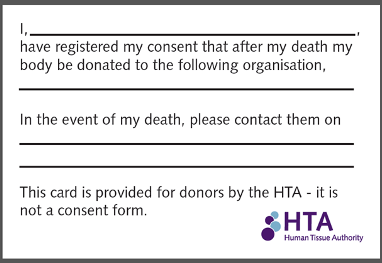
Some medical schools provide cards to show a person
wants to donate their body. Alternatively a donor can fill out and carry a body
donor card from the Human Tissue Authority.
When someone you think is a body donor has died:
- Confirm that they have consented to become a body
donor during their lifetime. The person may have confirmed this to staff at the
care home before their death, as body donors are encouraged to talk to those
around them about their decision before they die. If you are unsure you can
check this by asking family or carers who may be aware of their wishes. The
person may also have a donor card.
- Check which medical school they have contacted. This
will be listed on their donor card, as shown in the image below.
- Contact the medical school as soon as is practically possible
after their death.
Find out more information about body donation here.
Events
You can speak to CQC staff on our exhibition stand at the United Kingdom Homecare Association England Conference in London on Friday 8 September.
We will be attending NHS Expo 2017 on Monday 11 and Tuesday 12 September in Manchester. CQC staff will be available to talk to on our exhibition stand. Chief Inspector Andrea Sutcliffe will be speaking at a number of theatre sessions:
Follow
us on Twitter!
Keep up with our work with professionals and provider organisations in England by following us on Twitter @CQCProf.
|