|
In this issue:
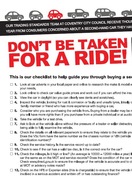 Two
local car traders were imprisoned and a third will have to pay more than
£20,000 for selling unroadworthy and misdescribed motor vehicles following
action taken by Coventry Trading Standards.
David
Barber of Walsgrave Road was sentenced to 32 months imprisonment, Martin
Pittaway of Dorcester Way was sentenced to 283 days and Gurdip Virdi from
Vicarage Lane, Ash Green was ordered to pay £20,868.82 including fines,
compensation and costs.
The
defendants had traded under numerous names including Longford Park Car Sales
and Barber Cars at 101A Longford Road, Coventry CV6 6DY. The defendants pleaded
guilty to supplying unroadworthy vehicles, misdescribing vehicles such as “a
good vehicle in lovely condition and fault free” when the vehicles had known
faults and often broke down within minutes of being driven off the forecourt.
Other vehicles were ‘clocked’ where the mileage displayed was less than the
vehicle had actually travelled and deposits were taken and not refunded.
When
customers complained, they often received an aggressive response, some of which
threatened violence to them or their property. Others were shown ‘doctored’
advertisements and E-Mails to discourage them from taking their complaints
further.
Charges were brought under the Fraud
Act and Regulatory offences covering misleading descriptions, failing to give
material information such as that a car has been an insurance loss, selling
unroadworthy cars, not giving ownership details on an invoice and generally
trading in a manner that contravened the requirements of professional diligence.
Back to top
|
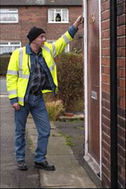 Several residents in Eastern
Green have been approached by tradesmen offering
various roof repairs. In one case a resident was asked if they had any spare
guttering as they needed this to fit at someone else’s property!
Trading standards is urging
residents to remain vigilant at all times and if they receive visit out of the
blue from someone offering to do house repairs or claiming they have spotted a
problem with the roof not to do business with them.
Commonly, cold
callers are often unqualified who charge extortionate amounts of money for
little or no work. They may exert pressure on residents to accept work claiming
repairs are needed urgently and that structural damage may
result if work is not done there and then. They usually
demand immediate payment.
Our advice is never to
accept work from cold callers as this is a favoured approach used by rogue
traders whose sole intention is to extract as much money from their victims as
possible.
If you or a neighbour or
relative is approached by a cold caller and you are concerned please call the
national Trading Standards hotline for advice on 08454 040506.
You can also report any
suspicious vehicles you have spotted in your area if you think they are
being used by workmen targeting houses or bungalows in areas predominately
inhabited by older or vulnerable residents.
Back to top
|
Trading
Standards have been made aware of an advertising scam currently targeting local
businesses. Several businesses have recently been contacted by someone who
falsely claimed to be calling on behalf of the Coventry Telegraph or the
Coventry Observer newspapers. The caller appears to be contacting businesses
who regularly advertise in the these newspapers offering them very cheap deals
for future advertising and ask for credit or debit card details from the
businesses in order to take payment.
Trading
Standards advises businesses to be extremely wary of all unsolicited phone
calls – and never agree to advertising contracts of any kind or disclose
payment card details to anyone during an unsolicited phone call.
Back to top
A mother-of-four who played a
crucial role in a multi-million pound international counterfeiting operation
has been jailed for 15 months following action taken by the National Trading
Standards Scambuster Team.
Jocelyn Hunter imported bogus goods
from China and then distributed them around Europe. The 42-year-old received
top quality fake Gillette razor blades and Oral B electric toothbrush heads
made in China which were delivered to addresses in the Swindon area. She
then sent them out to customers inside the EU including Poland, Lithuania,
Germany and Italy. The operation is
thought to have cost trademark holders Proctor and Gamble many millions of
pounds in lost revenue.
Had the goods been
genuine, the high street retail value would be in excess of £2.7million.
Her operation was discovered
when customs officers detained a consignment of goods at the Coventry Postal
Hub and it was found that between 2nd May and 30th June
2011 some 248 parcels were received by Hunter from China.
The Court heard how Hunter's role
was crucial in selling fake goods from China in Europe and had "the
potential of undermining international trade”.
People are often lured in by the promise of a
bargain but many counterfeit products, while they may look like the real thing,
can be very low quality and in some cases unsafe.
Back to top
Trading
Standards have received a report from a guest house owner targeted by an
‘overpayment scam’. There are several variations of the overpayment scam but
typically it works as follows:
A
customer contacts a business to order goods or services. The customer is often
based abroad, and payment for the goods or services will usually take the form
of a cheque or bankers draft which is paid into the business bank account.
Sometime after payment, the customer phones or emails the business to either
reduce or cancel the order, or to advise that an error has been made - and
requests an urgent refund. The business, keen to build a strong relationship
with a new customer, processes the refund quickly and returns it using an
electronic payment facility.
In
due course, the original cheque or bankers draft is returned unpaid because it
was fraudulent. The business, which has by now processed the full or partial
refund, is then left out of pocket.
Trading
Standards advises all businesses to be extremely wary of any overpayment by a
customer – whether ‘deliberate’ or ‘accidental’. Never make any refund payments
until you are sure that any funds paid into your account have cleared and
cannot be retrieved by the customer.
Back to top
For
more information on scams, visit: www.coventry.gov.uk/scams
|