
Hello, and welcome to the latest edition of the CSAB newsletter. You may have already heard that the CQC rated Coventry as 'Good', an outcome that is testament to the tremendous work carried out by you and your colleagues across the city. There is always more to be done and I know Pete Fahy and his team are already looking ahead. There are also updates on DoLS, self-neglect and other important safeguarding issues. As always, I hope you find it useful. Best wishes Derek.
|
In this issue:

Coventry has been rated as 'Good' by the CQC with a percentage score of 70%.
This is in large part due to the work and contribution of staff to the inspection process, demonstrating the work they day in day out to support people in Coventry with care and supports needs and unpaid carers. The enthusiasm, commitment and dedication of staff really came across to the inspection team and is reflected in the inspection report and overall judgement.
Specific comments within the report being:
- Staff were also positive about arrangements, with integrated working described as flexible and supporting joint working with health colleagues, which aided the identification of needs and swift decision making about support.
- Staff told us learning from SARs and serious case reviews was shared through team meetings, practice forums, targeted learning events, provider meetings and recorded training sessions.
- Staff told us there was a learning culture where their views were listened to and respected. They told us they were being supported by colleagues, managers and senior leaders, especially when working with complex situations.
The report highlighted a lot of positives but there were two areas we need to work on, including ‘equity in experience and outcomes’ and ‘care provision integration and continuity’. We are determined to work hard, and provide high quality experiences for everyone we work with.
|

Coventry Safeguarding Adult Board would like to draw your attention to the recent judgement provided by the Supreme Court.
The Supreme Court, in P v Cheshire West and Chester Council [2014] UKSC 19, known as Cheshire West 2014, set out an ‘acid test’ to determine if someone is confined and therefore deprived of their liberty. The Cheshire West 2014 judgment concluded that someone is confined if they are under continuous supervision and control and are not free to leave. It proceeded on the basis that, if someone lacks mental capacity to consent to their care and living arrangements under MCA 2005, they cannot give valid consent to their confinement.
Between 20 and 22 October 2025, the UK Supreme Court heard a case brought by the Attorney General for Northern Ireland concerning the definition of a deprivation of liberty.
The Supreme Court handed down its judgment on 2 June 2026 and concluded that:
- the Cheshire West 2014 judgment was incorrect
- instead of relying on the single ‘acid test’, an assessment of whether someone is deprived of their liberty must now consider multiple factors - that is, it is multifactorial
- the starting point in assessing whether someone is deprived of liberty is to look at the specific situation of the individual and take into account the type, duration, effects and manner of implementation of restrictions on the person - crucially, no single factor is determinative
- the Cheshire West 2014 judgment wrongly assumed that if someone lacks legal capacity under the MCA 2005, they cannot give valid consent to the arrangements. The 2026 judgment clarifies that a person’s expression of their wishes and feelings carries significant weight. A person can give valid consent if they are conscious of their environment, have a basic level of understanding and are capable of expressing a view that they accept and/or are happy with the situation. However, if there is serious doubt, no conclusion of valid consent can be drawn
- the effect of the restrictions on the person may differ based on whether or not the person is content with their arrangements - Cheshire West 2014 was wrong to conclude that a person’s lack of objection is never legally relevant to the question of objective confinement.
These changes apply with immediate effect.
NHS England will be publishing an updated DoLS e-learning module by 30 July 2026 and Coventry Safeguarding Adults Board will share this once it is published.
Visit the Gov.uk website to find out more about the judgement and how DoLS should be assessed .
|

CSAB carried out an audit to identify good practice and opportunities for improvement across the safeguarding system and the approach to supporting individuals at risk of or experiencing sexual abuse.
What practitioners are doing well
Risks relating to potential sexual abuse were appropriately identified and escalated: Practitioners demonstrated a clear understanding of indicators of harm and responded promptly Actions taken were proportionate to the level of risk which resulted in appropriate protective measures being implemented without delay, thereby reducing the risk of further harm and ensuring that the needs and safety of the individual remained central to decision-making and intervention.
Multi-agency arrangements were effective in the management of concerns relating to sexual abuse: There was clear evidence of coordinated and timely information sharing between partner agencies.
Practitioners consistently prioritised building rapport and developing safe, trusting relationships with victims: There was evidence of sensitivity in engagement approaches, particularly where individuals presented with complex needs or were hesitant to engage.
Where practice needs to improve
Recording concerns about sexual abuse: Greater clarity and consistency in recording is required. This includes explicitly documenting concerns (including naming sexual abuse where relevant), the questions asked, information shared, and actions taken.
Communication: Across agencies, there is a need to strengthen the quality and consistency of communication, ensuring safeguarding information is shared, clearly documented and accessible to support informed decision-making.
Identifying the source of risk: There was limited evidence of professional curiosity in identifying and documenting the source of risk.
Consideration of domestic abuse: Practitioners did not fully recognise and respond to the intersection between sexual abuse and domestic abuse, including appropriate consideration of Multi-Agency Risk Assessment Conference (MARAC) processes.
Key learning points for frontline practitioners
Work together early and effectively: Engage partner agencies and share information promptly to coordinate support and share expertise.
Prioritise relationship-building: Invest time in trust and rapport to better understand the person’s lived experience. Consistency, encouragement and sensitive, trauma-informed approaches are essential when individuals are reluctant to accept help.
Maintain high-quality recording: Ensure records are clear, proportionate, and reflect decision-making. State concerns clearly (including naming the type of abuse), and document questions asked, decisions, and actions.
Understand the person’s identity: Actively explore and record factors such as culture, ethnicity, and personal identity to inform care.
Be professionally curious: Ask questions, explore risks fully, and avoid assumptions. Actively explore and document the source of risk; who or what is causing harm and consider overlapping forms of abuse.
|

This multi‑agency audit evaluated the effectiveness of the partnership approach to working with adults who are at risk of or experiencing self-neglect.
What practitioners are doing well
Effective multi-agency working: Case records showed practitioners engaging in timely and effective joint working, drawing on multidisciplinary and specialist expertise to coordinate interventions and work towards shared goals
Strong relational practice: Practitioners took time to build rapport and establish a relationship of trust. This helped them to understand the individual’s lived experience and the factors contributing to their self-neglect.
Engagement with service users: Practitioners worked hard to build relationships with individuals who were initially reluctant to accept support. Encouragement, consistency, and persistence were key features of this work.
Consistent consideration of mental capacity: Formal assessments were completed where required with appropriate use of advocates, including IMCAs.
Recording was found to be of a consistently good standard: Cases demonstrated good quality recording, with clear, proportionate entries across all agencies.
Where practice needs to improve
Engagement with service users in acute/emergency health settings: There is need for more compassionate language and greater confidence when initiating difficult conversations.
Exploring identity: Although there were a small number of cases where ethnicity or identity had been explored, this was limited overall and more robust evidence was needed to demonstrate that practitioners fully understood and applied consideration of a person’s identity.
Complexity of self-neglect and hoarding: While the response to self‑neglect itself was generally strong, hoarding did not feature prominently, meaning there was limited specific learning in relation to hoarding behaviours.
|
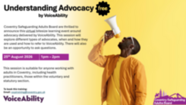
Coventry Safeguarding Adults Board is delighted to invite you to this virtual bite-size learning event on advocacy, delivered by VoiceAbility. The session will explore the various types of advocacy available, when and how they can support individuals, and how to make a referral to VoiceAbility. Attendees will also have the opportunity to ask questions and gain further insight from the presenters.
For more details please see the flyer or email cscptraining@coventry.gov.uk
|

Coventry Safeguarding Adults Board are looking to strengthen our relationships with communities across Coventry.
We want to share safeguarding resources and raise awareness of Safeguarding in Coventry. Our resources are available in 7 different languages and we need your help to share them!
If you live, work or have strong community links in Foleshill or St Michaels and want to help raise awareness of safeguarding for residents, please get in touch. We want to hear from you!
If you would like to join us in raising awareness of safeguarding across Coventry, please contact erin.jones@coventry.gov.uk
|
Coventry Safeguarding Adults Board has recently expanded its range of one-minute guides (OMGs) to provide practitioners with quick, accessible information on key safeguarding topics.
Newly released guides include:
-
County lines – offering an overview of county lines exploitation, key warning signs, risk factors, and how practitioners can respond to safeguard adults at risk.
-
Housing and homelessness – highlighting the links between housing needs, homelessness, vulnerability, and safeguarding, as well as outlining available support and referral pathways.
These concise resources are designed to support practitioners with essential knowledge and practical guidance that can be easily accessed and shared.
Visit the Coventry Safeguarding Adults Board website to view and download the latest One-Minute Guides.
|

Safeguarding adults - it’s everyone’s business
The City Council website provides additional information on adult safeguarding:
Safeguarding Adults webpage.
If you have concerns about safety and how others treat you / someone else, contact:
Adult Social Care
Tel: 024 7683 3003
Email: ascdirect@coventry.gov.uk
Mental Health - Single Point of Entry
Tel: 0300 200 0011
Email: cwp-tr.specoventryadult@nhs.net
You can also get in touch with the Safeguarding Boards Team regarding matters relating to the Safeguarding Adults Board:
Tel: 024 7683 2568
Email: Coventrysab@coventry.gov.uk
|