
Hello and welcome to the June newsletter from the Coventry Safeguarding Children Partnership (CSCP).
There are important updates on the latest iteration of Working Together, a pointer to the upcoming Practice Week, and information regarding the new Request for Support form.
I would especially want to highlight the updates concerning online safety and as we approach what may be a warm and sunny summer, the very timely reminder about staying safe around water.
With best wishes,
Derek Benson
|
As part of the Families First Partnership Programme, the referral route into Coventry's Children & Education Service has changed.
As of Monday 1 June, all new referrals must go through The Children and Family Initial Response Service, which brings together the former Multi-Agency Safeguarding Hub (MASH) and the Early Help front door.
The previous forms - the Early Help Request for Support and the MARF - are no longer in use. They have been replaced by a single Request for Support form.
Request for Support includes prompts to help you in share relevant information and indicate the level of support needed, ensuring families are directed to the most appropriate staff member within the Children and Family Initial Response Service.
The Request for Support Form is now live.
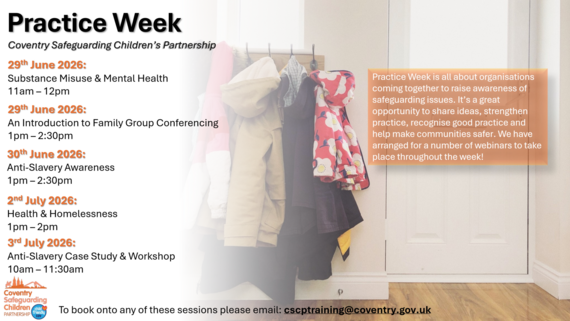
Practice Week begins on Monday 29 June and brings organisations together to raise awareness of safeguarding. It's a great opportunity to share ideas, strengthen practice, recognise what's working well and help make communities safer.
We have arranged for a number of webinars to take place throughout the week!
See below for full details.
29 June 2026
Substance Misuse and Mental Health
11am - 12pm
29 June
An introduction to Family Group Conferencing
1pm - 2.30pm
30 June
Anti-slavery Awareness
1pm - 2.30pm
2 July
Health and Homelessness
1pm - 2pm
3 July
Anti-slavery wase study and workshop
10am - 11.30am

Following practitioner feedback and partner recommendations from the Keeping Children Safe Online Audit, we have created new resources to help parents, carers, and professionals support children and young people to develop safe online habits.
The CSCP website has been updated with accessible, straightforward information around online safety and how to access support. Our homepage now includes an Online Safety tile for easier access.
We have also created two new One-Minute-Guides.
Getting Started Online: simple guidance on how to help younger children develop healthy digital habits when they start using screens and going online, as well as links to more helpful resources.
Talking to Children and Young People about Being Online: tips on how to talk to children and young people about their online behaviours and how to spot false content.
|
 |
The Coventry Safeguarding Children Partnership has completed a multi-agency audit to assess how effectively agencies work together to identify, assess, and respond to online harm where children experienced self-harm, suicidal ideation, suicide attempts, or significant mental health concerns. The audit highlighted strong practice alongside areas for improvement.
What practitioners are doing well:
- Strong identification of risk, with appropriate thresholds and timely referrals
- Prompt mental health assessments by CAMHS and hospital services, with clear safety planning
- Effective multi-agency working, particularly between schools and CAMHS
- Positive impact of specialist pathways (e.g. Horizon, MACE)
- Children’s voices well captured through trusted relationships
- Good consideration of identity and culture
- Tangible outcomes, including improved wellbeing, reduced self-harm and missing episodes, and better school engagement
Where we need to improve:
- Limited depth in exploring online harm during assessments
- Safety plans sometimes unrealistic (e.g. expecting no phone use)
- Need for more flexible, creative engagement around digital lives
- Delays in tools and MACE meetings affecting early intervention
- Online risks were not always understood through a neurodiversity/trauma informed lens.
- Family networks, including fathers, were felt to be under-explored in several cases
- Limited evidence of support provided to parents
Learning for practitioners:
- Online harm cannot be treated as a separate or secondary concern; it must be understood as core safeguarding issue from the earliest point
- Conversations about children's online lives should be routine, not exceptional
- Where children have a consistent, trusted adult, they were more likely to disclose online activity
- Actively link online behaviour to emotional wellbeing, trauma, identity, and lived experience
- Listening to children must be an ongoing process
- Avoid victim-blaming language and seek specialist advice
- Fully explore the role of individuals within the household, including fathers, and wider family network
- Support parents using clear messaging, delivered in a way that parents can understand and act upon
- Share relevant information with all professionals involved with the family to support a shared understanding of risk
- Ensure safety planning is realistic and sustainable
|
The Department for Education has published a new edition of its statutory guidance Working Together to Safeguard Children 2026, replacing the 2023 guidance. It sets out what organisations and professionals must and should do to help, protect and promote the welfare of children and young people under 18 in England.
The updated guidance introduces several important developments:
Chapter 1: A shared responsibility: Reinforced expectations on leaders to create inclusive, anti-discriminatory cultures and clear expectations for practitioners to challenge racism and discrimination.
Chapter 2: Multi-Agency Safeguarding Arrangements (MASA): Clarified MASA responsibilities to include children who are looked after, with clearer detail on accountability structures and how safeguarding partners are inspected.
Chapter 3: Providing help, support and protection: Explains that family help combines targeted early help and section 17 support to create a more seamless offer for families, with consistent practitioner relationships and a family help plan led by a multi-disciplinary team. Strengthened expectations emphasis anti-racist and anti-discriminatory practice, recognising how racism and past experiences influence relationships. There are clearer section 47 expectations for robust multi-agency assessments, direct work with children and strategy discussions for child sexual abuse.
Chapter 4: Organisational responsibilities: Clarifies the vulnerability of looked after children in certain settings and reinforces the link between care planning and child protection planning. There is emphasis on the local authority's duty to ensure support and protection through the care plan and highlighted risks such as sexual exploitation in residential settings.
Chapter 5: Learning from serious child safeguarding incidents: Re-structured and strengthened to ensure safeguarding partners better understand how and when to make timely, accurate and comprehensive notifications and engage in the learning process.
Working Together to Safeguard Children 2026 - full document
As warmer weather approaches, more families and children will be drawn to rivers, lakes and other open water - but these environments can be extremely dangerous. Hidden risks such as strong currents, sudden drops, cold water shock and unseen hazards often go unrecognised until it is too late. It’s vital that we are clear: open water is not a safe place to swim.
Coventry Safeguarding Children Partnership does not support or encourage open water swimming. Instead, we are committed to raising awareness of the serious risks involved.
Over the coming weeks, we will be sharing clear safety messages, advice, leaflets and videos to help protect children and families. We must work together as a city to reinforce this message, ensuring that all children, parents and communities in Coventry understand the dangers and make safer choices.
Drowning Prevention: Drowning is preventable – nobody should drown
13–20 June 2026: a nationwide campaign to raise water safety awareness
💡 Key safety messages
-
Stop and think before going near water
-
Stay together – never go alone
-
Float if you fall in, then call for help
-
Call 999 in an emergency
⚠️ Remember
- Open water is dangerous, even for strong swimmers
- Children must be actively supervised at all times
- Never enter the water to rescue someone 👉 Reach or throw – don’t go
🧒 For children
- Stop, Look, Think!
- Always stay with friends or a trusted adult
- If you fall in: float like a starfish and shout for help
👉 Respect the water – stay together, stay safe

The Coventry Safeguarding Children Partnership and Adult Board can now be found on LinkedIn.
We are using LinkedIn to increase visibility of safeguarding work carried out across the partnership and to strengthen our engagement with partners, professionals and the wider community across Coventry.
Connect with us to see regular updates on campaigns, resources, learning and training from across the partnership: LinkedIn
|
If you have something you would like to share on our page please contact erin.jones@coventry.gov.uk
Website: www.coventry.gov.uk/cscp
LinkedIn: CoventryCSCPandCSAB
X: @covCSCPandCSAB
Facebook: Coventry Safeguarding Board and Partnership
|