|
www.coventry.gov.uk/infoandstats
In this issue:

Source: Public Health Team, Coventry City Council
Coventry City Council is one of 30 local authorities across the UK that has been awarded funding by National Institute for Health and Care Research (NIHR) to establish a Health Determinants Research Collaboration (HDRC). The Coventry Health Determinants Research Collaboration (HDRC) is a citywide collaboration aiming to build an open, creative, and dynamic research network that uses evidence to address the wider determinants of health. The HDRC builds on Coventry’s track record of cross-sector engagement with the University of Warwick, Coventry University, University College London, University Hospitals Coventry and Warwickshire NHS Trust, the voluntary sector, and local communities. Sign up to receive the monthly HDRC newsletter.
In this HRDC webinar, Niamh Mellor (Coventry City Council) highlighted Coventry's Joint Strategic Needs Assessment (JSNA), which brings together evidence about the health and well-being of Coventry residents, to help leaders across health and care understand and work together to improve the health and well-being of the people of Coventry. This webinar explores Coventry's approach to the JSNA, the challenges encountered, and the opportunities for collective action to address complex social determinants of health. In addition, Sharon Thomas (Community Resilience Team) shared how she has used the JSNA in her work.
We are in the process of refreshing our profiles look out for updates in the future.
|

Source: Insight, Coventry City Council
In this edition, we are spotlighting another of the local area profiles. See below for a snapshot of some key findings about the Coventry neighbourhood of Tile Hill.
As part of the Joint Strategic Needs Assessment (JSNA) localised reports have been developed that capture what life is like in different parts of Coventry. These reports celebrate the strengths within each community while also highlighting challenges. They are informed by data, statistics, community feedback and on the ground experiences in these neighbourhoods.
To learn more, read the full report on Tile Hill.
|
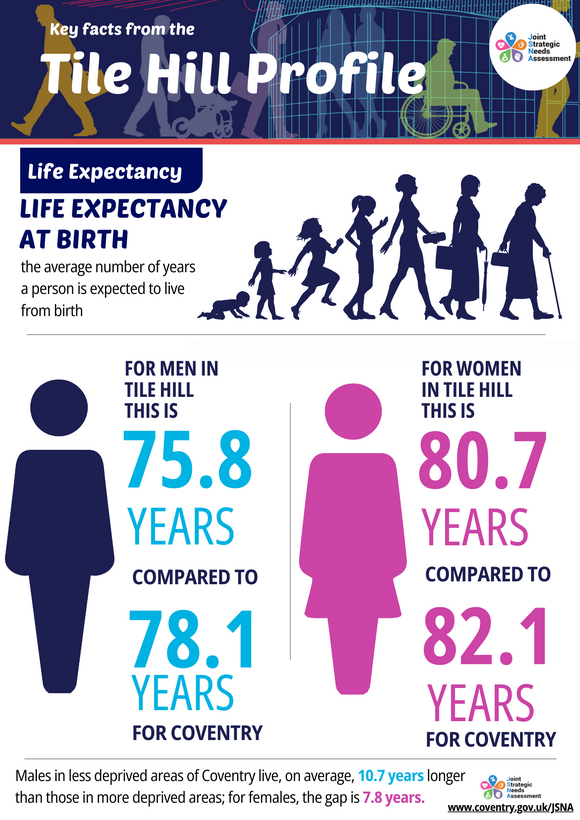
Life expectancy at birth
For men: in Tile Hill this is 75.8 years, compared to 78.1 years for Coventry.
For women: in Tile Hill this is 80.7 years, compared to 82.1 years for Coventry.
Males in less deprived areas of Coventry live, on average, 10.7 years longer than those in more deprived areas; for females, the gap is 7.8 years.
Source: Department for Education (DfE)
The Department for Education (DfE) have published the newly refreshed ‘Local Authority Interactive Tool’. This tool is designed to help compare a wide range of statistics related to children and young people across all local authorities in England.
Here are some of the key data areas that you can explore:
- Health & wellbeing
- Child Protection
- Children's Services workforce
- Early Years
Explore this interactive tool, which allows you to compare data across different local authorities, regions and national averages. It is a valuable resource for data analysis and benchmarking.
If you have any Coventry-related research, statistics, or findings that you would like to share here, please get in touch: insight@coventry.gov.uk
See previous e-bulletins for inspiration.
|