|
Welcome to the West Midlands Social Work Teaching Partnership Newsletter.
In this newsletter, we will keep you informed on updates, developments, events, masterclasses, best practice and research, within the West Midlands Social Work Teaching Partnership.
In this edition:

The West Midlands Teaching Partnership have taken the following steps during the coronavirus outbreak:
- The Partnership have released a collective statement on behalf of all of our Higher Education Institution partners regarding the provision of student placements.
- All of our events expected to take place in March, April and May have been postponed. This includes planned workshops, conferences and learning events, to ensure the safety of all.
- Supporting the deployment of social care staff to support critical services across Local Authorities and Trusts. This includes working with final year social work students to support vital services.
The Partnership would like to take this opportunity to recognise the difficulties faced in social work and thank you for your work and commitment at this time, as we continue to support adults, families, children and carers.
|
 |
Social work is all about relationships. We are always encouraged to look at how we build relationships with people with lived experience in order to support them in the most effective way.
For me, however, it is just as important to focus on the relationships with have with our colleagues at work. Throughout my career, and especially at the start, I have been lucky enough to work alongside some highly capable and supportive colleagues as well as being supervised by compassionate and insightful managers.
This has been so important in enabling me to continue in this profession and to work effectively with those seeking my support. There have been those of whom I could bounce ideas when contemplating a knotty problem. These have been critical friends who brought alternative perspectives and knowledge and who have helped me to grow in my decision making. There have been those who had a particular area of expertise which they were always willing to share with their colleagues. There were those who encouraged me to undertake further development, without which I would not be in my current role. There were those who would just listen when I needed to vent about a particularly stressful situation and would notice when I was feeling low. There were also those who would just make me laugh.
This may seem trivial but, in a profession which can often feel quite bleak, this is a wonderful antidote. All of these people, both past and present, have shaped me as a practitioner and have encouraged me to emulate their positive relationship building skills with the newly qualified social workers and students whom I support now. I would encourage everyone to consider how you build relationships not just with the citizens you serve but also with your colleagues, especially in the agile work environments of the modern social work office.
Margaret Stratton, Specialist Practitioner ASYE, Birmingham City Council Adult Social Care.

We are delivering ‘Training to Teach’ sessions for social work practitioners wanting to develop their confidence and skills in teaching in higher education. This is to support one of the ambitions of the partnership; to enable more practitioners to become part of delivering the social work curriculum on pre-qualifying courses.
The course will be designed to develop and enhance a participant’s personal teaching practice and prepare them to teach on qualifying social work programmes. This will be achieved by providing participants with opportunities to critically reflect on their personal training/teaching practice experience contextualized within the UK Professional Standards Framework (UKPSF), modern pedagogic theory, teaching observation and real student feedback.
This course will be designed to develop confidence, self-awareness and awareness of others when engaged with teaching and supporting students. The course will aim to support the development of effective teaching and learning practice mapped against key components of Descriptor 1 of the UKPSF. Successful participants will be ‘teachers’ who will demonstratively apply modern pedagogic theory in their practice.
The courses will be delivered at the University of Warwick with opportunities for participation in social work teaching both at Warwick and Coventry University.
Available days to attend the course are detailed below (attendance is only necessary at one day).
Cohort A:
Tuesday 2 June 10am – 4pm, Westwood Campus, University of Warwick
Then half-day teaching delivery in June, July or August*
*Participants will have opportunities to be involved on a Friday with teaching on the degree apprenticeship programmes either at Warwick or Coventry University.
Cohort B:
Tuesday 14 July 10am – 4pm, Westwood Campus, University of Warwick
Then half-day teaching delivery in July, August or September*
*Participants will have opportunities to be involved on a Friday with teaching on the degree apprenticeship programmes either at Warwick or Coventry University and/ or teaching on the BA or MA programmes at Coventry University (in September).
Note: We have a maximum capacity of 15 participants per cohort.
Please request an application by emailing westmidlandsteachingpartnership@coventry.gov.uk.
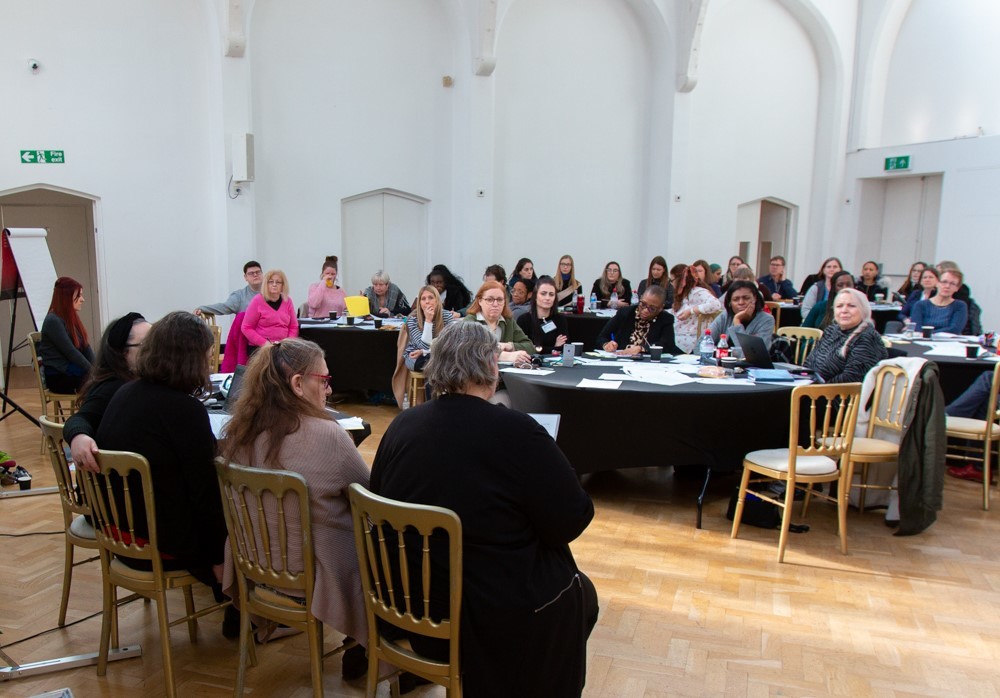 |
Firstly, thanks so much to all who attended our event on parent partnerships on 25 February in Birmingham, kindly funded by the Teaching Partnership.
The feedback we have had so far has been great, and we felt that it was a productive, engaging and collaborative day. The input of the parents was stunning and moving, with parents and allies kindly coming from New York, London, the West Midlands and a host of other areas too!
We discussed the current evidence base for parent partnerships and the positive impacts they can have. This includes reducing the need for children to be in care; developing better help for families; and creating better cooperation and partnership between parents and social workers.
More importantly we heard moving testimony from parents and parent advocates themselves. They all described wanting to work with social workers collaboratively to develop more humane and compassionate systems. I am confident that we all share this aim!
It was heartening that a number of Local Authorities/Trusts expressed sincere desire to take this agenda forwards with us. It seems clear that this is the next big thing in children and families social work, so be a part of the journey!
There’s still the opportunity to take this exciting and important agenda forwards with us, parents and their allies and other local authorities. If you are interested do make contact: s.p.c.haworth@bham.ac.uk.
Simon Haworth, Social Work Lecturer, University of Birmingham
Research in Practice have recently released Complexity and challenge: A triennial analysis of serious case reviews 2014-2017 with resources to support the application of learning into practice.
Analysing 368 serious case reviews relating to incidents between 1 April 2014 and 31 March 2017, this is the sixth consecutive analysis of serious case reviews by this research team; together these reports cover 14 years from 2003-2017.
Developed in collaboration with Research in Practice, University of East Anglia Centre for Research on Children and Families, and the University of Warwick, the resources support the application of learning from the Department for Education report.
The resources are designed to support safeguarding partnerships, social work and early help, police and criminal justice, health and education practitioners to apply learning from serious case reviews into practice. The open access website includes practice briefings, presentations, reports and videos.
There are a number of common themes in previous and current serious case reviews. Two particularly noticeable emerging themes in this review were:
- The complex and cumulative nature of neglect, often in a context of poverty.
- New and emerging threats of harm to adolescents.
The learning from these serious case reviews remains vitally important for everyone concerned in preventing and protecting children and young people from maltreatment.
|