|
Welcome to the first Monthly Signs of Safety Newsletter for
Coventry Children’s Services.
In this issue:
|
Signs of
Safety is an innovative strengths-based, safety-organised approach to child
protection casework which can also be used for early intervention work. The
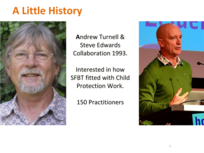
model was created in Western Australia by Andrew Turnell and
Steve Edwards, who worked with over 150 front-line statutory practitioners and
based it on what those practitioners know works well with difficult cases.
|
|
 |
1. Working
relationships
Relationships must enable
honest and respectful discussions of concerns and worries, draw on and honour
everything positive, consider multiple perspectives, and always incorporate
skilful use of authority. Research shows that, irrespective of the type of intervention,
professionals see better outcomes when there is shared understanding of what
needs to change, agreement on purpose and goals, and family members feel their
worker understands them.
2. Thinking critically and maintaining a stance
of critical inquiry. In
order to minimise error, a culture of shared reflective practice and a
willingness to admit you may be wrong are vital. Risk assessment is a core task
and requires constant balancing of strengths and dangers to avoid the common
errors of drifting into an overly negative or positive view of the
situation.
3. Grounded in everyday experience. Assessment and safety planning
is always focused on the everyday lived experience of the child. Service
recipients and front line practitioners are the key arbiters of whether
practice works or doesn’t.
Signs of Safety values both
professional and family knowledge.
Work with families within Signs of Safety fully involves families in assessing
risks and developing solutions. The child/
young person’s experience is central to this, and children, young people,
and their families are fully involved in developing and delivering their
plans.

Coventry is now in its 3rd year of a 5 year Signs of Safety
Implementation Planning journey. Years 1 and 2 focussed on introducing the model to social care children's services, working predominantly with child protection chairs, front door services (MASH) and introducing the model into neighbourhood teams.
The trajectory for Years 3 and 4 is to fully embed Signs of Safety within children's social care, and introduce / plan training events for colleagues from Multi-Agency LSCB partner agencies such as Education and Health and Police. Furthermore, develop and start to roll-out training events to all multi-agency children's services colleagues, and offer a range of training provision across the services.
Today in Coventry, over 90% of social care children's services workforce are confident in using Signs of Safety in everyday practice. Relevant colleagues from Education and Health have either attended training or have booked onto training between now and March 2019. There have also been several 1/2 and 1 day presentations to Community Paediatricians, Housing Officers, Head Teachers and CAHMS professionals. Coventry currently has a cohort of around 55
Signs of Safety Practice Leads who are tasked with sustaining good practice
with their own service areas, supporting colleagues, and driving improvement. The current trajectory
focusses on building confidence amongst LSCB partner agencies, continuing to
embed Signs of Safety across social care children’s services, developing
consistency of practice and driving ongoing training and development.
It
is forecast that by late 2020, all professionals involved within multi-agency children’s
services in Coventry will have a
good understand, and be practicing Signs of Safety within their daily practice.
|
 Since May 2018, a training provision has been scoped, created and developed. There are now two day training events taking place every month until March 2019. The training is available to all Coventry Social Care employees, as well as practitioners from our partner agencies such as Health, Education, Police and Youth Justice. Over 90% of all children’s services social workers have attended the two day training. There are also a number of one day training events taking place from September to January 2019. Spaces on all training events are filling quickly so please book on through www.coventry.gov.uk/safeguardingbookingform
Plans are now in place to develop a number of half day Signs of Safety training events. These will be available from October onwards.
Coventry social care now has five Signs of Safety Accredited trainers. They are Kerry Oddy, Louise Paterson, Joanne Woodfield, Dinesh Ranchhod and Robert Russell. They are tasked with presenting the 1 and 2 day training events throughout 2018 /2019. There are also a number of Signs of Safety Practice Leads who have attended the five day advanced training. This will enable Practice Leads to develop and present individual workshops or training events within their own service area. There are ongoing plans to encourage our partner agencies such as Health and Education to attend five day Practice Lead training events in order for them to become Signs of Safety ‘Champions’ within their particular service area.
Coventry is considering hosting a five day Practice Lead advanced training event in March 2019. If you are interested in attending this, please speak to your line manager. The current co-hort of Practice Leads are in the process of developing individual ‘workshops’ which will focus on particular elements of the model, such as
-
Developing words and pictures
-
Creating danger/worry statements – safety goals
-
Family network meetings
-
Developing meaningful questions
It is hoped that by the Autumn we will be in a position to offer some dates across multi-agency Children’s Services to attend the workshops.
|
Feedback
from those who have attended the 1 and 2 day training events has so far been
extremely positive.
“Just a
quick email to say thank you for the training last Thursday and Friday at
Corpus Christi School. It was informative and certainly made me think
about a special school perspective where 29% of our population is on some form
of CAF / CP etc.I will be getting in touch with you regarding some training for
our staff.” (Deputy Head Teacher)
“Yesterday I attended the 1 day SOS course with
Robert and Jo. I just wanted to share how useful I found the course and look
forward to putting into practice what I have learnt with families at school. I
felt reasonably knowledgeable beforehand as I had previously been on a
course (7 years ago solution focussed training). We use SOS frequently
here at AGCPS for conference, for gathering our concerns for conference and the report for pupils, 3 houses and supervision of children/families at
school. We use it in gathering our full concerns from all staff but now understand
that I can use this method further in trying to help, support, encourage and
empower the family to try make changes at an earlier stage. The safety planning
was a really useful tool too, plus using scaling in more ways than just at
conference will also be useful. It has also made me think more about how we
collet children’s wishes and feelings. I am hoping my two colleagues will
also be able to access the course as it was so good!” (Designated Safeguarding
Lead)
‘Just to let
you know that I attended the signs of safety training last Wednesday - course
trainers I believe were Kerry and Louisa - (CP managers - MASH team ) They were
fantastic and delivered a brilliant and informative workshop ; applying
their wealth of knowledge , expertise and challenge - I felt I needed to make
you aware - thank you’ .
Beth Foulstone Senior
Learning Mentor (School Counsellor- AdProfDipPC
)(BACP member /National Counselling society)

Every month, we would like to use this part of the newsletter to showcase
good practice. Social Workers generally shy away from showcasing good work, despite
the fact that they are demonstrating some excellent practice which results in positive outcomes for our
children and families. We want to start by showcasing some work which was
completed by Jackie Bryan (Families for All Hub).
Jackie took part in a ‘group
supervision’ exercise with Bharti Patel and her team. Participants were asked
to develop their own worry statements and safety goals with the information
that was shared regarding the family. Jackie was able to capture the worries in
such a sensitive, emotive and simplistic nature, that anyone reading them would
instantly be able to understand the worries and safety goals. Excellent work
Jackie.
Worry Statement 1 - Mum feeling sad
and unhappy
Early Help Practitioner from Families
for All Hub is worried that Mum is feeling very sad and unhappy and thinks
there is no one to help her. Mum is trying to keep it all together for Z but
sometimes it gets too hard for her and she gives up trying. Early Help
Practitioner is also worried that when Mum gives up trying, the house becomes
very dirty and unsafe and isn’t a nice place for Z and Mum to live.
Wellbeing goal 1 - Mum feeling sad
and unhappy
Mum you are the only person looking
after Z and it is really hard for you at times to do everything you need to do;
especially when you’re not feeling well yourself. Mum, you and Z need to live
in a safe and clean house and have people that you both can turn to, to help
out. For this to happen Mum you need to tell people what you need and what you
think will help you, and not be scared that people are thinking badly of you as
a mum. If this doesn’t happen Mum you will get more stressed and not be the
best mum you can be to Z; the home will get dirtier and it won’t be safe for Z
to live there; if he lives away from you, with his nan maybe, he will be sad,
upset and angry.
Worry Statement 2 - The home
Early Help Practitioner from Families
for All Hub is worried that Z and Mum are living in a home that is full of
rubbish; mouldy food scraps, packets and tins, overflowing bin bag and dirty
clothes and these are on the floors and furniture. We know that mice are in the
home as we can see their droppings and there are lots and lots of flies buzzing
around. Flies and mice spread germs which will make Mum and Z poorly. Z is
worried that he doesn’t want to be away from his mum for a long time and told
Early Help Practitioner “I want this all to be sorted very quickly”.
Well-Being goal 2 - The Home
Mum, you and Z need to be living in a
safe, warm and happy home together where you can enjoy being a mum and Z can be
in his normal routine. Mum, you can make small steps forward so this can
happen, by letting other people like your sister into the home to help you.
With Z helping too this will make him feel important and proud of himself. If
this doesn’t happen, Z will have to stay with Nan and this will make you both
very sad, upset and worried.
Worry Statement 3 - Z going to school
Early Help Practitioner from Families
for All Hub is worried that Z’s school attendance is only 66%. Z is a very
clever lad but isn’t in the top set anymore. If he’s not at school he can’t
learn and he misses out on doing stuff with his friends. Early Help
Practitioner is also worried that Z’s friends may make fun of him as his
clothes are sometimes dirty and don’t smell very nice.
Well-Being goal 3 - Z going to school
Z needs to be happy and doing lots of great things
in school and Mum will be so proud of him. Z is starting Year 11; a really
important time for him to learn and do really well in his exams. Good exam
results will give Z more chances to follow his dream of going to
university. For this to happen Z needs to be in school every day and look
and smell good in his school uniform. If this doesn’t happen Z will get
more behind with his work and will feel that he is not as clever as other
children; this will make him feel bad about himself and he may give up trying.
Also
a big thank you to Bharti and her team for taking on the new Signs of Safety
Early Help Assessment trial in her hub.
There
have been a number of parents who have recently visited Coventry social care to
talk about their experiences and journeys as a service user. Parents talked
about their challenges with social care alongside their positive experiences.
These presentations were extremely powerful and such a good learning event for
practitioners. We can learn so much from listening to the children and families
we are working with, and in line with the core principles of Signs of Safety –‘Working
relationships’ – ‘Grounded in everyday experience’ let’s get more families in to talk about their
journey with social care.
|
|
Please start sending some good examples of Signs of
Safety practice so we can include this in future newsletters. Also, if anyone
has some research, articles or information they would like to share, please
drop a line to: robert.russell@coventry.gov.uk
|
|
 |
|