|
In this issue:
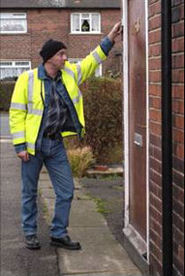 Yet again, we have received reports that rogue
mattress sellers are back in the City. Residents in Walsgrave and Holbrooks had
visits from separate sellers offering memory foam mattresses for sale. In one,
the caller claimed that they had come out of an unidentified ‘show home’.
We have issued previous warnings about mattress
sellers operating in the City as we are concerned with the way
in which these mattresses are described, the methods used to sell them and the
safety of the mattresses despite the fact that they may display a Fire Safety
Label. This may not be genuine.
In the most recent incidents the sellers failed to
provide any paperwork or written cancellation rights as required under the
Consumer Contracts (Information, Cancellation and Additional Charges)
Regulations 2013.
Trading Standards advice to residents is not to
purchase goods or services from cold callers.
Back to top
|
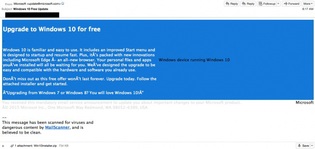 With the recent launch of the new Windows 10,
Trading Standards is warning of a new email scam claiming to be from Microsoft
with the subject line: "Windows 10 Free Update".
The message is
designed to replicate real emails coming from Microsoft, even
down to using the same colour scheme.
The 'from' field features the email address ‘update@microsoft.com’
which although looks like an official address actually originates in Thailand.
It even goes as far as to include a disclaimer
message and a section to say the email attachment has been scanned for viruses.
|
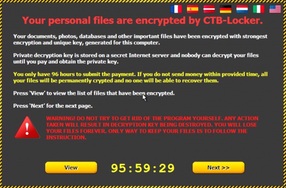 However, by clicking the attachment you
will be greeted with a message from CTB-Locker which is known as ransomeware
and encrypts the files on your computer and demands a ‘ransom’ be paid or risk losing the files forever.
Prevention Advice
- Never click or download unsolicited email
attachments.
- Update your Antivirus software and
operating systems regularly.
- Back up all your important files and store
them off your network.
- Where a computer becomes infected, disconnect it from the network and seek professional assistance to clean the computer.
Back to top.
|
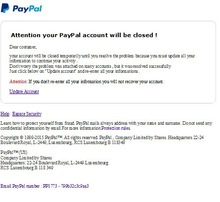 A Westwood Ward resident received a very authentic looking email
claiming to be from PayPal. It indicated that the resident's PayPal account had been
locked and requested that they click on a link in order to log in and see a
message.
PayPal confirm this is a scam ‘Phishing’ email which attempts to
trick recipients into revealing personal or financial information such as bank
details, passwords etc. The links take you to fake websites where any
information input can be collected.
How to spot a ‘Phishing’ email:
- The email uses a generic greeting like ‘Dear user’ or ‘Hello, PayPal
member.’ PayPal always address you by your first and last name or the business
name on your PayPal account.
- The email requests financial and other personal information. PayPal would
never ask for your bank account, debit or credit card number nor would they ask
for your account password or the answers to PayPal security questions in an
email.
- The email asks you to provide the tracking number of a dispatched
item, before you've received the payment into your PayPal account.
- The email includes a software update to install on your computer.
Report PayPal Phishing emails to: spoof@paypal.co.uk and delete the fake email. If you have responded to a fraudulent email and believe your
PayPal account has been compromised, report this to PayPal via: report the unauthorised
access
Back to top.
|
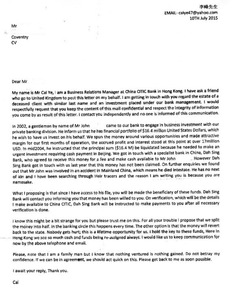 A
Keresley resident received a letter from a Mr Cai Xu, ‘Business Relations
Manager’ at the China CITIC Bank in Hong Kong which claimed that a person
sharing the same family name as the resident had died intestate leaving a
vast investment worth $16.4million US dollars.
The
letter said no next of kin could be traced meaning the money would go to the
government but to avoid this the resident was told
they could claim the inheritance if they agreed to split it with Mr Cai Xu.
The
letter emphasised the need for speed and secrecy and not to tell anyone else
about the deal but there is no inheritance and Mr Xu isn't a Business Manager, but is a fraudster.
Our
advice - Do not respond to this or similar letters. If you do, the fraudster
will ask for various fees to be paid such as taxes, legal fees, banking fees etc.They say they need these to release your non-existent inheritance.
If
a payment is made, the fraudsters will come up with other reasons why the
inheritance can’t be paid out unless a further fee is made.
By responding, your details may also be passed to other scammers
meaning you will be subjected to even more scams letters and phone calls.
We are aware of many versions of this letter but they all tell
the identical story but use different names for the person who is said to have
died leaving a large fortune but no will.
Back to top
|
A local Radford business was bombarded with telephone calls earlier this
year by a company saying they may be able to get a reduction in the Business
Rates they pay each year!
Anyone can apply to the Valuation
Office Agency if you believe the rateable value of your property is wrong.
This appeal process is free of charge.
In addition, some small businesses may be able to claim discounts or
Rate Relief on their business premises where the Rateable Value is below a
certain threshold. These discounts or ‘Relief’ are administered by local
Councils and there is no fee to pay
to make a claim.
Rateable Value calculations are often complex and there are companies that
offer to lodge an appeal with the Valuation Office or offer to apply to the
Council for the various Rate Relief and Exemptions.
Although, this can be a legitimate and useful service, such
companies will charge either a fixed fee or a payment linked to the result of an appeal
or reduction in Rates, or a combination of the two.
Some companies may also describe themselves as
‘surveyors’ and if they do, check that they are accredited by the Royal
Institution of Chartered Surveyors [RICS]. This means they are professionally
qualified and also brings the security of the RICS complaints process if
things go wrong.
The company that contacted our local Radford firm
were very persistent and eventually it was agreed to accept a ‘Rates Saver
Package’ – with the fee based on any reduction achieved irrespective
of whether or not it was shown that the Rate Reduction Company was the
effective cause of any reduction.
Following several months the local firm was notified that total savings of
over £10,000 had been made going back to 2010 but the fee for this was nearly
£5,500.
Paperwork was then sent to the local firm who then realised that the
saving was made up of the Governments Small Business Rate Relief, something
that the firm would have been entitled to for free had they applied for it.
If you want FREE advice and information visit the Valuation
Office Agency website or Coventry
City Council website and avoid having to pay for something you can do for
free yourself.
Back to top
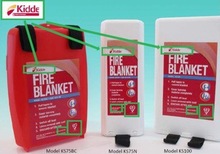 Kidde Safety Europe Ltd has
identified a potential safety issue with regard to fire blankets sized one
square metre, which may impact the fire blankets’ effectiveness in the event of
an oil pan fire.
No reports of any adverse
incidents have been received to date, however, testing of certain fire blankets identified a risk in that the affected fire blankets may not fully extinguish
an oil pan fire and/or may allow the fire to re-ignite very soon after application
of the fire blanket.
If you have one of the
potentially affected fire blankets do not use it on any oil pan fire.
Instead return it to the retailer it was purchased from and Kidde Safety Europe
Ltd will arrange for a replacement fire blanket to be supplied.
The recall applies to fire
blankets one square metre in size in containers labelled
with the brand name ‘Kidde’ or ‘Lifesaver’ and are marked with the Kitemark
symbol and Licence Number 35021.
The label on the fire blanket refers to ‘Homesaver.
These details can be found on
the fire blanket containers as shown in photographs.
The Kidde Safety helpline is
0800 917 0722. Email admin@kiddesafety.co.uk.
For further information see www.kiddesafetyeurope.co.uk.
Back to top
|
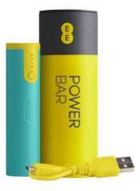 EE
has identified a very small number of incidents where Power Bars have
overheated, all of which relate to batch E1-06 (written as Model:E1-06 on the
side of the device), and could pose a fire safety risk.
EE
are therefore recalling batch E1-06 and request that customers stop using them
and return their device to a local EE store at their earliest convenience.
Power Bars from any other batch aren't affected by this recall.
EE intends to replace the chargers once they have completed their investigations
and will contact customers once these have been concluded.
|
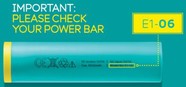 EE Power Bars can be identified by a code found on the side of the device. For the recalled models this code will read 'E1-06' (see image).
Customers
should stop using Power Bars from batch E1-06, and unplug them from handsets
and the mains. They should return the Power Bar to a local EE store at their
earliest convenience.
Customers
returning batch E1-06 will be issued with a replacement once EE investigations
are concluded. The swap program has been temporarily suspended while EE
complete this recall process and restock.
How
do I know the other batches are safe?
EE
not seen any issues of overheating with other batches and they meet all safety
standards. Here is some general advice on use of portable chargers.
Find
your local
EE store here.
Returns
process
- If you have a Power Bar from batch E1-06, please stop charging and using it.
-
For anyone with a Power Bar from batch E1-06, please return it to your nearest
EE store.
-
For those who are unable to get to an EE store, please call our information
line on 0800 079 030.
Back to top
|
For
more information on scams, visit: www.coventry.gov.uk/scams
|