|
In this issue:
|
Residents are again being urged to
be vigilant following further reports of doorstep sellers targeting the elderly
and vulnerable.
A Lower Stoke resident had a persistent mobility aid salesperson knock at their door despite having one of our 'Stop Cold Calling' stickers clearly displayed on their door.
The resident has
subsequently written to the firm asking them not to call again.
A Binley resident reported
the same firm, who are not based in Coventry after they had knocked on the door of their very elderly parent and
arranged to visit on another day to try and sell them a rise and recliner chair. This appointment
has now been cancelled.
In Styvechale, a resident
unfortunately employed a cold caller to clean their driveway but after the work
had been completed and paid for they found some damage had been caused to their
property. Attempts to contact the firm, who gave an address outside Coventry,
have so far been ignored.
No paperwork was given by the
trader which is a legal requirement in the case of work carried out at a
householder’s property costing £42 or more. Not only should the trader have
given written details of their name and address, they are also required to provide
consumers written notice of their 14 days' right to cancel.
If this is
not given, any agreement entered into is not enforceable and the trader also
commits a criminal offence.
Our advice is never to
deal with cold callers as this is a favoured approach used by rogue traders
whose sole intention is to extract as much money from their victims as
possible.
Information on our Stop Cold Calling sticker pack can be found on our
website: www.coventry.gov.uk/stop-cold-callers
Back
to top
|
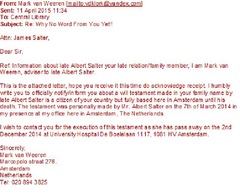 Residents continue to report receiving scam
emails offering a share of a large inheritance from an unknown relative whose
only connection is that they share the same surname!
Even the Coventry Central Library received one of these emails which had very little information other than advising to open an
attachment so that full details could be revealed. It claimed to be
from a ‘Mark van Weeren’ of Amsterdam, an Advisor to the deceased.
There is a Mark van Weeren who is a lawyer at an Amsterdam Law firm and when we contacted him he confirmed that neither he
nor the firm he works at was responsible for this particular email which is a typical
Advance Fee fraud, whereby fraudster will usually require some personal and
sensitive information before requesting an upfront fee before they can
release the funds.
Trading Standards advice to anyone who receives
such an email is not to click on any links or open any
attachments. If you have opened an attachment, it is strongly recommended that you
run an anti-virus or anti malware program to check your computer.
By
responding, your details may also be passed to other scammers and you will
receive more scam emails, letters and phone calls.
Back
to top
|
Trading Standards is warning job hunters posting their CV on LinkedIn and other online forums to
check any contacts they receive carefully as fraudsters are targeting job
seekers on these sites.
The latest report relates to selling products on eBay where, as the chosen ‘applicant’ a local resident was asked to act
as an intermediary, using a personal eBay account to sell high value electronic
goods on behalf of an employer.
Under the arrangement, payment
for any purchase on the auction website would be passed on to the employer,
minus commission of around £40-£60 for each listing. Once the employer has
received payments, goods would then be dispatched.
However, the goods are never
sent, and when the buyer complains, the Seller finds as they are the person
acting as the eBay seller, they are responsible. By this time, all means of
making contact with the employer will have ceased and you never hear from them
again. Your eBay account will be banned, and as you won't be able to prove the item was sent out, you become liable for any monies owed.
Back to top
New reports have come in from residents who have received calls from people falsely
claiming to be from Microsoft stating there is an error with their PC which
needs to be fixed, often for a fee, and also requiring remote access to the
computer.
In the latest report a
Canley resident had someone claim that their PC had been hacked and it needed
to be sorted. Luckily the resident had seen previous warnings on this type of scam and hung up. On dialling '1471' to check the number that had called, 01642 878714 came up giving the impression the person was calling from Middlesbrough.
However, scammers can deliberately change the caller ID that is recorded by your phone, a practice known as 'spoofing' which hides their identity or gives the impression that they are based in the UK when in fact they are not. Fraudsters can also use spoofing to mimic the number of a real company.
Remember, allowing remote access to your
PC may lead to the caller installing an antivirus programme that you could
most probably download from the internet for free. Alternatively they may
interrogate your PC for personal information which could then be used for
fraudulent purposes. Malware that may damage your PC could also be installed.
Back to top
 Watch out also for fraudsters using the name of other well-known
companies to commit their crimes as it makes their communication seem more
legitimate.
A
telephone caller claimed to be from the from the technical department of the
internet and phone company TalkTalk and went on to say that there was a problem
with the resident's IP address which the caller could fix but first required
remote access to the resident's computer.
When
the Walsgrave resident questioned this, they were advised that if access was
refused, the broadband would have to be disconnected for 3 days, and may
never be reconnected! The resident hung
up which is exactly the right thing to do.
TalkTalk advised the resident that the call was not from them but was an attempt to
obtain personal information and money from them and was a scam.
Scam
attempts like this and those involving Microsoft are unfortunately common as are Phishing emails that look like they have come from a legitimate company but have instead been sent by a fraudster looking to obtain your log in details enabling them to take control of your online account.
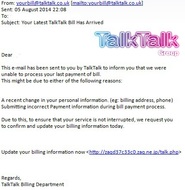
We have also had reports of a scam email from Talk Talk which is headed 'Your Latest Talk Talk Bill Has Arrived' and says they were unable to process your last payment so require you to log on and confirm your billing information.
Our
advice as with any unsolicited call or email from someone offering a service
etc. is not to deal with them no matter what they say or claim.
Back
to top
|
For
more information on scams, visit: www.coventry.gov.uk/scams
|