|
Bulletin 413
9 November 2026
|
|
|
Welcome to our Early Years and Childcare Bulletin. Previous Bulletins are available at: Cheshire East Early years and Childcare Bulletin.
The Early Years and Childcare Bulletin is issued every week during term time and a condensed version during the school holidays.
|
|
Balancing payment
The balancing payment for the autumn term will be paid by Friday 13th November.
You can continue to make midterm changes for the autumn term until Friday 27th November.
Estimates for spring term
The portal will be open between 13th and 29th November, to submit your estimates for the spring term.
You can access your live register at any time to add new children and make changes to hours in readiness for this submission.
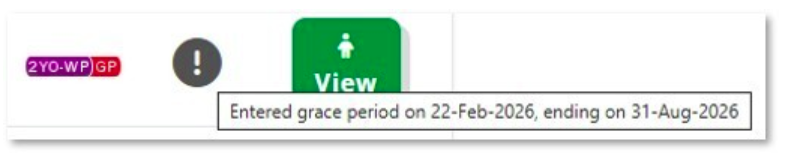
Please check the end date of codes on your live register, and prompt any parents/guardians whose code is still in the grace period ending 31st December to reconfirm their code in plenty of time.
The alert shows as an ! as below and also shows the red GP alert.
|
|
Help shape the delivery of Cheshire East’s Community Cohesion Strategy
Cheshire East Council is developing our Community Cohesion Strategy 2027–2031, which sets out our vision for stronger, more connected and inclusive communities.
Your organisation’s experience of working with residents and communities will help us understand:
- What people and communities are experiencing on the ground.
- Where the main needs, barriers, and opportunities are;
- What practical actions should be prioritised.
- What existing strengths, assets and approaches could support delivery.
- How the Council, partners and communities could work together.
Your responses will be used to develop a high-level delivery plan to sit alongside the strategy. This will help identify priority actions, potential delivery partners, and opportunities for joint working under each of the strategy’s five aims.
The engagement form also asks whether your organisation has a relevant strategy, policy, evidence, or delivery plan that you would be willing to share. You will also be able to express an interest in becoming involved in future work to support delivery.
Please submit your response by Sunday 15th November 2026. Where possible, they would welcome one coordinated response on behalf of your organisation.
The form will ask for your name, role, and organisation. This will help us understand the range of organisations and perspectives represented and allow them to contact you about relevant follow-up activity.
To request a copy of the draft strategy please contact: communitycohesion@cheshireeast.gov.uk
To complete the engagement form please click the button below.
|
|
Subscribe to the product safety alerts, reports and recalls service on GOV.UK
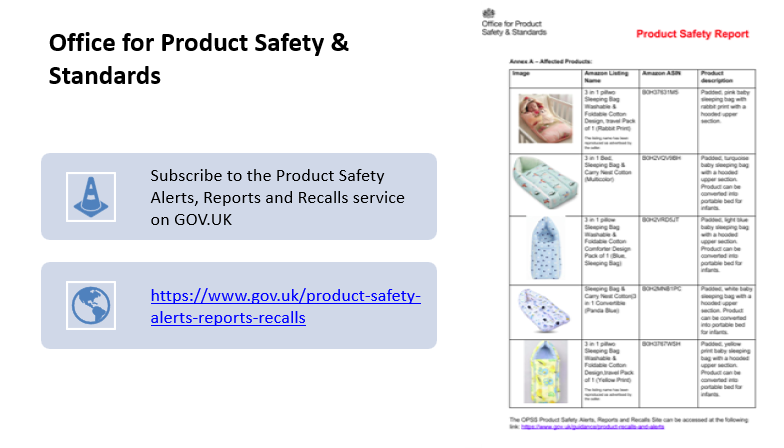 To raise awareness of product safety issues, settings are encouraged to subscribe to the product safety alerts, reports and recalls service on GOV.UK. Subscribers receive regular updates on important product safety issues. They offer a weekly alert option that helps keep email volume manageable and includes documents with images that can easily be:
- Printed for noticeboards or a warning folder.
- Shared in staff areas.
- Used with families.
Thank you for helping raise awareness of these important product safety issues.
To subscribe click the button below.
|
|
|
The Terrorism (Protection of Premises) Act 2025: in education
The Department for Education (DfE) have published guidance for education and childcare settings in England on how they can meet their legal duty to prepare for potential terrorist attacks and keep people safe.
The guidance sets out the key principles for education and childcare settings in England under the Terrorism (Protection of Premises) Act 2025 (‘the Act’), also known as Martyn’s Law. It covers:
- who Martyn’s Law applies to
- who is legally responsible
- what education settings must do
- enhanced-tier and event requirements
- how the law applies to different educational settings
Click on the button below to access the guidance.
|
|
|
Early Years SEN inclusion funding – autumn term dates
Please see below the dates for SENIF in autumn term.
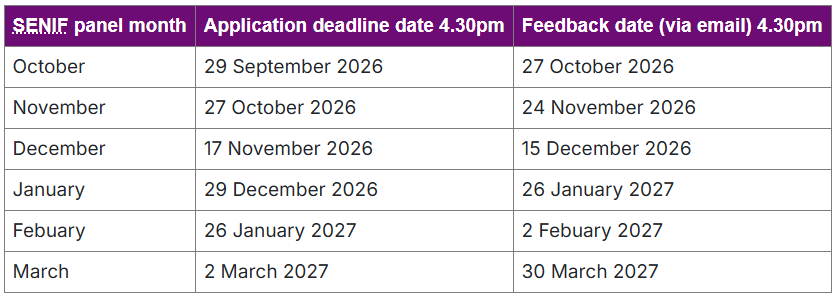 All requests for Special Educational Needs Inclusion Funding (SENIF) must have a completed provision map to support the application. The provision map template is available on the application link Early Years SEND Inclusion Funding and should be used in conjunction with the SENIF policy documents. The provision map is essential when applying for support provided over and above ordinarily available inclusive provision. SENIF is to support children accessing the Early Education Entitlement hours only.
You will receive an email confirmation for all documents submitted to EarlyYearsSenHelpline@cheshireeast.gov.uk. If you do not receive confirmation, please contact 01625 374170.
|
|
Reading is an adventure: celebrate non-fiction November with Cheshire East libraries

This November, Cheshire East libraries are celebrating non-fiction Month, an annual celebration of the wonderful world of factual books. This year’s theme, “Reading is an adventure” encourages children to explore their interests, discover new things and learn more about the world around them through non-fiction.
Non-fiction books can open the door to all sorts of adventures. Young children can learn about animals, bugs, nature, people and places, then take their learning beyond the page through real-life exploration and play. From spotting birds in the garden to finding out how things work, non-fiction can help children develop curiosity, language and a love of learning.
Libraries have a fantastic range of non-fiction books for young children and families to borrow free of charge. Whether a child is fascinated by dinosaurs, vehicles, space, plants or animals, there is a book waiting to inspire their next adventure.
Throughout November, early years practitioners and other professionals supporting children and families are encouraged to help spread the word. Families could be encouraged to visit their local library and choose a non-fiction book alongside their usual storybook. Practitioners might also use a non-fiction book as the starting point for an activity, conversation or real-world adventure, helping children connect what they read with the world around them.
Libraries are free to join, and our friendly staff are always happy to help families discover exciting new books to explore and enjoy together.
|
|
|
Training bookings reminder

To help us keep accurate training records, we would like to remind all settings of the importance of booking a place for every individual who plans to attend training through the Early Years ChESS Hub.
We have recently seen an increase in practitioners attending training without being registered. This can impact training costs as some sessions are commissioned based on booking numbers. It may also mean we are unable to issue attendance certificates as we may not have a record of their attendance or contact details.
Please also ensure that anyone attending training is registered as a user on the Early Years ChESS Hub under your setting before a booking is made.
If you require support registering staff on the Early Years ChESS Hub, please contact the team at earlyyearsandchildcareteam@cheshireeast.gov.uk and we will be happy to help.
|
Free webinars with experts from Tales Toolkit

Tales Toolkit offer a selection of free webinars for early years professionals on a broad range of topics.
From Tuesday 3rd November to 1st December Tales Toolkit will have the webinar "Children's behaviour: Why curiosity is always more effective than control" with Dr Suzanne Zeedyk free to view.
To create a free account to access the webinars click the button below.
|
Autumn term training available on the Early Years Training Hub
The ChESS Early Years Training Hub has lots of training opportunities for the autumn term, please take a look and book on now!
Upcoming training next week
Step Inside the Baby Room – 16th November 2026 09:30 – 12:30 (Oakenclough Family Hub)
This session is part of a series focussing on supporting the three different age groups of children within the Early Years. Did you know? 'For children aged under two - at least half of all staff must have received training that specifically addresses the care of babies' (EYFS, 2025). This training aims to support practitioners working in the baby room to implement best practice and provision. The training will cover how babies learn and develop, how we can best meet their needs through attachment and interactions and how to build an environment and play resources that are right for babies. We will also discuss safer sleep, parent partnerships and the importance of the first 1001 days of a little one’s life for holistic development.
Safeguarding in Play and Out-of-School Settings – 17th November 2026 09:30 – 12:00 (Microsoft Teams)
This two-and-a-half-hour training course will provide essential safeguarding knowledge and understanding for practitioners working in playwork, wraparound, and out-of-school settings. It has been specifically designed to address the unique safeguarding responsibilities and challenges within these environments. This training will help you develop an awareness of, and the ability to act on, concerns about the safety and welfare of children. You will explore your safeguarding responsibilities, recognise signs and indicators of abuse and neglect, and understand the procedures for responding appropriately to concerns. The session will also consider safeguarding within play-based environments, including managing risks, maintaining professional boundaries, and creating safe spaces where children can thrive. By the end of the course, you will have increased confidence in fulfilling your safeguarding duties and promoting the wellbeing of every child in your care.
Early Speech and Language Lead Network – 18th November 2026 18:30 – 20:00 (Microsoft Teams)
These sessions are delivered by Cheshire East Chatters Speech and Language Therapists. The Early Speech and Language Lead Network offers information and advice on how to support the early communication and language development of the children in your setting. These sessions are a chance for you to find out more about local and national updates around supporting children with SLCN.
Responding to and Regulating Emotions in Early Years Settings – 19th November 2026 18:30 – 20:30 (Microsoft Teams)
Emotion Coaching is an evidence-based communication strategy that has been developed by psychologists. The strategy helps to support children to understand and self-regulate their emotions, empowering them to feel more confident and resilient. It is based on the principle that developing a nurturing and emotionally supportive relationship will improve children’s wellbeing and academic outcomes. Emotion Coaching enables a setting ethos of positive learning behaviour and gives confidence to practitioners to de-escalate situations when behaviour is challenging, and emotions are heightened. This training will cover an introduction to key psychological theories behind emotions, emotional literacy and communication, practical strategies and ways of working to encourage co-regulation and self-regulation of emotions within young children.
|
|
|
|
|