|
Bulletin 396
13 July 2026
|
|
Estimates – Autumn Term
The window to submit estimates for the autumn term is open until Friday 7th August. Please ensure you submit by this date, so we can calculate your interim payment.
Removing 4 year olds from Autumn Term Estimates
When submitting your estimates for Autumn term, please amend any 4-year-olds who will be leaving your setting to start school to 0 weeks funding on your estimate submission wizard.
If you have any 4-year-olds who are deferring their school place, please claim for them as normal and email FEEE@cheshireeast.gov.uk
Eligibility Codes – Grace Period Check
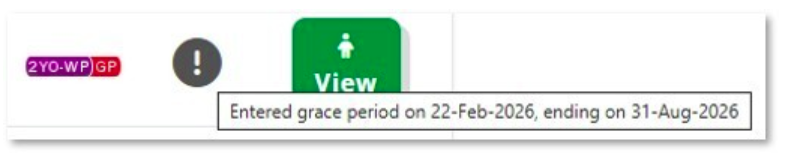
Please check the end date of codes on your live register in readiness for the autumn term, and prompt any parents/guardians whose code is still in the grace period ending 31st August to reconfirm their code in plenty of time.
Whilst the hours may go through for the estimate, if the code is not reconfirmed, they will not go through on your headcount and the child will lose that funding for the autumn term.
The alert shows as an ! as below and also shows the red GP alert.
|
|
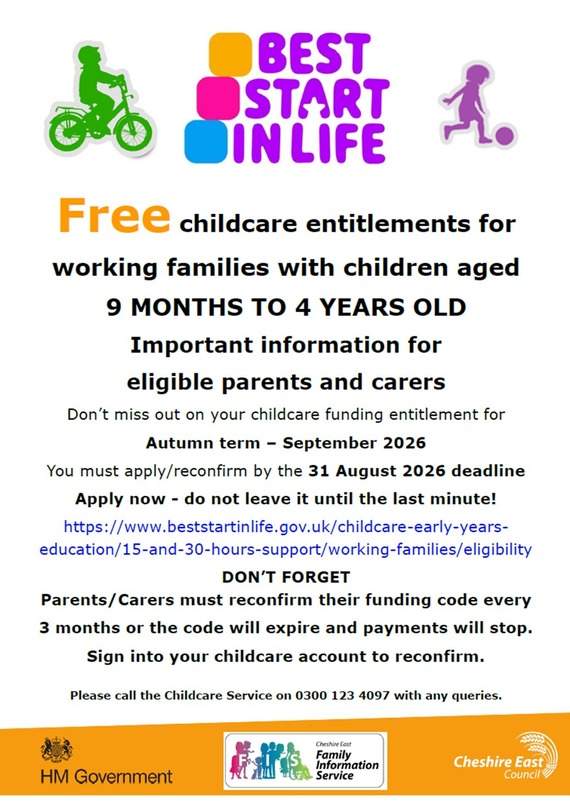
Reminder to apply/reconfirm childcare funding codes for free childcare entitlements for working families with children aged 9 months to 4 years old
Priority services register – support for families and staff
The priority services register (PSR) is a free UK-wide service that provides additional advice and support for eligible households, including extra assistance and communications during interruptions to electricity, gas or water supplies. Parents and carers with children under five can register, as can people who are reliant on medical equipment, have a disability, a chronic illness, a mental health condition, or other circumstances that mean they may need extra support.
Eligibility is not limited to these groups. If anyone in a household meets the vulnerability criteria – even on a temporary basis – they may be eligible to join the PSR. Additional eligibility criteria are available on the PSR website.
The PSR helps utility companies identify households that may need extra support, including priority updates during supply interruptions, tailored communications, and access to additional assistance where needed. Parents, carers and members of the early years workforce can register themselves directly.
To find out more, click on the button below.
|
|
Keeping children safe in education
Keeping children safe in education (KCSIE) 2026, the statutory safeguarding and child protection guidance for schools and colleges in England, has been updated to come into effect on 1st September 2026. All schools are required to have regard to the government’s statutory guidance ‘Keeping children safe in education’, and other childcare providers may also find it helpful to read this guidance.
To view the guidance, click on the button below.
Additional child protection framework consultation webinars
Additional webinar dates have been made available by the Department for Education (DfE) to support engagement with the consultation on proposed updates to the statutory framework for help, support and protection of children in England.
The webinars will provide an opportunity to learn more about the proposed changes to Working Together to Safeguard Children, the Children’s Social Care National Framework, and policy underpinning the development of multi-agency child protection team regulations.
General Overview Webinars (please only sign up to one of them):
Thursday 30 July, 11:00am – 12:30pm or Thursday 27 August, 1:30pm – 3:00pm
Five deep-dive webinars on key policy proposals
Voice of the children and their families webinar: Tuesday 1 September, 10:30am – 12:00pm
Mult-agency safeguarding arrangements webinar: Wednesday 19 August, 10:00am – 11:30am
Help and support webinar: Thursday 6 August, 1:30pm – 3:00pm
Protection Webinar: Tuesday 28 July, 10:00am – 11:30am
Improving outcomes webinar: Thursday 23 July, 3:00pm – 4:30pm.
Capacity is limited to 250 registrations per event so please sign up early.
|
|
Getting children out of nappies between 18-30 months
The way the nation helps children learn how to use the toilet is changing. There is a new approach across education, care, health and family services.
Children need to be out of nappies between 18-30 months, research shows this is what is best for their bowel and bladder health. Potty training can be introduced from 6 months, when a baby can sit up, they can sit on the potty or on a toilet with the right seat and foot support. There’s no need to wait for signs of readiness.
To access the guidance, click on the button below.
Allergy safety in schools
The Department for Education (DfE) have published statutory guidance for schools on allergy safety. Although this isn’t statutory for early years, the guidance will be of relevance to early years settings and should be treated as good practice. The webpage also includes an allergy safety policy template and an individual healthcare plan for allergy template.
To read the guidance, click on the button below.
|
|
New programme of SEND CPD for early years practitioners
On 16 January, the Department for Education (DfE) announced a new £200 million investment in SEND and inclusion training to upskill teachers and educators across early years, schools and post-16.
As part of this commitment, they are developing a national Early Years SEND CPD programme over the next three years to support early years educators in delivering inclusive, high-quality education for every child.
The first phase of this training programme will be available from September 2026, when every early years practitioner will be able to access an initial package of free online training focusing on inclusive practice and developing the knowledge and skills needed to identify and effectively support children with SEND in their settings.
From autumn 2027 a more comprehensive training offer will be rolled out, which will include in-depth webinars and a local support offer, to further develop the knowledge and skills needed to put inclusive practice into action.
New digital service for Disability Living Allowance for children
The Department for Work and Pensions is introducing a new digital service for Disability Living Allowance (DLA) for children to improve how information on a child’s needs is gathered. From July 2026, you may be invited to the trial. If selected, you will receive an email with a secure link and unique code to submit information online.
Your participation is vital in shaping this service. For further information please email smp.pqfoiministerialcorrespondence@dwp.gov.uk
|
|
Autumn Term Training available on the Early Years Training Hub
The ChESS Early Years Training Hub has lots of training opportunities for the autumn term, please take a look and book on now!
Training back by popular demand next term:
New and Aspiring Managers - 23rd September 2026 09:30 - 12:30 (Microsoft Teams)
This course is suitable for new managers, deputy managers, senior staff and those who aspire to be in a management position. This course will support you to develop your knowledge and skills to move into or within your management role. This training will cover statutory requirements, vision and values, leadership and management, managing staff, supervision and wellbeing.
Prevent Awareness - 28th September 2026 10:00 - 11:30 (Microsoft Teams) or 7th October 2026 18:30 - 20:00 (Microsoft Teams)
The Prevent Engagement Officer for Liverpool City Council will be leading this Prevent awareness session for early years providers. The training will highlight the differences between terrorism and extremism, explain the current terror threat level to the UK, the prevalence and the impact of the internet and social media on the radicalisation journey and why the Prevent strand is so important in helping to reduce that threat. It will also describe where the current threat to the UK in respect of terrorism is perceived to emanate from, along with some explanation about other ideologies that are of concern. This will include a description of some of the indicators that may be displayed by those who are or might be, susceptible to radicalisation. Most importantly it will explain the local referral process and how you can make a referral for anyone that you may have concerns about.
Think Equal - 30th September 2026 09:30 - 12:30 (Holmes Chapel Comprehensive School and Sixth Form College Training and Conference Centre)
We have teamed up with Think Equal who are a global movement shaping our children's thinking and positive life outcomes during their brain-building years. As a multi-award winning education charity, they bring social and emotional learning, for psychosocial support, well-being and positive life outcomes to children aged 3-6 across the globe. Think Equal currently have an exciting offer of FULLY FUNDED world class materials for every pre-school child! You will receive; 24 narrative picture books, 90 lesson plans, 50+ resources and access to online training.
Safe Sleep and ICON - 14th October 2026 18:30 - 20:30 (Microsoft Teams)
Join us to learn about safer sleep and ICON (Infant Crying and preventing abusive head trauma). Delivered by Charlotte Coop Specialist Health Visitor on Enhancing Families Programme, and Megan Vause Family Nurse with 12 years safeguarding midwifery experience. The training will provide information on safer sleep practices including the most up to date, evidence-based practice regarding the safest ways of babies to sleep. This session will also provide you with information regarding ICON, a national initiative to help reduce the risk of abusive head trauma, more commonly known as shaken baby syndrome.
Developing Play in the Early Years (NEN) - 9th November 2026 18:30 - 20:30 (Microsoft Teams)
This is a Neuroinclusive Education Network (NEN) training course. This training will develop your understanding of the importance of play in the Early Years and how autism can impact upon a child's play development. You will also build your awareness of strategies that can be used to support autistic children with their play development. This course is intended to equip you with an understanding of the importance of play in the Early Years Foundation Stage and how the Three Areas of Difference in autism can impact on play skills. The training also considers how person-centred planning and making reasonable adjustments can enable autistic children to develop their play skills.
|
|
|
|
|