Early Years SENCO Level 3 - Free training from the Best Practice Network
An Early Years Special Educational Needs Coordinator (EYSENCO) plays a key role in identifying and supporting children with Special Educational Needs and Disabilities (SEND). They work closely with families and professionals to make sure children receive the right support, helping to secure the best possible outcomes in their early development and learning.
The Best Practice Network is offering free training funded by the Department for Education.
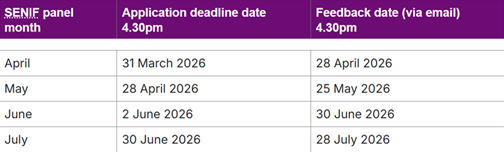
The June intake is now full. Apply for the July intake by 21st June.
Register for a place by clicking on the button below.
Early Mathematic Support from Education Endowment Foundation
You want to support your children to build their mathematical understanding in meaningful ways, while having fun. How can you do that?
You can find practical ideas from the Education Endowment Foundation in their Evidence Store, which brings together evidence-informed approaches for early maths. You’ll find:
- Video examples from real settings, showing how educators put approaches into practice.
- Clear summaries of what the evidence suggests could support children’s learning.
- Downloadable posters to use with your team.
To explore the resources please click the button below.
Free online child development training for all those working in early years, including reception
The Department for Education’s Early years child development training is a free, online programme designed by early years experts to support educators working with children from birth to reception.
This flexible online training will help you to:
- Build and strengthen your child development knowledge
- Get practical advice and ideas to support children in your setting, including reception classes
- Reflect on your practice and test your knowledge
- Learn from practical training videos filmed in early years and reception settings
- Access modules in any order, at any time
- Download a certificate on completion of each module
The programme includes 8 modules, covering key areas such as:
- Brain development and how children learn
- Personal, social and emotional development
- Communication and language
- Physical development
- Mathematics
- Effective curriculum and assessment
- Supporting individual differences and needs
The training has recently been updated to include:
- Additional videos and practical advice for supporting children in reception
- Guidance on supporting the EYFS profile assessment
Access the training: Visit the Early years child development training to register or sign-in if you already have an account.
Free early years resources: Help for Early Years Providers also offers free resources for educators working with children aged 0 to 5 years. The website has recently been updated to include EYFS profile assessment support including bite-sized videos and case studies. A new safer sleep page has also been created in collaboration with The Lullaby Trust, providing advice to create and maintain safer sleep environments for babies and young children in their care.
Supervision bitesize recording
The Early Years Team have recorded a bitesize training session around supervision in early years settings. This could be helpful to anyone new to completing supervisions with staff members or anyone who would like a refresher.
If you would like to view the recording, please email earlyyearsandchildcareteam@cheshireeast.gov.uk to request the YouTube link.
Summer Term Training available on the Early Years Training Hub
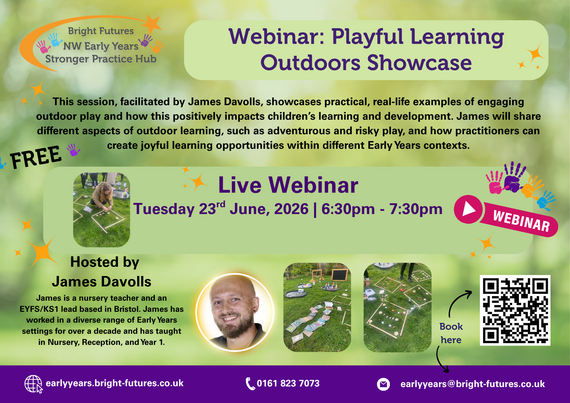
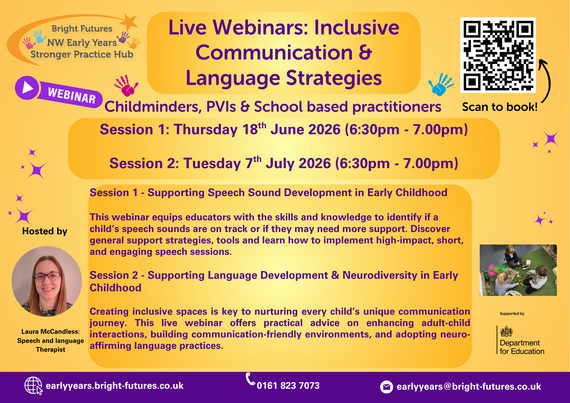
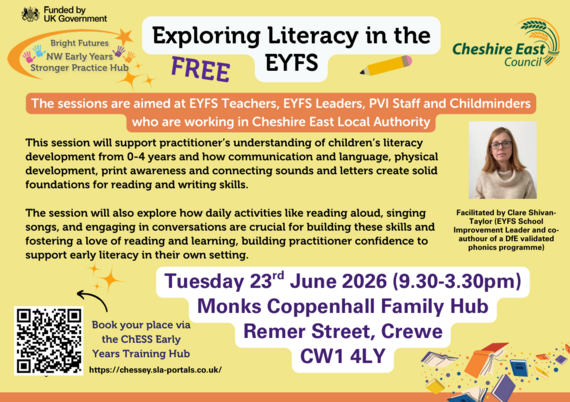
The ChESS Early Years Training Hub has lots of training opportunities for the summer term, please take a look and book on now!
Upcoming training next week:
Preschool Network - 16th June 2026 18:00 - 19:30 (Oakenclough Family Hub)
This network session is for Preschool providers. This Preschool network is an opportunity for preschool managers, committee chairs and business managers to meet together, make new connections and share experiences. There’s no agenda. Please feel free to come along, network and ask questions. The Childcare Development Team will be facilitating the network.
Progress check at age 2 - 17th June 2026 10:00 - 11:30 (Microsoft Teams)
“When a child is aged between two and three, practitioners must review their progress and provide parents and/or carers with a short written summary of their child’s development in the prime areas. The summary must highlight areas in which a child is progressing well, areas in which some additional support might be needed, and focus particularly on any areas where there is a concern that a child may have a developmental delay, which may indicate a special educational need or disability. The summary must describe the activities and strategies the provider intends to adopt to address any issues or concerns” (EYFS, 2025). Explore the process of writing a good quality progress check including when to do it, what to include and how you can work in partnership with parents/carers and other professionals to put in place appropriate early support and intervention in order to best meet the individual needs of the child. Delegates will be given access to a variety of resources that can be used when completing this statutory assessment.
Safe Sleep and ICON - 17th June 2026 18:30 - 20:30 (Microsoft Teams)
Join us to learn about safer sleep and ICON (Infant Crying and preventing abusive head trauma). Delivered by Charlotte Coop Specialist Health Visitor on Enhancing Families Programme, and Megan Vause Family Nurse with 12 years safeguarding midwifery experience. The training will provide information on safer sleep practices including the most up to date, evidence-based practice regarding the safest ways of babies to sleep. This session will also provide you with information regarding ICON, a national initiative to help reduce the risk of abusive head trauma, more commonly known as shaken baby syndrome.
Safer Recruitment - 18th June 2026 10:00 - 16:00 (Crewe Lifestyle Family Hub)
Childcare settings share with others a duty to safeguard the children in their care. Implementing safer recruitment practices is one way of discharging this safeguarding obligation. Keeping Children Safe in Education recommends that at least one of the persons who conducts an interview has completed safer recruitment training. This one-day course gives childcare providers, including childminders who employ assistants, information and understanding they need to recruit safely and comply with relevant statutory guidance. This course covers safer recruitment and the wider context of safeguarding, the prevalence of abuse and profile of abusers, important features of a safer recruitment process including interview and selection, setting acceptable standards of behaviour and maintaining an ongoing culture of vigilance.
|