|
Headcount Window Closed
The submission window to submit the Summer term headcount has now closed on the establishment portal.
If you have any new children or changes to children’s hours, that you could not include in your headcount, please add them to your live register, or change their hours as a midterm adjustment, so we can include them in your balancing payment for the Summer term.
Midterm Leavers
If you have any children leaving your setting during the term, please ensure you remove them from your live register on or after their final day.
Click ‘View Child’ and then ‘Remove’
Enter their leave date and the number of weeks funding you are claiming for the term.
|
|
Advertise your vacancies via the free Find a job website
The Department for Work and Pensions' (DWP) free ‘Find a job’ vacancy platform supports applicants to search for early years roles in their area.
Employers are encouraged to advertise their jobs on the Find a job website. Click the button below to create an account or login to the Employer section to add your company to post job adverts and manage your team.
You should use the term ‘early years’ in the title of your job adverts and select ‘Education jobs’ for the job category. Watch the video tutorials below to help you list any vacancies in your setting on Find a job.
|
|
NSPCC PANTS resources
NSPCC Learning has published a new series of Talk PANTS videos. Talk PANTS is an NSPCC campaign to keep children safe from sexual abuse and includes a range of resources to help teachers, schools and early years settings deliver age-appropriate sessions with children. The new videos include an introduction to what Talk PANTS is. They also feature videos for use with children aged between 3- to 5-years-old, 5- to 7-years-old, and 7- to 11-years-old, as well as children who have special educational needs and disabilities (SEND) and additional support needs (ASN) aged 4- to 11-years-old to help them understand Talk PANTS.
|
|
|
UKHSA advice for Early Years settings and recently vaccinated children
The Department for Education and the UK Health Security Agency (UKHSA) have become aware that some early education settings are temporarily excluding children who have recently been vaccinated, even if they feel well enough to attend. This statement from a UKHSA health protection expert explains why such policies are unnecessary and can have serious unintended consequences for children and the early years settings they attend.
Dr Mary Ramsay, Director of Public Health Programmes at the UK Health Security Agency, said:
“Vaccinations are vital for protecting children against serious and potentially life-threatening diseases. With measles outbreaks occurring in areas of the UK, it's more important than ever that children receive their routine immunisations on schedule.
While some children may experience mild side effects after vaccination, there is absolutely no medical reason to exclude a vaccinated child from a setting if they are feeling well. This practice could potentially discourage parents from getting their children vaccinated and therefore increase the risk of having outbreaks in nurseries and schools.
All medicines can cause side effects, but global health authorities agree that immunisation is the safest way to protect children's health. If a parent or carer feels their child is well enough to attend nursery or school after vaccination, they should be welcomed as normal.
There is no reason to exclude children who have been recently vaccinated as vaccine viruses cannot spread to others.
By supporting childhood vaccination and maintaining inclusive and evidence-led policies, early years and education settings play a crucial role in protecting not just individual children, but entire communities from preventable diseases.”
|
|
National Year of Reading event in May
The National Literacy Trust would like your setting to help craft the next Go All In Together! event on Wednesday, 20 May, delivered as part of the National Year of Reading 2026.
This years event is called: Where sticks become stories: A musical journey
This is inspired by the much‑loved children’s book Stanley’s Stick, designed for Early Years and KS1/P1–P3 pupils, the event will spark imagination, creativity, and early storytelling skills, while celebrating voices from all four nations.
The first half features an active musical performance of Stanley’s Stick, accompanied by the Northern Chamber Orchestra.
In the second half, children will help shape a special four‑nation version of Stanley’s Stick, brought to life by storyteller Danyah Miller and illustrator Neal Layton.
Click the button below to sign up to the event.
|
|
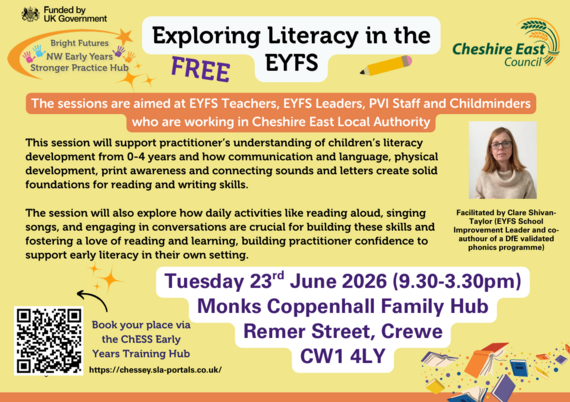
Summer Term Training now available on the Early Years Training Hub
The ChESS Early Years Training Hub has been updated with lots of training opportunities for the summer term, please take a look and book on now!
Upcoming training next week:
Early Years Leaders Network - 18th May 2026 18:30 - 20:00 (Microsoft Teams)
The Early Years Leaders Network is for owners, managers, leaders and childminders of Early Years and Childcare settings. These networks are an opportunity to hear the latest updates from the Early Years Team, ask questions and network with other professionals.
Basic Safeguarding Awareness - 20th May 2026 18:30 - 20:30 (Microsoft Teams)
This two-hour training course will provide basic information and understanding about safeguarding children. It has been specifically written to address safeguarding in Early Years and Childcare settings and covers practice and procedures used within Cheshire East. This training is in line with the criteria set out in Annex C. This training will help you to develop an awareness of, and the ability to act on, concerns about the safety and welfare of children and young people. It will enable you to understand your safeguarding role, be able to define, identify, understand and respond appropriately to signs of possible abuse and neglect and identify safer caring practices.
Let's Get Outside - 21st May 2026 09:30 - 12:00 (Oakenclough Family Hub or Oak Tree Family Hub)
Let’s explore the benefits of outdoor play and learning; from promoting physical health and wellbeing to nurturing creativity, critical thinking and social skills. The outdoors is the perfect canvas for holistic development. Curiosity is sparked, imaginations can run wild, and learning can become an adventure. This training will empower and enable practitioners to make the most of their outdoor space. Sharing ideas on how to enhance your learning environment to give children the opportunity and space to explore no matter how small, large, man-made or natural it may be. All attendees will receive a PDF copy of our ‘Let’s Get Outside’ toolkit.
|
|
|
|