|
Bulletin 383
23 March 2026
|
|
Free Early Education Entitlement Agreement 2026/27
Providers should shortly receive the Agreement for the Provision of Free Early Education Entitlement Places 2026-2027 electronically via DocuSign. To guarantee receiving your summer term interim payment by Friday 10 April, please sign and return your agreement as soon as possible. Without a signed agreement, interim payments cannot be processed.
If you have received an agreement via email but do not have the authority to enter into contracts on behalf of your provision, please contact the FEEE Team as soon as possible with the details of the appropriate person (name and email address).
Summer Term Estimate
The window to submit the summer term estimate closed on Friday 20th March. If you have not submitted your estimate, please contact the FEEE team.
Without an estimate, we are not able to calculate an interim payment for summer term.
|
|
Updated guidance for childminders on claiming household expenses
HMRC has published guidance for childminders on how they can continue to claim household expenses, including wear and tear costs deductions, whether they use Making Tax Digital for Income Tax or not. The new guidance and the updated Business Income Manual guidance can be found on GOV.UK.
Key points from the guidance:
- All childminders can claim a deduction for costs of buying, repairing or replacing household items used for their business, including wear and tear of household items and furniture, household costs and food and drink, whether they use Making Tax Digital or the alternative rules for the sector.
- Only those with qualifying income above £50,000 will begin using Making Tax Digital from 6 April 2026. In 2027 the qualifying income threshold will drop to £30,000 and then in 2028 to £20,000.
- If childminders use Making Tax Digital they will record and claim their actual expenditure on buying, repairing or replacing household items and furniture, which can be higher than 10% in some instances. If they are still using the alternative method, they will continue to claim for ‘wear and tear’ using the flat 10% estimate.
The government will actively engage with childminders and stakeholders to review the impacts of moving from the 10% deduction to actual costs for wear and tear expense claims.
You can also find out more information about Making Tax Digital for Income Tax on HMRC’s campaign page.
|
|
Working Together to Safeguard Children 2026
The working together to safeguard children statutory guidance has been updated on 18 March 2026.
Please click the button below to view the updated document.
Safe sleep requirement in the Early Years Foundation Stage (EYFS) statutory framework
Early years providers are required to meet the safer sleep requirements set out in the EYFS statutory framework, which currently links to the NHS safer sleep guidance. To make the existing requirements to follow the NHS guidance clearer, the DfE will update the wording in the EYFS framework so that more detail on safer sleep is set out directly within the framework itself.
The DfE intend to introduce this for September 2026, subject to the parliamentary and legislative process.
See the following links for more advice on safer sleep:
Sudden infant death syndrome (SIDS) - NHS
Safer Sleeping Practices for Early Years Educators - Foundation Years
Home | The Lullaby Trust
|
|
New Ofsted blog: Scam text messages claiming to be from Ofsted
Ofsted are aware of a rise in scam text messages claiming to be from Ofsted, so they have written a blog to reassure you and let you know what you can do if you receive one.
Please click the button below to read the blog.
Early years foundation stage (EYFS) profile assessment support
The Department for Education (DfE) have published practical support to help school leaders and early years practitioners understand and carry out the early years foundation stage (EYFS) profile assessment.
This support is designed to correct common misunderstandings about what the assessment requires and to make EYFS profile data more reliable. Improving assessment practice will help children move smoothly into year 1, because EYFS and year 1 staff will be able to discuss children’s progress using accurate and consistent information.
The resources include:
- short written guides on key parts of the EYFS profile assessment, including the role of headteachers and senior leaders and how to assess children fairly and inclusively
- short videos, each under 5 minutes, for example on how to assess specific Early Learning Goals
- case studies that show how assessment works in real situations
For more guidance on supporting children in the early years, visit the Help for Early Years Providers website. You can also give the DfE feedback on the Help for Early Years Providers website or sign up to take part in their user research.
Meningococcal disease outbreak in Kent and Medway
You will have seen recent media reports about an invasive meningococcal disease outbreak in Kent and Medway.
The DfE want to reassure you that while meningococcal disease can affect all ages, recent outbreaks have shown that older children, teenagers and young adults are more likely to be affected, and the individuals affected so far in this outbreak have been older teenagers and young adults. Meningococcal disease does not spread easily, and most children in primary age groups will have had access to the national infant vaccination programme. Vaccination coverage is above 90%.
Children can and should continue to attend their early education setting as normal unless their parents or carers have been directly advised otherwise by the local health protection team. Outbreaks of this size are rare. If parents have not been contacted directly by the UK Health Security Agency, the risk to them/their child is low.
It is always important for parents and carers to make sure that children stay up to date with all their routine vaccinations, as these offer important protection against infectious disease outbreaks.
Parents and carers should also be aware and alert to the signs and symptoms of invasive meningococcal disease.
For more information, visit the NHS website https://www.nhs.uk/conditions/meningitis/ or see the information available from two charities who offer free support via their websites and helplines:
The Meningitis Research Foundation
www.meningitis.org
Helpline UK 080 8800 3344
Meningitis Now
www.meningitisnow.org
Helpline 0808 80 10 388
or helpline@meningitisnow.org
UKHSA blog post
Meningitis B outbreak: what you need to know – UK Health Security Agency
|
|
Summer term SENCO Networks
- 27th April 2026 10:00 - 11:30 (Holmes Chapel Comprehensive School and Sixth Form College - Training and Conference Centre)
- 29th April 2026 18:30 - 20:30 (Microsoft Teams)
These sessions will be led by Sarah Clough - Strategic Lead for Mainstream Inclusive Practice at Cheshire East Council. An update will be provided for all Early Years settings on the reforms in the white paper and the work that is already being undertaken across Cheshire East. Attendance at each termly network is highly recommended to keep your SEND knowledge up to date.
Log in to your ChESS Early Years Training Hub account to book a place.
Join Olivia Bailey for an Early Years SEND reform online event
On Wednesday 22 April, the Minister for Early Years, Olivia Bailey will be answering your questions on the early years and SEND reform.
Join Olivia Bailey, the Best Start in Life Champion, Sue Robb, alongside a sector co-host, for a live online event about the government’s plans for the sector and what the recently announced SEND reforms mean for you.
Please click on the button below for further details and to sign up to the event.
|
|
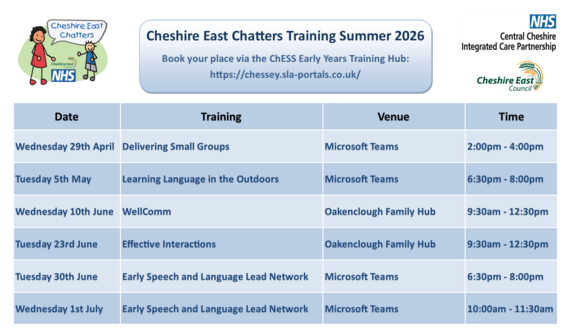
Summer Term Training now available on the Early Years Training Hub
The ChESS Early Years Training Hub has been updated with lots of training opportunities for the summer term, please take a look and book on now!
New training next term:
Teamwork, Culture and Communication
- 11th May 2026 18:00 - 20:30 (Microsoft Teams)
This two-and-a-half-hour training course will provide practical strategies to strengthen teamwork, workplace culture, and communication within early years and childcare settings. It has been designed for practitioners and leaders who want to build positive, collaborative, and high-performing teams. This training will help you develop effective communication skills, foster a supportive team culture, and improve collaboration across your setting. You will explore strategies to build trust, manage conflict professionally, and promote shared values and expectations. The session will also consider how strong teamwork positively impacts staff wellbeing, retention, and outcomes for children. By the end of the course, you will have clear, actionable approaches to strengthen relationships and create a culture where everyone can thrive.
STEM in the Early Years
- 1st June 2026 18:00 - 20:30 (Microsoft Teams)
This two-and-a-half-hour training course will introduce Science, Technology, Engineering, and Mathematics (STEM) concepts within early years settings. It has been designed to help practitioners confidently embed STEM learning into everyday practice. This training will support you in understanding how STEM can be delivered through play-based, child-led experiences. You will explore practical activities that promote curiosity, investigation, problem-solving, and critical thinking. The session will demonstrate how everyday resources and environments can be used to introduce early scientific and mathematical thinking in meaningful and engaging ways. By the end of the course, you will have a bank of ideas and strategies to integrate STEM opportunities seamlessly into your provision.
Safe Sleep and ICON
- 4th June 2026 9:30 - 11:30 (Microsoft Teams)
- 17th June 2026 18:30 - 20:30 (Microsoft Teams)
Join us to learn about safer sleep and ICON (Infant Crying and preventing abusive head trauma). Delivered by Charlotte Coop Specialist Health Visitor on Enhancing Families Programme, and Megan Vause Family Nurse with 12 years safeguarding midwifery experience. The training will provide information on safer sleep practices including the most up to date, evidence-based practice regarding the safest ways of babies to sleep. This session will also provide you with information regarding ICON, a national initiative to help reduce the risk of abusive head trauma, more commonly known as shaken baby syndrome.
|
|
|
|
|