“The truth is: the natural world is changing. And we are totally dependent on that world. It provides our food, water and air. It is the most precious thing we have and we need to defend it.”
Sir David Attenborough
Welcome to the second edition of our climate change in Cheshire East newsletter.
Becoming a net zero borough
We have already committed to becoming carbon neutral in our own operations by 2025, and are doing this through a range of projects to both reduce and offset our emissions. You can read more about how we are doing this on our carbon neutral webpage.
In January this year, we went further with our ambition by joining the UK100 network, pledging to make the borough carbon neutral by 2045.
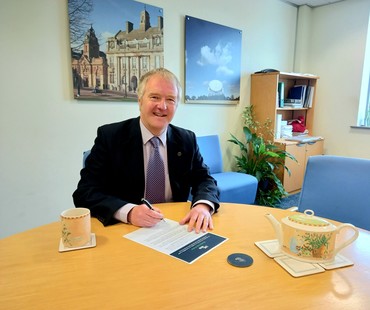
Leader of the council, Councillor Sam Corcoran, signing our UK100 pledge.
We recognise that achieving net zero targets is not something that any one person or organisation can do alone – there must be a collective effort by everyone across the borough to take the necessary action to protect the future of not only Cheshire East, but that of the planet.
Membership of UK100 will provide tailored insights, evidence and recommendations on the challenges to local net zero. This will help us to broaden our projects and implement the solutions needed to further reduce carbon emissions across Cheshire East.
Carbon neutral action plan in focus - offsetting our emissions
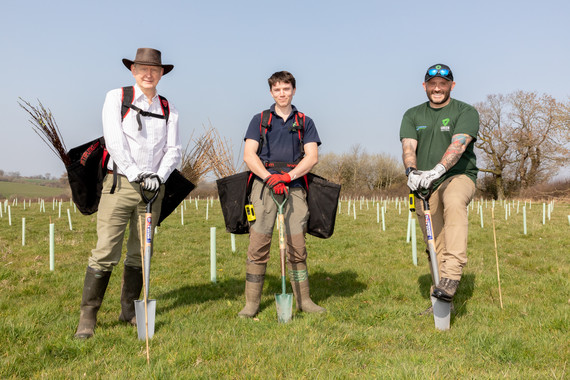 We are working to reduce carbon emissions where we can. Where we can’t remove or reduce emissions to zero, we have plans to offset those emissions in Cheshire East, through initiatives such as tree planting in the borough.
The latest tree planting season ended in March 2022, and we have now planted around 22 hectares of trees in parks and green spaces across the borough – the equivalent of 30 football pitches. This has been achieved with support from Cheshire Wildlife Trust, The Mersey Forest, Ansa Environmental Services and our Ranger service.
Last month, we completed our largest single-site tree planting scheme to date at Leighton Grange, Crewe, where planning permission has recently been secured to also install a large-scale solar farm. This means the site at Leighton Grange will help make a significant contribution to the council’s carbon neutral commitment for years to come.
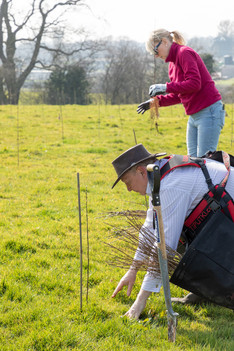
The seven-hectare tree planting site (equivalent to around 10 football pitches) is the first major site delivered in partnership with The Mersey Forest, with funding from Trees for Climate – a multi-million-pound woodland creation programme and part of the government-led Nature for Climate Fund.
Volunteers from the Green Task Force, a charity that uses nature-based therapy to help veterans struggling with their mental health into work, helped to plant the large site over five days.
Planting trees across the borough is one way that we are aiming to offset some of the emissions generated through service delivery, and we are on target to be a carbon neutral council by 2025.
The next tree planting season will start in October 2022. We will share more details nearer the time for those of you who'd like to get involved and show your support.
|
With thanks to:
Improving energy efficiency will lower your carbon footprint – and save you money
With funding from the government’s Public Sector Decarbonisation Scheme, we are working to improve the energy efficiency of council buildings, leisure centres, libraries and depots all over the borough.
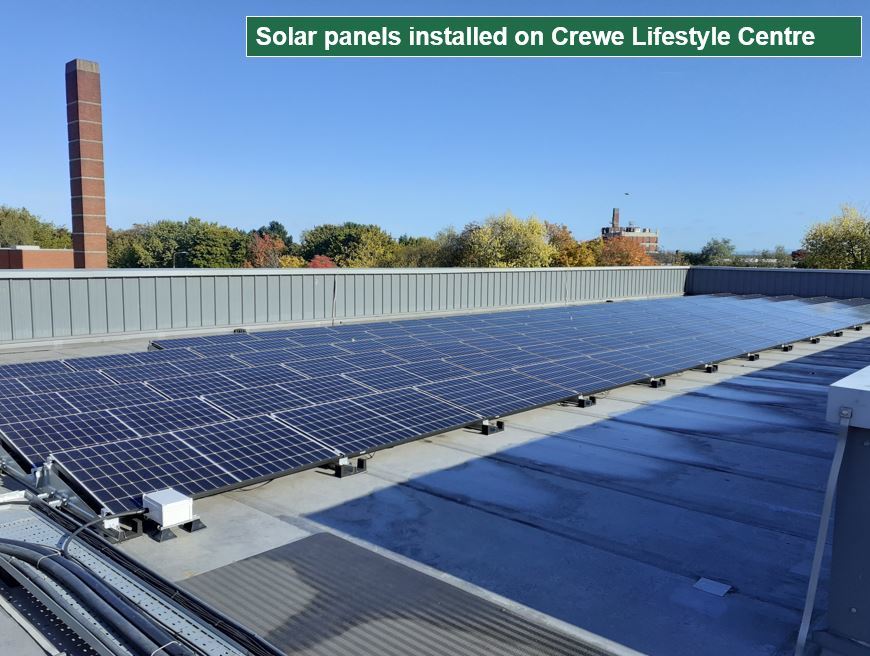
Projects include significant solar panel installation, building insulation, LED lighting upgrades, installation of heat networks and heat pumps, and improved energy controls.
With the sharp rise in energy bills, there are some simple steps you can take that will not only save you money, but also reduce your carbon footprint too.
Smart heating technology
Many of us are familiar with smart meters – which have handy in-home displays making it easier to monitor and manage your energy usage at home, and automatically send energy data to your supplier (no more meter readings or estimated bills!).
|
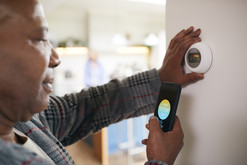
Did you know that you can also have a smart thermostat as well as a smart meter?
Smart thermostats give you more control over your heating via an app on your phone, with some even learning your habits and adjusting your heating schedule to save energy when you don’t need it – such as when you’re not at home.
|
|
 |
Other quick wins for saving energy – and your purse:
 |
|
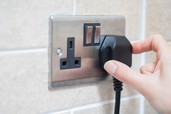
Get into the habit of unplugging devices when they are fully charged. Televisions, set-top boxes, games consoles, electric toothbrushes and razors etc that are left plugged in and on stand-by all use power – and the older the device, the greater the standby load. Unplugging them could reduce energy usage by up to 23%.
|
|
Wash laundry at less than 40C – modern washing powders and detergents work effectively at lower temperatures. Simply reducing the temperature to 30C will make a big difference to the cost of running a washing machine.
|
|
 |
 |
|
Take more showers rather than baths – Provided you shower in less than 10 minutes, a shower will be more economical than a bath – which typically uses 90 litres of water compared to nine litres from a shower.
|
Give the tumble dryer a rest – tumble dryers notoriously use a lot of electricity. Try line-drying your clothes when the weather is warmer, or a clothes airer in the home. If you do need to use the tumble dryer, don’t overload it and make sure your washing is untangled and shaken out before putting it in. If you do all your drying on the same day, the dryer will retain some of the heat from load to load, which will also save energy. |
|
 |
Trialling a new approach to managing our green spaces
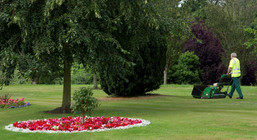
To promote biodiversity, we are trialling a different approach to the way we manage the grass areas of some major parks.
In most of our larger parks, which are managed by Ansa Environmental Services, grass areas that show promise to enable nature and wildlife to thrive, will be mown less.
 |
|
We will continue to mow areas where there is a need to do so, for example to ensure the visibility and safety of those in the area or where the space is currently used for recreational activities such as sports fields or picnic areas. Paths and trails will continue to be maintained to ensure safe usage. |
There will also be a trial to increase the use of wildflower mix in South Park, Macclesfield and Nantwich Riverside, creating an opportunity for excellent natural habitats for birds and butterflies that will be relatively low maintenance once established.
In some areas there will be increased planting of perennials, reducing waste from the removal and replacement of annual bedding plants. Perennials provide structure and form to areas, and as some plants are nectar-rich or provide food for birds, will help to attract wildlife. Other plans include allowing hedges in rural and open spaces to grow and flower between maintenance. |
|
 |
We are also trialling the use of electrical tools in place of traditional petrol-powered ones such as mowers – reducing localised emissions.
Look out for signage coming soon in some of our larger parks that will explain more about these trials, the changes you can expect to see and how it will benefit biodiversity and local wildlife.
If you’d like to share some photos with us of the changes you see, send them to carbonneutral@cheshireeast.gov.uk and we may feature them on our social media channels.
The North West is taking action – and Green Expo 2022 will show how

Join us at the inaugural Green Expo in Chester in June 2022 – showing what has been achieved in the region on progress to Net Zero and climate change and how it will impact how we live, work and play.
Green Expo will have components for business, with the Green Expo welcome and awards dinner on Wednesday 15 June and The Green Expo Conference with a special inward investment focus, on Thursday 16 June.
|
A youth conference for school and college students will take place on Friday 17 June.
And the Green Expo Exposition, FREE to attend, will run alongside the River Dee in Chester, on Castle Drive from Thursday 16 to Saturday 18 June.
All will feature the latest sustainable technologies for powering our future homes, transport and lives. There will be demonstrations, exhibits and presentations from many leading organisations in the region, and it will offer a chance for both businesses and individuals to gain an understanding of how these technologies will impact upon their lives
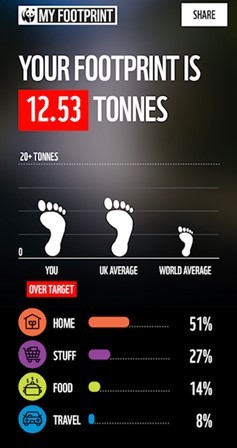
How big is your environmental footprint?
 |
|
Taking action to combat the very real threat of climate change is in all our hands – we can't do this alone.
There are many ways to reduce your own carbon emissions – but before you start, it’s helpful to know what your own carbon footprint is.
WWF have an easy-to-use carbon footprint calculator, so within a couple of minutes you can find out how big your carbon footprint is compared to the world and UK averages.
Once you know that – you can start to understand the steps you can take to reduce your carbon emissions and do your bit to protect the future of the planet.
|
|