|
Welcome to the latest Blue Belt newsletter!
In this edition, we wrap up the beginning of 2024, including new updates to the South Georgia & South Sandwich Islands (SGSSI) Marine Protected Area, latest coastal processes fieldwork in Anguilla and sargassum workshops in the Turks & Caicos Islands.
You’ll also be able to meet our latest person spotlight, Pia, a green turtle intern on Ascension Island.
Outcomes of South Georgia & the South Sandwich Islands' MPA review announced
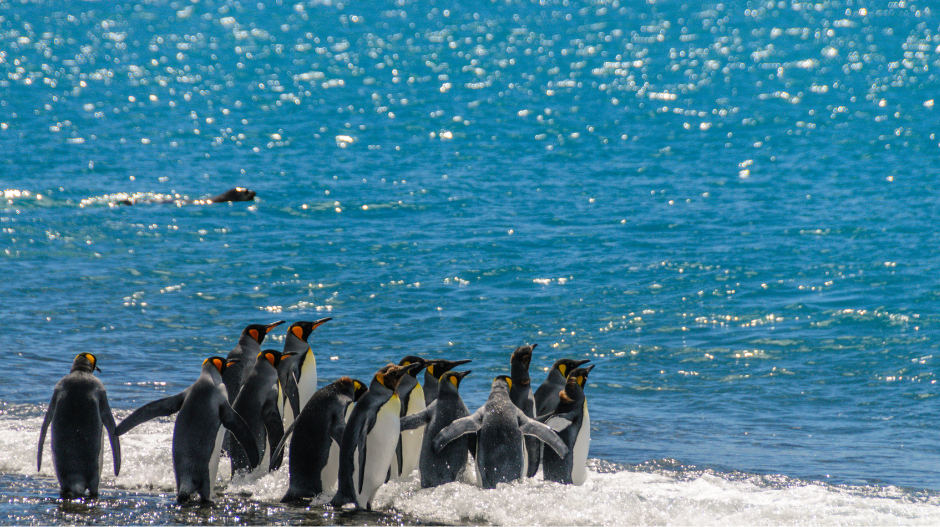 King Penguins at South Georgia
The second 5-yearly SGSSI Marine Protected Area (MPA) review concluded in February with an expert panel confirming that the MPA is exceptionally well managed with a high level of compliance with protection measures, and that it is achieving its intended objectives.
Thanks to investment from the Blue Belt Programme and other funding bodies, there has been substantial scientific effort in areas considered as data poor and in need of additional research during the previous MPA review in 2017/18. An extensive body of new scientific work supports the management of the MPA, with a Research & Monitoring Plan directing activities to where they are most needed.
The diverse range of stakeholders who participated in the MPA review highlighted the rigour of the process and commended the Government of South Georgia & the South Sandwich Islands (GSGSSI) on their commitment to adaptive management.
This approach was reflected in the recent GSGSSI announcement of an additional 166,000km2 of ‘No Take Zones’ within the existing MPA, resulting in 449,000km2 of highly biodiverse marine habitat (an area over 21 times the size of Wales) being closed to all fishing activity. An additional 17,000km2 will also be closed to krill fishing through new pelagic closed areas.
Helping to address sargassum influxes in the Turks & Caicos Islands
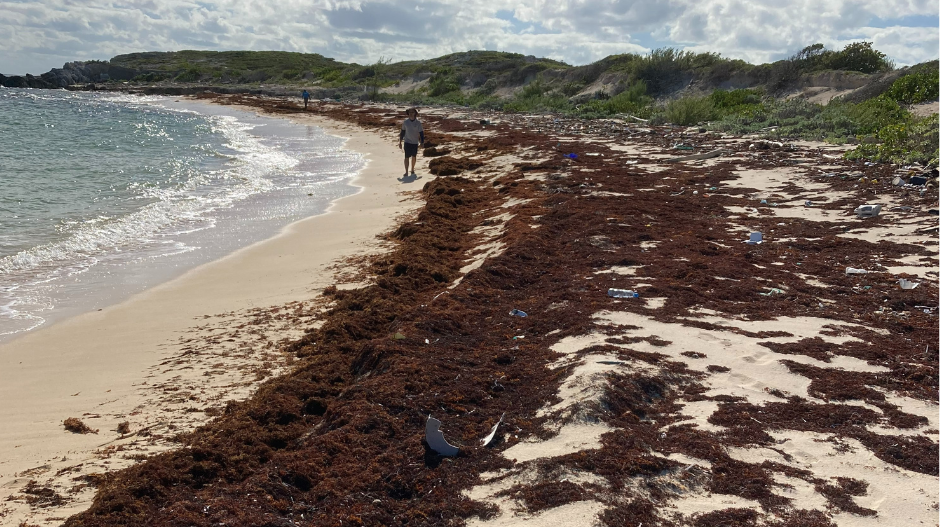 A sargassum influx in Turks & Caicos Islands
In recent years large increases of sargassum – a type of brown seaweed – has led to high influxes in coastal regions across the Caribbean, posing new challenges for local communities.
Recently a Blue Belt team travelled to the Turks & Caicos Islands (TCI) to support the delivery of a landmark workshop on addressing sargassum influxes.
The workshop, delivered in close collaboration with the TCI Department for Environment and Coastal Resources, brought together sargassum experts, practitioners, policy makers and local communities to discuss effective strategies for managing sargassum influxes.
Blue Belt team delivers coastal processes support in Anguilla
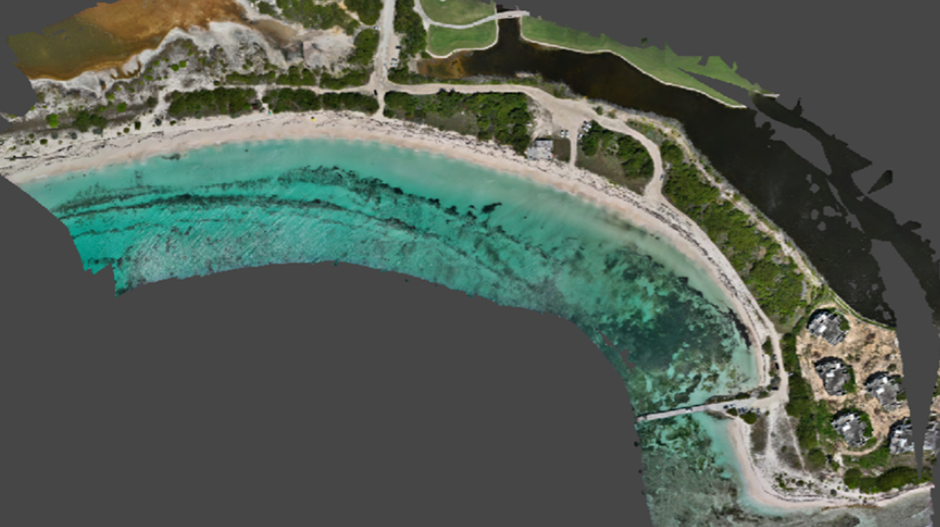 Drone derived Orthophoto of Cove Bay
Anguilla has an impressive 30-year beach monitoring programme, however each survey uses Abney Levels (beach profiling), which have low accuracy, and reference markers (survey start points), which can potentially move or be destroyed. Indeed, several have been lost to hurricanes, permanently ending the record.
In February 2024, the Blue Belt Coastal Processes team delivered new equipment and training to upgrade the Anguilla Beach Monitoring Programme. New, highly accurate, survey-grade GPS and drone equipment was acquired for detailed mapping of coastal features and erosion.
The team delivered classroom and practical training to Anguilla’s beach surveyors and drone pilots (10 staff from Fisheries Division, Physical Planning and Lands and Survey Department, as well as Anguilla National Trust), as well as supporting Anguilla’s first drone survey (at Cove Bay) and the production of orthophotos and digital elevation models for measuring coastal erosion.
Alongside this work, the team explored the potential of citizen and corporate (holiday resort) scientists for future shoreline monitoring using smart phones (at Sandy Ground) and web cameras (at Meads Bay).
The new technology will significantly improve data quality and survey efficiency (i.e., reductions in staff time). Long-term coastal monitoring is essential to characterise the trends and behaviours of each beach, which need to be understood for effective coastal zone management, planning, flood/erosion risk assessment and disaster management.
Conversations with the UK Overseas Territories at the Blue Belt symposium
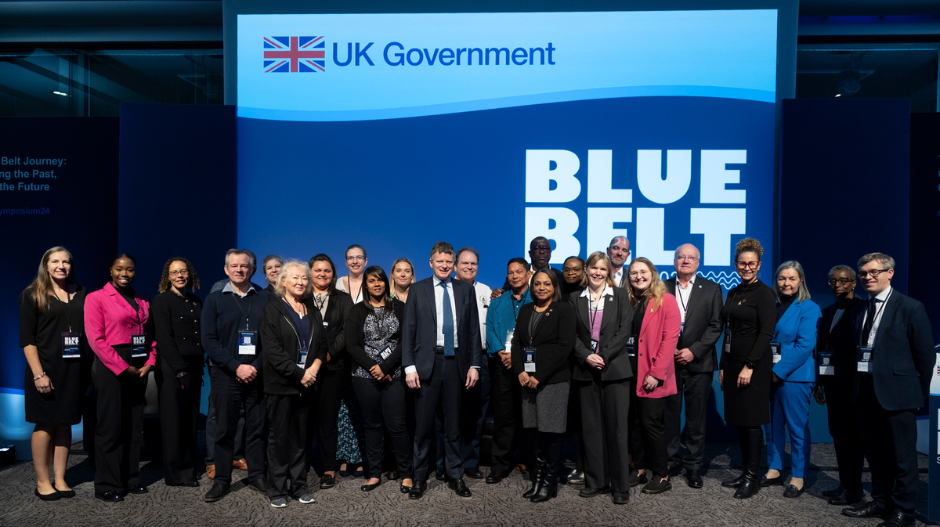 Blue Belt UK Overseas Territory representatives with Minister Benyon
It’s been just over a month since our Blue Belt Programme symposium, where we brought together over 170 UK Overseas Territory representatives and partners to reflect on the Programme’s progress to date, and chart future priorities.
During the event, we took the opportunity to catch up with some of the UK Overseas Territory representatives present at the event to find out more about how they were finding the event, the benefits of cross territory collaboration, and how they currently work with the Blue Belt.
Bitesize Blue Belt news
The people behind the Blue Belt Programme
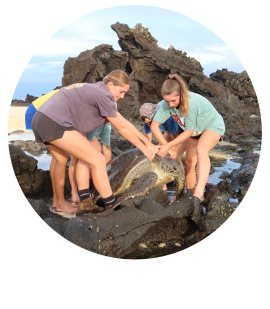
Each quarterly newsletter we'll shine the spotlight Ascension Island turtle intern.
"I am currently working as a turtle intern on Ascension Island, an incredibly remote island in the Atlantic Ocean with an incredible variety of wildlife. This year I was able to come here to work specifically with green turtles as it is a census year meaning that we are monitoring all 25 Ascension beaches for green turtle nesting activity.
The role includes counting turtle numbers each weekday and recording GPS points of the nests that they have laid. Also, we conduct night work to insert temperature loggers into a proportion of the nests on each of the three nature reserve beaches. This is such an incredible thing to be a part of as the data can help us to identify potential changes in trends of the sex of turtle hatchlings and indications of climate change.
I have also been lucky enough to be involved in a satellite tagging programme, whereby we have tagged 11 individuals to monitor their distributions and movement patterns when travelling between their feeding and nesting grounds. The individual that I tagged was named ‘Salty’ by the local schoolchildren and is still moving around the coast here."
|
|