|
|
In September's issue, we look back on our recent activities which range from researching record breaking sea temperatures to creating 12 new marine pollution scholarships. We hope you enjoy the latest issue and let us know what you think on Twitter, Instagram or our new Facebook page.
New WaveNet data shows record breaking UK sea temperatures
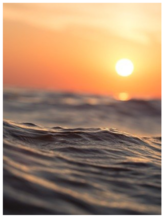
New data published by Cefas shows that sea temperatures across the south and east of England hit record breaking levels this summer.
The data provided by WaveNet shows that sites in Tyne/Tees (off the Yorkshire coast), Dowsing, Southwold, Gabbard (in the southern North sea), South Knock (Thames Estuary), Hastings (in the English Channel) and around to Poole Bay in the Western Channel have reached new highs. In the southern North Sea temperatures were above 20 degrees for several weeks and reached 21 degrees at South Knock, exceeding the last twenty years of data previously collected.
The WaveNet data, which is incorporated into Met Office meteorological models, will help forecasters, local authorities, and scientists to better understand the risks and impacts of climate change on the marine environment and coastal communities.
|
Cefas attends ICES conference
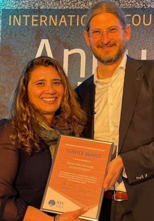
Last week, scientists, students and advisors gathered in Dublin for the first in person International Council for the Exploration of the Sea (ICES) Annual Science Conference in two years.
Cefas scientists played an important role in the hybrid event, chairing and participating in a range of sessions covering topics from offshore wind to climate and biodiversity.
The conference held daily activities for early career scientists and several scientific meetings to support the ICES Science Plan. During the closing ceremony Cefas’ Silvana Birchenough was presented with an Honour Service Award for her role as Ecosystem process and Dynamic Steering Group Chair.
|
New scholarships to tackle marine pollution and support sustainable seas
New research sheds light on marine biodiversity of South Sandwich Islands
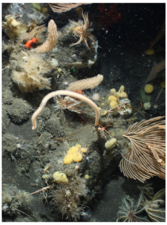
Scientists from Cefas have contributed to a new special collection of scientific papers dedicated to the South Sandwich Islands.
This remote UK Overseas Territory is home to vast colonies of penguins and other seabirds, including an estimated one third of the world’s population of chinstrap penguins. It is also part of the South Georgia and South Sandwich Islands Marine Protected Area (MPA), one of the world’s largest, covering 1.24 million square kilometres - an area 5 times larger than the UK.
The recent special issue aims to provide new insights into this unique environment. You can read more in our latest blog.
|
Introducing the Ocean Country Partnership Programme to Ghanaian stakeholders

Last month, a UK delegation that included Defra, the MMO and Cefas visited Accra, Ghana to introduce the Ocean Country Partnership Programme.
During their visit, the team engaged with Ministries and Government Authorities, donor organisations, and non-Government stakeholders through meetings, workshops, and site visits. The Ocean Country Partnership Programme aims to partner with in-country stakeholders to deliver joint projects that tackle marine pollution, biodiversity, and sustainable seafood.
Defra and representatives from Cefas, JNCC and MMO are also planning a similar visit to Mozambique and Senegal later this year.
|
Blue economy for a sustainable future

Earlier this month, Cefas' Grant Stentiford joined One Earth discussions on the need for a blue economy for a sustainable future.
In the article Grant describes ‘‘One Health Aquaculture’’ a proposition that successful and safe production of food from water must must consider the environment, organism, and human health.
|
|
|
The people behind 120 years of science
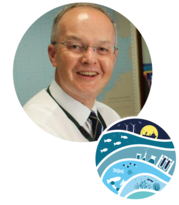
Each month we shine the spotlight on the work of a current member of Cefas staff as part of our celebrations of #120yearsofScience. This month we hear from ICES 1st Vice-President, Carl O’Brien, on some of the unusual places he's worked and how he ended up in his role.
“I worked in a remote area of the Brazilian Amazon in the 1990s based at the Museu Goeldi, Belém, Pará – in a climate totally unlike Suffolk. As an applied statistician, I have had an eclectic career – from modelling multi-component radioactive decay processes, determining 3-dimensional crystal structures, developing commercial numerical software packages to modelling the phenology of tropical trees. Over twenty years ago I changed direction and embarked upon the most rewarding period of scientific discovery working in fisheries science – first as a research scientist and then as a science adviser to our government ministers. I have always been attracted to difficult problems so would be looking to future areas where problems are difficult to define and where solutions are hard to identify"
Carl O’Brien CBE - Chief Adviser Marine Fisheries at Cefas and Defra Chief Fisheries Science Adviser
|
|
|
|
|