Invasive ribbon worms reach UK waters for the first time
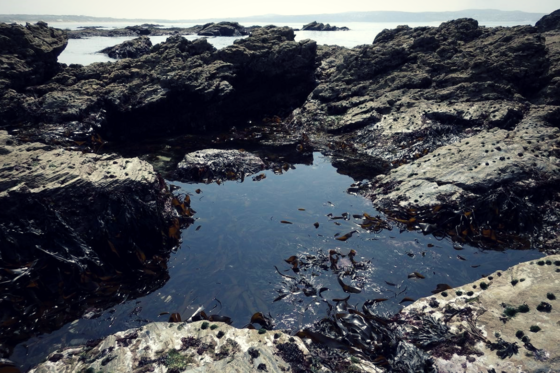 The low tide pool in the south west of England where the ribbon worms were found. Image credit: David Fenwick.
Though commonly associated with pufferfish poisoning, tetrodotoxins, the toxins in pufferfish, are found in a variety of organisms from crustaceans to octopus. Over 1,200 species of nemerteans, or ribbon worms, are known to exist, some of which are native to UK waters. One particular species, Cephalothrix Simula, may contain high levels of the potent toxins associated with pufferfish poisoning.
Until recently this particular species had never been found in UK waters. But, last year two worms were found off the south west coast of England by David Fenwick and sent to Cefas for testing. “These particular ribbon worms originate from the Pacific Ocean and though they have been found in European waters they’ve never made it as far as the UK. We used DNA sequencing methods to confirm the ribbon worm’s identity and conducted further analysis to test their toxicity levels” explains Cefas' Andrew Turner.
The discovery confirms that the spread of the species is wider than initially anticipated. “Next we hope to be able to assess the number of these ribbon worms along the UK coast and test their toxicity levels. We need more data to fully gauge the impacts on the UK environment and human safety” adds Andrew. Andrew Turner was awarded Cefas science paper of the year - you can read his full publication here.
Commended papers:
Stephen Mangi: Progress in designing and delivering effective fishing industry-science data collection in the UK
Tiziana Luisetti: Quantifying and valuing carbon flows and stores in coastal and shelf ecosystems in the UK
Assessing the impact of underwater noise
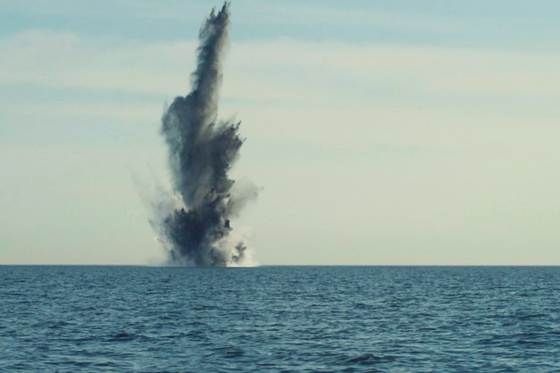 Explosions generate some of the highest peak sound pressures of all noise-generating human activities. Image credit: Flickr.
Underwater noise pollution poses a global threat to marine wildlife, from ocean giants like the blue whale to small fish, crustaceans, and zooplankton. As the ‘blue economy’ continues to grow noise-generating human activities are increasingly taking place in our oceans. “Noise pollution from shipping traffic, renewable energy infrastructure, coastal construction projects and more can drown out the sounds that marine mammals and some fish use to communicate. This can displace animals, increase physiological stress, and in some cases cause auditory injury or mortality“ explains Cefas’ Rebecca Faulkner, a noise and bioacoustics scientist.
To manage this threat, developers are often required to undertake an Environmental Impact Assessment (EIA). The EIA informs the regulator of the possible risks to acoustically sensitive species in the area and uses modelling to estimate the potential extent of adverse effects. Our understanding of the impacts of underwater noise is advancing rapidly, but many EIAs do not yet apply appropriate methods and lack reference to the best available science. At the same time, regulators often lack the expertise to critically assess consent applications.
To begin to bridge this gap, scientists from Cefas have set out clear guiding principles for assessing the impact of underwater noise, providing developers, regulators, and policymakers with a robust, science-based framework to address this emerging threat. In their paper the team identify common shortcomings in current practice at each stage of the EIA process, and suggest remedies based on Cefas’ experience of advising these stakeholders and of conducting assessments. “Underwater noise pollution poses a growing threat to marine wildlife. We hope our paper will encourage more rigorous and informative assessments of underwater noise pollution” adds Rebecca. Rebecca Faulkner was awarded early career scientist paper of the year - read her full publication here.
Commended papers:
Mike Spence - a general framework for combining ecosystem models
Emmanouil Tyllianakis: the value of information: Realising the economic benefits of mapping seagrass meadows in the British Virgin Islands
A new approach to analysing fish movement data.
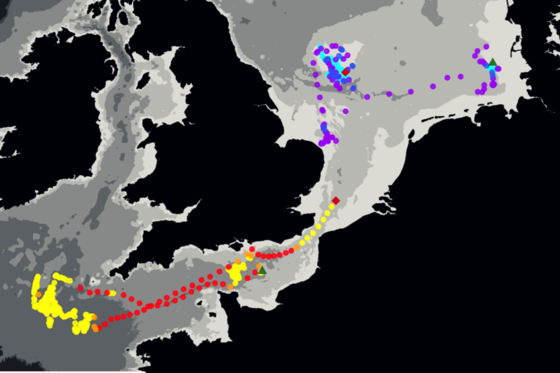 The movements of two individual fish used in the study. Shown is the movement track of an Atlantic cod (red to yellow) and a European plaice (purple to cyan). Different colours reflect changes in the fish’s behaviour. Image from: CA Griffiths et al. Scaling marine fish movement behavior from individuals to populations. Ecol. Evol. 2018; 8: 7031–7043.
Tagging studies, where electronic tags are deployed on free-roaming marine animals, are now commonplace in marine ecology. Tags provide a window into a world that is otherwise unobservable allowing us to learn about fish movement and behaviour. Chris Griffiths, a Fisheries Scientist from Cefas, says, “despite the importance of these studies their uptake in policy has been slow. Tagging studies often result in small sample sizes and people question if the movement of a few fish accurately represents the movement of many fish.”
Using Cefas’ extensive tagging dataset of Atlantic cod and European plaice a team of scientists have been working to address this issue. The dataset contains over 100 movement tracks - some that are suitably long and informative and some that are short and would normally be overlooked. In their paper, the team used a new approach to make the most of this data. First, they applied a statistical model to a handful of those suitably long movement tracks. They then used the information gained to ‘teach’ the model about fish behaviour and applied it to the remaining dataset.
This new approach allowed the team to learn more about the seasonal behaviour of these species throughout the North Sea and the English Channel. “Because behaviour can be linked to catchability, we can start to learn about the vulnerability of fish to capture by certain fishing gears such as trawls. Such information, gained from a sufficiently large sample size, is essential to management and conservation, especially as policy decisions become more tailored towards the species they aim to protect” says Chris. Chris Griffiths was awarded Cefas student paper of the year - read his full publication here.
Commended papers:
Oliver Ashford: Phylogenetic and functional evidence suggests that deep-ocean ecosystems are highly sensitive to environmental change and direct human disturbance
Rob Boyd: A general approach to incorporating spatial and temporal variation in individual-based models of fish populations with application to Atlantic mackerel
Nigel Sainsbury: Changing storminess and global capture fisheries
Thank you for reading, to subscribe to future editions click here.
|